
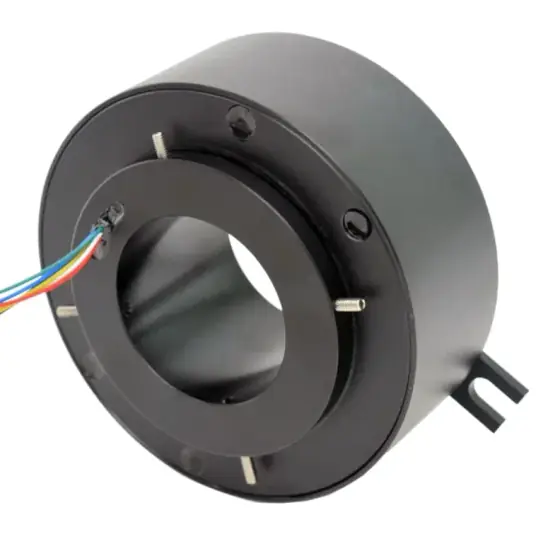
Any machine where something keeps turning, and still needs power, sensors or a network on the rotating side, needs a rotary interface. A cable wrap or cable chain works for limited rotation; for continuous rotation, or many turns, the answer is a slip ring. Get it right and it is forgotten for the life of the machine. Get it wrong and it causes noisy signals, dropped Ethernet packets and early wear-out that is expensive to reach.
This hub gives an overview. For the full step-by-step process, read how to specify a slip ring.
How a slip ring works
Conductive rings are mounted on the rotor, insulated from each other; stationary brushes press against them. Each ring and brush set is one circuit. Contacts are usually precious-metal alloys (gold for low-level signals and data, silver alloys for power), while very high currents use carbon/graphite brushes. Moog’s slip ring FAQ puts typical contact resistance variation during rotation at about 10 to 20 milliohms, below the noise floor of most common signals, and typical speed limits at about 250 to 1,000 rpm depending on size, materials and environment, with special designs much faster.
Many units also integrate a rotary union for air, oil or coolant, or an encoder for rotor position.
Slip ring types compared
| Type | Best when | Typical trade-off |
|---|---|---|
| Capsule | Small, compact devices; low to moderate current | No through-bore; limited current |
| Through-bore | A shaft, pipe or cables must pass through the centre | Larger diameter; higher surface speed at the contacts |
| Pancake | Little axial height but room radially | Larger diameter; more sensitive to runout |
| High-current | Motor power, heaters, welding, cranes | Larger rings and brushes; may need maintenance |
| High-speed | Spindles, test rigs, centrifuges | Fewer circuits; careful balancing and cooling |
| Large-diameter | Turntables, CT gantries, cranes, turrets | Custom engineering; longer lead times |
| Open/frameless | Ring and brush sets built into your own housing | You own the sealing and alignment |
| Ethernet | Fieldbus, IP cameras, industrial Ethernet | Needs impedance-controlled contacts |
| Fibre optic rotary joint | High bandwidth, EMI immunity, long cable runs | Optical-only; often combined with electrical rings |
| Marine and rugged/military | Salt spray, shock, vibration, sealing | Heavier, higher cost |
| Rotary union | Fluid or air through rotation | Seals are wear parts |
Example series: Moog AC6023 and Servotecnica SVTS A capsules; Moog AC4598 and Servotecnica SVTS C through-bore rings; Servotecnica SVTS F pancake; Servotecnica SVTS E open high-current; Moog EC3848 high-speed capsule; Moog AC7203 Ethernet capsule; and the Moog FO310 single-channel FORJ.
How to specify a slip ring
The specification guide goes into detail. The essentials:
- Space envelope. Outer diameter, length, and any required through-bore. This usually decides the type before anything else.
- Circuits. List every circuit with its current and voltage. Group power, signal, data and shielding separately, and add spares (a rule of thumb is 10 to 20% spare circuits on a new design).
- Current. Use continuous current per circuit, plus inrush and peak with duration. Parallel rings for high currents only where the supplier approves it.
- Voltage. Working voltage and any insulation test requirement between circuits and to the housing.
- Speed. Maximum and continuous rpm, and whether rotation is continuous, oscillating or occasional. Oscillating motion over small angles wears contacts differently from continuous rotation.
- Data. Protocols and data rates (CAN, RS-485, encoder signals, 100BASE-T, Gigabit Ethernet, EtherCAT, HD-SDI video, USB), plus cable lengths either side.
- Environment. Temperature, IP rating, washdown, salt spray, vibration and shock, hazardous area.
- Life. Revolutions over the machine’s life, calculated from rpm and duty.
- Mounting. Flange or shaft mount, anti-rotation tab, cable exit direction and connector types.
Worked life example. A turntable runs at 20 rpm for 16 hours a day, 250 days a year, for a 10-year design life. That is 20 × 60 × 16 × 250 × 10 = 48 million revolutions. That falls in the range Moog describes as typical for instrumentation slip rings, but it is a point to confirm in writing with the supplier, and it rules out contact technologies rated far below that.
Ethernet and data through slip rings
Data is where most slip ring problems now arise. Machine Design explains why Gigabit is harder than 100BASE-T: 1000BASE-T uses all four pairs with five-level PAM signalling and smaller voltage steps, whereas 100BASE-T uses two pairs with more noise margin. A gigabit slip ring needs a ring-and-brush set for each of the eight conductors, and the concerns are frequency-dependent effects, crosstalk and jitter rather than contact resistance, which at about 20 mΩ contributes negligible noise.
Practical points:
- State the exact protocol (100BASE-T, 1000BASE-T, EtherCAT, PROFINET), not just “Ethernet”.
- Give total cable length on both sides; the slip ring consumes part of the channel’s loss budget.
- Agree the test method up front: a full-length channel test, a test normalised to your installed cable length, or a loss-and-noise budget.
- Keep data circuits twisted and screened through the slip ring and away from power rings; Servotecnica recommends shielded, twisted pairs for high-frequency data.
Moog’s FAQ states that slip rings can be optimised for 1000BASE-T and HD video (SMPTE 292). For higher bandwidth, or when electrical noise from adjacent power rings is a concern, a fibre optic rotary joint or a hybrid electrical/fibre unit is the robust choice; the Moog FO310 quotes insertion loss below 1.0 dB typical with rotational variation below 0.5 dB typical. See Ethernet through slip rings for a deeper treatment.
Life and maintenance
Contact life is a trade-off between contact pressure, speed and wear. Servotecnica explains that higher contact pressure reduces resistance variation but shortens life, and that higher speed needs more pressure to keep brushes stable. It gives about 10 million revolutions and 500 rpm for monofilament fibre brushes, and up to about 100 million revolutions and 3,000 rpm for multifilament fibre brushes. Moog cites more than 100 million revolutions for wind turbine slip rings.
Maintenance follows the contact type:
- Precious-metal brushes (signals, data, moderate power): minimal maintenance; usually replaced as a unit at end of life.
- Graphite/carbon brushes (high current): produce wear dust and need regular cleaning and brush replacement; design in access.
- Seals on IP-rated or marine units wear; include them in service schedules.
Early failure usually comes from outside the slip ring: misalignment between the slip ring and the machine’s rotation axis, a rigid mount that forces the slip ring to carry shaft runout, cable strain on the rotor side, or contamination past a damaged seal.
Slip rings by application
The right design depends heavily on the application. We have dedicated pages for wind turbines, medical imaging, robotics, packaging, CCTV pan-tilt, radar and antennas, ROVs and subsea, cable reels, cranes and slewing, defence turrets, gimbals and drones, test rigs, bottling and filling, wrapping machines, amusement rides, stage and entertainment, welding positioners, mixers and process plant, satellite antennas and marine mooring.
Common slip ring specification mistakes
- Listing circuits without current, voltage and signal type for each.
- Saying “Ethernet” without the protocol, speed and cable lengths.
- Specifying maximum speed but not duty, so the life requirement is unknown.
- Hard-mounting both rotor and stator, so the slip ring takes the machine’s runout.
- Running sensitive analogue or encoder signals next to switched motor power without screening.
- Forgetting spare circuits, then needing a redesign for one extra sensor.
What to send us for a slip ring quote
- Space envelope and through-bore requirement
- Full circuit list: current, voltage and signal type per circuit
- Data protocols, rates and cable lengths
- Speed, duty and required life in revolutions
- Environment: temperature, IP rating, vibration, shock, hazardous area
- Any fluid or air passages
- Mounting, cable exits and connectors
- Quantities and target date
Use the spec builder to capture the details and our engineers will propose suitable designs from our engineers.
Frequently asked questions
What is a slip ring and when do I need one?
A slip ring is a rotary electrical joint: conductive rings on the rotor run against stationary brushes, so circuits stay connected while the shaft turns without limit. You need one whenever a rotating part needs power or signals and either rotates continuously or turns too far for a cable to wind up safely, for example turntables, robot wrists, cable reels, radar pedestals and wind turbine hubs.
How long does a slip ring last?
Life depends on contact technology, speed, current and environment. Moog reports tens of millions of revolutions for typical instrumentation slip rings and more than 100 million revolutions for wind turbine designs. Servotecnica gives about 10 million revolutions for monofilament fibre brushes and up to about 100 million for multifilament fibre brushes. Specify the life you need in revolutions, not years.
Can I run Ethernet through a slip ring?
Yes. Purpose-designed slip rings carry 100BASE-T and Gigabit Ethernet using impedance-controlled contacts for each conductor. Gigabit uses all four pairs, so crosstalk and attenuation matter more than at 100 Mbit/s. Specify the protocol, the total cable length either side and how the link will be tested. For higher bandwidth or very long life, consider a fibre optic rotary joint or a contactless data link.
Do slip rings need maintenance?
Precious-metal contact slip rings used for signals and moderate power are usually treated as sealed, maintenance-free units within their rated life, though they should be inspected at machine service intervals. Carbon or graphite brush designs for high current produce wear dust and need regular cleaning and brush replacement. Plan access for inspection on high-current and high-duty machines.
What is the difference between a slip ring and a rotary union?
A slip ring transfers electrical power and signals across rotation. A rotary union transfers fluids such as air, hydraulic oil, water or coolant. The two are often combined into one assembly, for example on wind turbine pitch systems, indexing tables and automotive production cells, so a single rotating interface carries electrics, data and media together.
What is a fibre optic rotary joint (FORJ)?
A FORJ passes optical fibre signals across a rotating interface, giving very high bandwidth with immunity to electrical noise. Single-channel units are the simplest; multi-channel units use optical de-rotation. Key specifications are fibre type (singlemode or multimode), wavelength, insertion loss and its variation with rotation; Moog's FO310, for example, quotes insertion loss below 1.0 dB typical.
Sources
- Moog: slip ring frequently asked questions
- Servotecnica: slip ring technology article
- Machine Design: how to choose slip rings for gigabit Ethernet connectivity
- Moog: FO310 single-channel fibre optic rotary joint
Figures are summarised from the sources above and from manufacturers' published data on the date shown. Always confirm against the current datasheet for your exact part.