
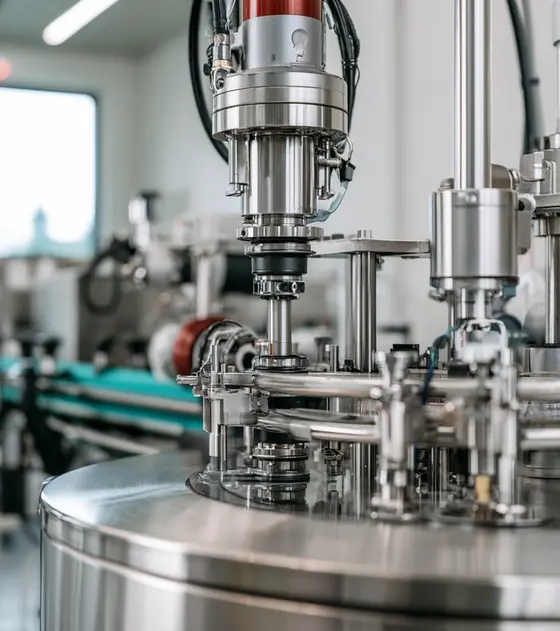
In short:Packaging and food machines replace mechanical cams and line shafts with servo axes so formats change from a recipe, not a toolkit. In wet and product zones, choose motors and actuators built for washdown, with the IP rating, materials and hygienic design evidence your customer's hygiene audit will ask for.
Typical requirements
| Washdown ingress | IP69K: 80 °C water at 80–100 bar, 14–16 L/min, 10–15 cm, four angles |
|---|---|
| Hygienic servo motor torque (example) | About 3.1–14 Nm rated in one stainless range (0.45–1.9 kW) |
| Stainless servo actuator (example) | Up to about 3.8 kN continuous, 11 kN peak, 457 mm stroke, IP69K static |
| Housing materials | AISI 304 or 316 (1.4404) stainless, EPDM or FDA-compliant seals, H1 grease |
| Rotary machine slip rings | Up to 250 circuits, 500 A, 1,000 rpm with PROFINET or Ethernet (published range) |
| Servo feedback | 18–22 bit multi-turn absolute, often single-cable (Hiperface DSL, DRIVE-CLiQ) |
Machinery we specify motion for
- Form-fill-seal and flow-wrap machines
- Cartoners and case packers
- Palletisers
- Rotary bottle filling and capping machines
- Labelling machines
- Thermoformers and tray sealers
- Induction screw sealers
- Checkweighers and scales
- Washdown food processing lines
- Pick-and-place packaging robots
What packaging and food machines need from motion
Form-fill-seal, flow-wrapping, cartoning, case packing, filling and capping all repeat the same few moves very quickly: index, feed, cut, seal, transfer. Each machine runs many formats and stops for washdown. Motion choices therefore come down to three questions. How quickly can the machine change format? How well does it survive cleaning? And how much does it lose to stops and rejects, which is what OEE (availability × performance × quality) measures?
Servo axes, electronic cams and changeover
Older machines drove everything from one line shaft through mechanical cams. Modern machines give each function its own servo axis, linked through electronic gearing and cam tables in the motion controller. The benefits show up in all three OEE terms:
- Availability: a format change loads new cam profiles and positions from a recipe. Motorised change parts (guide rails, film widths, tool heights) remove manual adjustment and setting errors.
- Performance: each axis gets the profile its product needs, with jerk-limited moves that let speed rise without spilling or damaging product.
- Quality: registration marks on film or labels are corrected on the fly, and cut and seal positions stay consistent.
Typical axes and what they need:
| Axis | Typical drive | Watch out for |
|---|---|---|
| Film feed and registration | Servo motor with low-backlash gearhead or direct drive | Inertia matching to the reel, registration response |
| Rotary knife or cross-seal jaw | Servo with electronic cam | Peak torque during the cut, RMS heat over the cycle |
| Pick-and-place, transfer | Servo with belt or linear module | Settling time, payload variation |
| Dosing piston or nozzle lift | Servo linear actuator | Washdown, force, repeatability |
| Format change parts | Small integrated servo or stepper | Absolute position at power-up |
For mainstream axes look at servo and stepper motors, servo drives and gearboxes; for coordination, motion controllers. Many lines standardise on the PackML state model (ISA-TR88.00.02) so different machines report states and stoppages the same way, which makes OEE data comparable.
Hygienic and washdown motors and actuators
Food plants divide the machine into zones: dry areas, splash zones, and product-contact areas. The deeper you go, the harder the cleaning and the stricter the design.
Ingress. IP69K comes from DIN 40050-9 (now in ISO 20653). OMRON summarises the test: 80 °C water at 80–100 bar and 14–16 L/min, from 10–15 cm, at 0°, 30°, 60° and 90°, 30 s per angle. It is a jet test, not immersion. IP67 is the immersion test, so specify both if a part may sit in standing water. Check whether the rating applies to the whole motor, including connectors and shaft seal, or only to the housing.
Hygienic design. Ingress protection keeps water out; hygienic design stops soil and bacteria building up on the outside. That means smooth stainless surfaces, no exposed threads or fins, sloped faces that drain, food-grade seals and lubricants, and cable entries without crevices. The EHEDG certification scheme includes cleanability-tested types (EL Class I, which covers items such as gear drive units and sensors), aseptic types with sterilisability and bacteria-tightness tests, and design-evaluated types that assess surface roughness, radii and accessibility. In Europe, EN 1672-2 and EN ISO 14159 set the hygiene requirements for the machine, and Regulation (EC) 1935/2004 governs materials in contact with food.
Examples:
- The Siemens SIMOTICS S-1FS2 is a stainless (1.4404) servo motor with EPDM seals and H1 grease, rated IP66/IP67 overall with an IP69K housing, covering about 3.1–14 Nm rated.
- Allen-Bradley’s Kinetix VPS (304 stainless, Hiperface DSL) and Kinetix MPS (IP66, IP67 and IP69K) serve the same washdown role on Rockwell platforms.
- The Tolomatic IMA-S is a 316 stainless integrated servo actuator, IP69K static, with FDA seals and EHEDG cord grips, for volumetric filling, pumping and slicing.
Stainless gearheads, hygienic couplings and covers matter as much as the motor. A stainless motor bolted to a painted gearbox with an exposed shaft gap is still a cleaning problem.
Worked example: sizing a servo dosing actuator
A piston filler doses 500 ml through an 80 mm bore piston at 30 cycles per minute, with 0.8 s allowed for the fill stroke.
- Piston area: π × 40² = 5,027 mm². Stroke for 500 ml (500,000 mm³) is about 100 mm.
- Speed: 100 mm in 0.8 s is 125 mm/s average; with a trapezoidal profile the peak is about 190 mm/s.
- Force: a viscous product needing 3 bar (0.3 N/mm²) gives 5,027 × 0.3 = 1,508 N, plus seal friction and acceleration. Call it 1.8 kN peak.
- Duty: fill and return run every 2 s, so this is close to continuous. Size on RMS force, not peak.
- Screw: a 10 mm lead needs about 1,140 rpm at peak speed. Check screw life at this force and cycle count; at 30 cycles/min over two 8-hour shifts and 250 days the actuator sees about 7 million strokes a year.
The result sits inside the published IMA-S envelope (3,770 N continuous, 497 mm/s). Confirm the fit with the supplier’s thermal and life calculation, and see how to size a linear actuator and ball screw vs roller screw.
Slip rings on rotary fillers, cappers and wrappers
Rotary fillers, cappers, labellers and rotary-arm stretch wrappers carry powered and monitored parts on a continuously turning turret or arm. A slip ring carries power, sensor signals and fieldbus across the axis, often with a rotary union for air or vacuum.
Moog’s packaging slip ring range is published at up to 250 circuits, 500 A, 800 V and 1,000 rpm with DRIVE-CLiQ, Ethernet and PROFINET options, for winders, flow-pack and stretch-wrapping machines. Points to specify:
- Data: servo heads on the turret need a drive bus or feedback across the ring. Check the protocol and cable category end to end; see Ethernet through slip rings.
- Washdown: brush slip rings must be sealed or housed out of the spray. State the IP rating and cleaning chemicals.
- Speed and life: a wrapper arm or filler turret turning continuously for two shifts builds up millions of revolutions a year. Ask for rated life in revolutions.
- Mounting: through-bore designs leave room for product pipes or a central shaft.
Our pages on slip rings for bottling and filling, wrapping machines and packaging go into detail.
Safety and compliance
Packaging machine safety falls under the EN 415 series, which builds on the machinery directive and regulation. Servo drives with Safe Torque Off and safe speed functions let operators work at guards and change parts without removing all power. Ask for the PL or SIL your risk assessment needs.
Typical pitfalls
- Specifying IP69K and assuming immersion protection, or forgetting the connector and shaft seal.
- Stainless motor, painted gearbox: the cleaning problem moves next door.
- Sizing on peak force for an axis that cycles almost continuously.
- Underestimating revolutions on wrapper and filler slip rings.
- Mixing feedback protocols across a line, so recipes and diagnostics do not carry over.
Send us your axes, cycle rates and hygiene zone, and our specialist engineering and supply partners can propose servo, actuator and slip ring options to suit.
Servo motors for packaging machines
Each function on a modern packaging machine gets its own servo motor, so size every axis on its own cam profile. Work out RMS torque over one machine cycle for the thermal rating, peak torque for the steepest part of the cam, and the load-to-motor inertia ratio, which matters most on film feeds and rotary knives with large reels or heavy tools. Choose multi-turn absolute feedback so axes know their position after a stop without homing, and single-cable motors where cable count through guards is a problem. Use painted motors in dry zones and stainless or sealed motors in splash zones. Small integrated motors suit motorised format-change parts.
- Flow wrappers: film feed and rotary cross-seal jaws
- Cartoners: carton feed, flap folding and transfer axes
- Labelling machines: label web feed with registration correction
- Format change parts: motorised guide rails and tool heights
- Case packers: pick-and-place and indexing axes
Available through our supply network
All servo and stepper motors →Specify servo and stepper motors for packaging and food →
Hygienic linear actuators for food processing
Servo rod actuators replace pneumatic cylinders on dosing pistons, nozzle lifts, cutting, pressing and diverting, where programmable force and position cut changeover time and give repeatable fill volumes. In product and splash zones, check whether the IP69K rating is static or dynamic, what the rod seal and scraper are made of, and whether they are rated for your caustic and acid cleaning chemicals and temperatures. Ask for H1 food-grade lubricant, a smooth stainless body without exposed threads, and hygienic cable entries. For a near-continuous dosing axis, size on RMS force and calculate screw life in strokes, because a fast filler builds up millions of strokes a year.
- Piston fillers: volumetric dosing stroke
- Nozzle and filling head lifts: position and speed per product
- Slicers and portion cutters: cutting stroke and force
- Conveyors: gating, sorting and diverting
- Forming and pressing stations: controlled force
Available through our supply network
All linear actuators →Specify linear actuators for packaging and food →
Slip rings for bottle filling and capping machines
A rotary filler or capper carries servo heads, valves and sensors on a turret that never stops, so the slip ring is one of the most heavily used parts on the line. Split the circuit list into power, servo feedback or drive bus, discrete I/O and Ethernet, and ask how the ring separates and shields them. Combine air or vacuum passages with the electrical rings where heads need them, and choose a through-bore design if product pipes or a central shaft pass through the axis. Mount the ring above the spray zone or specify a sealed housing for the cleaning regime. Brush wear sets the service interval, so agree it in revolutions.
- Rotary fillers: power and fieldbus to valves and sensors on the turret
- Rotary cappers: servo capping head power and feedback
- Rotary labellers: power and signals to rotating stations
- Flow-pack machines: sealing jaw heater power
- Rotary-arm stretch wrappers: power and signals to the arm
Available through our supply network
Servo drives for flow wrappers and cartoners
Packaging drives need fast, deterministic communication with the motion controller so that cam tables run in step across every axis. EtherCAT is the common choice. Check that the drive has a high-speed touch-probe or latch input for registration marks, so print-to-cut correction happens on the exact encoder position rather than after a PLC scan. Safe Torque Off with a stated PL or SIL lets operators open guards for jams and change parts without isolating the whole machine. Multi-axis drives and shared DC bus modules reduce cabinet width and let a braking axis feed energy to a motoring one. Size each axis on its own peak and RMS current.
- Flow wrappers: film registration and cross-seal cam profiles
- Cartoners: synchronised feed, fold and transfer axes
- Thermoformers: index and forming station axes
- Palletisers: multi-axis gantry or robot axes
- Labellers: web feed with mark correction
Available through our supply network
All servo drives →Specify servo drives for packaging and food →
Planetary gearboxes for packaging machines
A gearhead lets a smaller servo motor drive a heavy knife, reel or conveyor by reducing the reflected inertia by the square of the ratio, which is often the main reason it is there. For cam-driven axes, specify backlash in arcmin, torsional stiffness, the peak output torque at the cam and the emergency stop torque, which can be several times the running torque. Planetary gearheads suit inline mounting; right-angle versions save length beside a conveyor. In washdown and splash zones, choose stainless housings, food-grade lubricant and smooth exterior surfaces, because a hygienic motor bolted to a painted gearbox just moves the cleaning problem along the shaft.
- Rotary knives: low-backlash drive for cut accuracy
- Film unwind and feed: inertia matching to large reels
- Conveyors and indexing tables: compact speed reduction
- Washdown machines: stainless gearheads in splash zones
Available through our supply network
All gearboxes and harmonic drives →Specify gearboxes and harmonic drives for packaging and food →
Motion controllers for electronic line shafting
The motion controller replaces the mechanical line shaft with a virtual master axis that every servo follows through its own cam table or electronic gear. Choose a controller that can hold the number of synchronised axes you need at the cycle time you need, switch cam profiles from a recipe, and correct registration on the fly. IEC 61131-3 programming, a PackML state model and a common fieldbus make machines easier to support across a line. An HMI that stores recipes and shows stoppage reasons helps operators and gives the OEE data customers ask for. Check how the controller handles a format change with axes at known absolute positions.
- Flow wrappers: virtual master with cam-profiled seal jaws
- Fillers and cappers: synchronised turret and infeed axes
- Cartoners: recipe-based format changes
- Labellers: registration correction on web feed
- Packaging lines: PackML state reporting
Available through our supply network
All controllers and plcs →Specify controllers and plcs for packaging and food →
Direct-drive motors for rotary indexers and sealers
A direct-drive rotary motor bolts straight onto an indexing table, starwheel or rotary sealer, with no gearbox, belt or cam between motor and load. That removes backlash and wear parts, and the index profile can change per product. Size the motor on load inertia and index time: torque equals inertia multiplied by angular acceleration, plus friction, and the RMS over the full index and dwell cycle sets the continuous rating. Direct drives tolerate a much higher load-to-motor inertia ratio than geared servos, but stiff mounting matters. In dusty or wet areas, choose a version whose encoder is designed to resist contamination, and check the housing IP rating.
- Rotary indexing tables: programmable index angle and dwell
- Starwheels and turrets: smooth, backlash-free transfer
- Rotary sealers and cutters: direct-driven tool rotation
- Tray and carton handling dials: frequent short moves
Available through our supply network
All frameless and torque motors →Specify frameless and torque motors for packaging and food →
Standards to have in view
- DIN 40050-9 / ISO 20653 (IP69K high-pressure, high-temperature water jet)
- IEC 60529 (IP codes)
- EN 1672-2 (food processing machinery: hygiene and cleanability requirements)
- EN ISO 14159 (safety of machinery: hygiene requirements for machinery design)
- EN 415 series (safety of packaging machines)
- Regulation (EC) No 1935/2004 (materials in contact with food)
- ISO 21469 (lubricants with incidental product contact, H1)
- ISA-TR88.00.02 (PackML machine state model)
Which standards apply depends on the end product and its market. Your engineer will confirm what the component itself needs to meet.
Frequently asked questions
What does IP69K actually test?
IP69K is a close-range, hot, high-pressure water jet test, originally defined in DIN 40050-9. Water at 80 °C is sprayed at 80–100 bar and 14–16 L/min from 10–15 cm, at 0°, 30°, 60° and 90°, for 30 seconds at each angle while the part turns. It is not an immersion test, so an IP69K motor is not automatically IP67; look for both ratings if parts can be submerged.
Can I buy an EHEDG-certified servo motor?
EHEDG certifies specific equipment designs after evaluation, and some motors, actuators and drive units carry certificates. The scheme includes cleanability-tested types such as EL Class I, aseptic types, and design-evaluated types. A certificate covers the certified design and its stated installation, so check the certificate's scope and ask how the item must be mounted. Unlisted parts can still be suitable if the machine builder shows the design is hygienic.
Stainless or painted motors in food machinery?
In splash or product zones that are washed down with caustic and acid detergents, stainless housings with smooth, crevice-free surfaces and food-safe seals are the safer choice. Painted or anodised motors suit dry zones and guarded areas outside the splash zone. The deciding factors are the cleaning regime, chemicals, pressure and temperature, and whether the motor sits above open product.
Why use servo axes instead of mechanical cams on packaging machines?
Servo axes linked by electronic cams change motion profiles from a recipe, so a format change is a menu selection rather than swapping cams and gears. They also allow registration correction, gentle product handling and different profiles per product. The trade-off is cost per axis, more electronics in the washdown area, and the need for good motion programming.
When does a filler or wrapper need a slip ring?
Whenever powered or monitored parts rotate continuously: rotary fillers and cappers with servo or sensor heads on the turret, rotary-arm stretch wrappers, flow-pack sealing jaws and winders. The slip ring passes power, fieldbus or drive feedback and sometimes air through the rotating axis. Specify circuits, currents, data protocol, speed, washdown rating and any rotary union passages together.
What should I send for a packaging axis enquiry?
Send the mechanism and load, stroke or index angle, cycle rate, move and dwell times, accuracy, the zone (dry, splash or product contact), cleaning chemicals, pressure and temperature, required IP rating and materials, mains voltage, the PLC or motion platform and fieldbus, and any slip ring circuits on rotary machines. A sketch of the motion profile helps a lot.
Sources
Figures are summarised from the sources above and from manufacturers' published data on the date shown. Always confirm against the current datasheet for your exact part.