
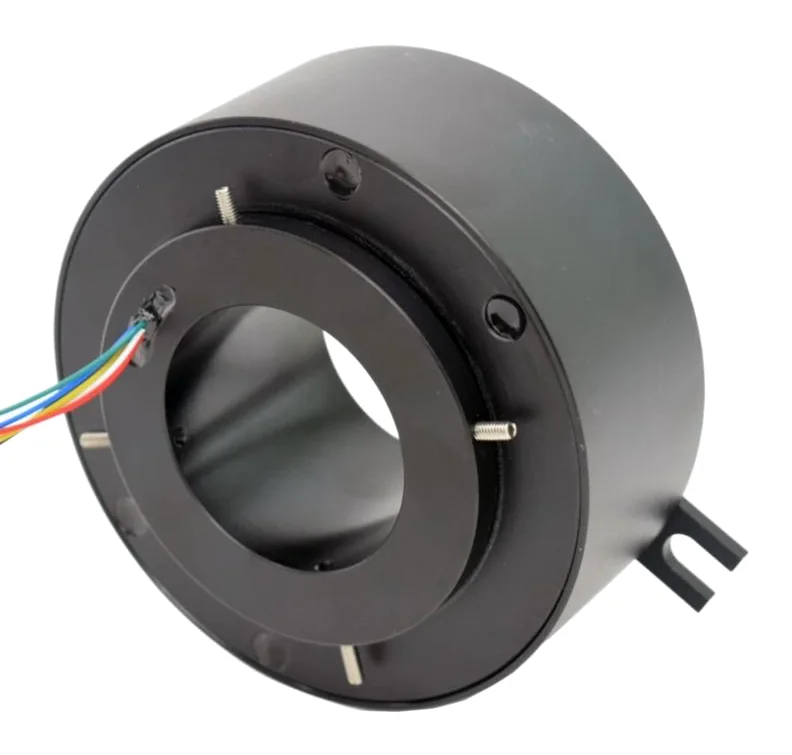
What the slip ring has to handle
- Motor power circuits (240/380/480 V AC) for film carriage and pre-stretch drives
- 24 V DC control, E-stop, photo-eye and encoder signals
- Ethernet on shielded channels separated from power
- Through-bore mounting at turntable shaft or arm hub
- Speed rating for continuous duty (platforms 8-30 rpm, rotary arms up to about 60 rpm)
- IP54 indoors, IP65 or higher outdoors
- Pneumatic channels for clamps and cutters on bale wrappers
Typical figures
| Circuits | 4-30 depending on type; rotary arm 10-24 |
|---|---|
| Current | About 2 A signal, 5-15 A motor, 20 A+ high-power drives |
| Voltage | 24 V DC control; 240/380/480 V AC motor |
| Speed | Pallet turntable 8-15 rpm; bale wrapper 20-30 rpm; rotary arm up to about 60 rpm |
| Ingress protection | IP54 indoor; IP65 minimum outdoor |
| Bore | 12-60 mm common |
| Life | 50-100 million revolutions (ring and brush) |
Example figures from the published sources listed below. Your requirement may differ; an engineer will confirm against your duty cycle.
Recommended slip ring types
Standards to consider
- IEC 60529 - IP code
- IEC 60204-1 - electrical equipment of machines
- EN 415 series - safety of packaging machines
The complete system
A slip ring rarely works alone. For stretch-wrapping & flow-wrapping machines it is usually specified together with:
- rotary arm or ring drive motor
- VFD or servo drive
- film pre-stretch motor
- encoder
- load cell
Specifying these together avoids mismatched connectors, cable routes and feedback interfaces, and gives you one point of contact for the whole axis.
Common problems to design out
- Encoder losing counts from contact resistance drift
- Motor stalls from undersized current rating or worn brushes
- Arcing from moisture or overcurrent
- Intermittent E-stop trips from loose terminals
Series used in this application
Frequently asked questions
Where is the slip ring on a stretch wrapper?
On turntable machines it sits at the platform shaft; on rotary-arm or ring machines it is at the mast or arm hub, feeding the film carriage. Compact capsule units are common where space is tight.
What IP rating does a wrapper slip ring need?
Indoor pallet wrappers usually manage with IP54. Outdoor bale wrappers should be at least IP65, rising to IP66-IP67 if hosed down or exposed to heavy rain.
How long do stretch wrapper slip rings last?
Ring-and-brush designs are often rated for 50-100 million revolutions, which at typical wrapper speeds can exceed the machine life. Correct current sizing and sealing matter more than speed.