
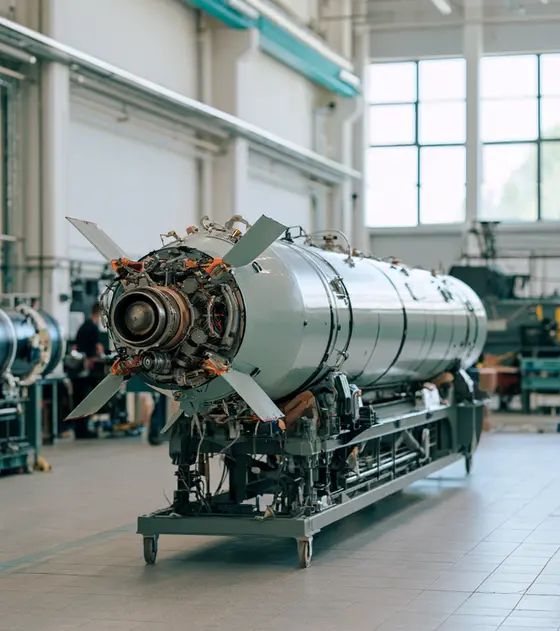
In short:Military UUVs need the same pressure-tolerant motion parts as scientific AUVs, specified for longer missions, higher reliability and defence qualification. Decide per component whether it lives in a one-atmosphere housing or is oil-filled and pressure-compensated, then size propulsion, fins and any tether or winch rotating joints around that choice.
Typical requirements
| Large UUV propulsion motor (example) | About 366 Nm (270 lbf·ft) at 180 rpm, 270 V DC, pressure-compensated housing |
|---|---|
| Propulsion motor pressure rating (example) | Sea level to 345 bar (5,000 psig), about 3,400 m of seawater |
| Oil-filled actuator depth | To 6,000 m when pressure-compensated |
| Pressure-compensated linear actuator (example) | 50–150 mm (2–6 in) travel; about 180–1,800 N (40–400 lbf) |
| Winch slip ring rating | 7–125 A per pass; 1 kV to 7.2 kV AC; 5–100 rpm |
| USV mast pan-tilt (example) | 1.8–9 kg payload, 0.01–60 °/s, IP67, 9-channel slip ring |
Machinery we specify motion for
- UUV thrusters and propulsion motors
- Fin and control-surface actuators
- Buoyancy engines and ballast valves
- Mast and antenna raising drives
- USV mast-mounted pan-tilt sensor heads
- Rotating sonar heads
- Tether management and winch drums
- Launch and recovery systems
Military underwater drones cover a wide span: small man-portable AUVs for mine countermeasures and survey, larger and extra-large UUVs for long-endurance missions, tethered vehicles deployed from ships, and unmanned surface vessels that carry their own sensor masts and launch and recover underwater vehicles. The motion components are close relatives of those on scientific and offshore ROVs and AUVs, so start with our subsea ROV and AUV page for the fundamentals of pressure, housings and oil compensation. This page covers what defence adds: longer missions, higher reliability, larger propulsion motors, and the environmental, EMC and shock standards a naval customer will call up.
Thruster and propulsion motors
Small AUVs use the same brushless thrusters as commercial vehicles. Larger military UUVs move to purpose-built propulsion motors. Moog’s published UUV propulsion motor gives a sense of scale: 270 lbf·ft (about 366 Nm) at 180 rpm on a 270 V DC bus, roughly 7 kW of shaft power, in a pressure-compensated housing rated from sea level to 5,000 psig (about 345 bar, or roughly 3,400 m of seawater by the 1 bar per 10 m rule). It weighs 294 lb (about 133 kg), is cooled by convection and conduction to the sea, and is designed to meet MIL-STD-810.
Points to settle with a supplier:
- Direct drive or geared. A low-speed, high-torque motor driving the propeller directly avoids a gearbox in oil, at the cost of motor size. Geared drives are smaller but add a wear and noise source.
- Bus voltage. Higher voltage (270 V DC in the Moog example) keeps current and cable mass down on a large vehicle; small vehicles run from lower-voltage battery packs.
- Electronics location. Moog places propulsion control electronics in a separate one-atmosphere housing. Potted electronics inside the oil are possible but harder to qualify.
- Acoustic and magnetic signature. Military vehicles often care about radiated noise and magnetic field. Raise it early: it affects pole count, skew, drive switching frequency and bearing choice.
- Efficiency at cruise. Endurance depends on efficiency at the low-power cruise point, not the peak. Ask for the efficiency map, including oil drag losses.
Compare motor and drive options on servo and stepper motors, frameless torque motors and servo drives.
Pressure-compensated designs
Oil-filled, pressure-compensated motors and actuators are the default for deep military UUVs, because the same component works at any depth within its rating and the seals see almost no pressure difference. maxon’s oil-filled motor and gearbox assemblies are compensated for depths to 6,000 m and used for fin actuation, propulsion, grippers and manipulators.
What to specify for a pressure-compensated motor: oil type (and compatibility with every elastomer, adhesive and cable jacket it touches), compensator volume for the full temperature and pressure range plus slow leakage over the service interval, positive offset pressure, and whether the encoder or Hall sensors are rated for oil. Non-contact inductive and capacitive encoders cope well with oil; see absolute vs incremental encoders.
Fin and control-surface actuators
Fins steer and trim the vehicle in pitch and yaw, and on some designs control roll. Moog describes its UUV fin control actuators as sinusoidally wound motors, pressure-compensated for deep seawater, with one-atmosphere control electronics serving up to four independent axes. Its pressure-compensated linear integrated actuator offers 2–6 in (about 50–150 mm) of travel and 40–400 lbf (about 180–1,800 N). That kind of linear unit also suits buoyancy engines, valves and release mechanisms.
Size fin actuators from hinge moment at maximum speed and deflection, add margin for fouling and marine growth, and define behaviour when a fin jams or loses power. How to size a linear actuator and ball screw vs roller screw cover the screw options, both of which run in oil.
Masts, periscope-type and sensor drives
UUVs and USVs raise antennas, GNSS and communication masts, and optical sensors above the surface. Mast drives combine a linear or rotary actuator for raising with, often, a rotating head that needs a slip ring. Key points: sealing at the waterline, where the mast passes from dry to wet; holding force in waves; speed of raising and lowering; and protection for the slip ring and connectors from salt crystallisation.
On unmanned surface vessels, mast-mounted pan-tilt sensor heads look much like their crewed-ship equivalents. General Dynamics OTS’s Vector 20, for example, carries 1.8–9 kg payloads with continuous pan, 0.01–60 °/s slew, under 2 mrad RMS stabilisation, an integrated 9-channel slip ring and IP67 sealing, with vibration to IEC 60945. See our naval shipboard systems page for more on deck equipment.
Slip rings and FORJs for tethered systems and winches
Tethered UUVs and vehicles launched and recovered by cable need a rotating joint at the winch or tether management drum. Moog’s winch slip ring range runs from 7 A per pass at 1 kV (Model 180, 100 rpm) to 125 A per pass at 7.2 kV AC (Model 129, 50 rpm), with fibre optic options. For single-fibre tethers, a standalone fibre optic rotary joint is often enough; for multiple fibres plus power, use a hybrid unit. On the vehicle, continuously rotating sonar heads use oil-filled slip rings on the vehicle’s compensation circuit. Read how to specify a slip ring, the marine slip ring page and slip rings for ROV and subsea.
Environment, compliance and export
- Depth. Agree operating depth and proof test pressure separately. IP68 under IEC 60529 is not a depth rating.
- Environment. Military programmes tailor MIL-STD-810H or DEF STAN 00-35 for transport, handling, storage and deck conditions as well as the dive.
- Shock. Equipment installed on a naval host ship may need MIL-DTL-901E high-impact shock qualification.
- EMC. MIL-STD-461 (revision H since April 2026) for drive emissions and susceptibility.
- Export control. Underwater vehicle components designed for military use may be controlled. Moog’s UUV literature carries an ITAR export notice, for example. The supplier and exporter handle classification; see our defence and security overview.
Typical pitfalls
- Sizing propulsion for peak speed and losing endurance at cruise.
- Ignoring oil compatibility with cable jackets and adhesives.
- Under-sizing the compensator for cold water at depth.
- Leaving signature requirements until after the motor is chosen.
- Treating the launch and recovery winch slip ring as a commodity when it is a single point of failure.
Share your depth, voltage, thrust and fin requirements and our specialist engineering and supply partners can propose motors, actuators, slip rings and feedback for the vehicle.
UUV thruster motors and pressure-compensated motor kits
Larger UUV propulsion motors and fin actuators are often built around frameless rotor and stator kits inside an oil-filled, pressure-compensated housing, with the drive electronics in a separate one-atmosphere bottle. Specify shaft torque and speed at cruise as well as at maximum speed, because endurance depends on efficiency at the low-power cruise point. Ask the supplier to confirm that winding insulation, varnish, magnet bonding and lead sleeving suit the chosen oil and depth, and allow for oil drag losses. Raise acoustic and magnetic signature limits early: they affect pole count, skew and drive switching frequency. Match the winding to the vehicle bus voltage.
- UUV propulsion: direct-drive motors in compensated housings
- Fin actuators: compact motors for control surfaces
- Buoyancy engines: motor drives for pumps and pistons
- Mast drives: motors for raising and rotating heads
Available through our supply network
All frameless and torque motors →Specify frameless and torque motors for military underwater drones (uuv) →
Slip rings and FORJs for UUV winches and sonar heads
Tethered UUVs and vehicles recovered on a cable need a rotating joint at the winch or tether management drum, and it is a single point of failure for the whole system. Hybrid units combine high-voltage power passes with a fibre optic rotary joint for video, sonar and control data. Specify voltage and current per pass, fibre type and count, insertion loss budget, drum speed, and deck conditions including salt, spray and shock. On the vehicle, rotating sonar heads use oil-filled rings on the vehicle compensation circuit. USV mast heads need sealed rings with condensation control and connectors that survive salt crystallisation.
- Launch and recovery winches: power and fibre across the drum
- Tether management systems: hybrid slip ring and FORJ
- Rotating sonar heads: oil-filled signal rings
- USV mast pan-tilt heads: sealed rings for continuous pan
Available through our supply network
All slip rings →Specify slip rings for military underwater drones (uuv) →
Servo drives for UUV propulsion and fin control
UUV drives usually sit in a one-atmosphere housing, so rate continuous current at the housing temperature with heat leaving by conduction to the sea. Check that the input range covers the vehicle bus: larger vehicles use higher voltage, such as the 270 V DC propulsion example on this page, to keep current and cable mass down, while small vehicles run from lower-voltage packs. Fin control may put several axes in one housing, so multi-axis or compact single-axis drives both appear. Specify feedback interfaces, network, current limiting for a fouled propeller or jammed fin, and EMC: drive switching frequency also affects radiated acoustic noise on signature-sensitive vehicles.
- UUV propulsion: high-voltage motor drives
- Fin control: compact multi-axis drives in one housing
- Mast and sonar drives: low-voltage servo control
- Launch and recovery systems: deck-mounted drives
Available through our supply network
All servo drives →Specify servo drives for military underwater drones (uuv) →
Encoders for UUV fins, masts and sonar heads
Fin actuators need output position to detect a jammed or failed fin, and masts and sonar heads need absolute angle at power-up. In oil-filled housings, non-contact inductive and capacitive encoders cope well because there is no optical path to foul. Confirm that electronics and potting are rated for the oil and pressure, that the interface survives the cable run to the electronics housing, and that shock ratings suit launch, recovery and any MIL-DTL-901E requirement from the host ship. Specify resolution, accuracy, bore, temperature range and supply voltage, and ask about magnetic emissions if the vehicle has signature limits, which can favour capacitive types.
- Fin actuators: output angle and jam detection
- Mast drives: raised and stowed position
- Rotating sonar heads: absolute bearing
- USV pan-tilt heads: axis feedback
Available through our supply network
All encoders and feedback →Specify encoders and feedback for military underwater drones (uuv) →
Linear actuators for UUV masts, hatches and recovery gear
Linear actuators raise masts, open payload and recovery hatches, move buoyancy-engine pistons and operate latches on launch and recovery systems. In-water units are usually pressure-compensated assemblies built from a brushless motor, screw and encoder, while USV and host-ship equipment can use sealed industrial actuators. Specify force, stroke, speed, holding force in waves or under hydrodynamic load, power-off behaviour and cycle life. For mast drives, the seal where the mast passes from dry to wet is the critical detail. For deck units, check IP code, materials, salt fog evidence and temperature range against the ship specification, and qualify shock where the host ship requires it.
- UUV and USV masts: raising and locking
- Launch and recovery systems: latches and capture mechanisms
- Payload hatches: sealed electric actuation
- Buoyancy engines: piston strokes in compensated housings
Available through our supply network
All linear actuators →Specify linear actuators for military underwater drones (uuv) →
Gearing for UUV fin and mast drives
Fin and mast drives combine a small motor with high-ratio gearing to reach the hinge or raising torque within a tight envelope. Strain-wave gearing gives zero backlash and a hollow centre for wiring, which helps fin control accuracy; planetary gearheads give robust reduction for masts and winches. Inside a compensated housing, the gear runs in the compensating oil, so confirm lubricant and seal compatibility and allow for oil drag in efficiency. Size on hinge torque at maximum speed and deflection with margin for fouling and marine growth, holding torque with power off, and shock. Stainless gearheads with sealed housings suit USV deck and mast equipment.
- UUV fin actuators: zero-backlash high-ratio reduction
- Mast drives: geared raising and rotation
- USV deck equipment: corrosion-resistant gearheads
- Launch and recovery winches: compact reduction
Available through our supply network
All gearboxes and harmonic drives →Specify gearboxes and harmonic drives for military underwater drones (uuv) →
Standards to have in view
- MIL-STD-810H (environmental engineering and laboratory tests)
- MIL-STD-461H (control of electromagnetic interference; supersedes MIL-STD-461G)
- MIL-DTL-901E (high-impact shock tests for shipboard equipment)
- IEC 60945 (maritime navigation and radiocommunication equipment: general requirements and tests)
- IEC 60529 (IP codes)
- DEF STAN 00-35 (environmental handbook for defence materiel)
Which standards apply depends on the end product and its market. Your engineer will confirm what the component itself needs to meet.
Frequently asked questions
What is a UUV thruster motor?
A brushless motor, usually permanent-magnet, that drives the propeller or ducted thruster of an unmanned underwater vehicle. On small vehicles it may be a wet motor with a potted stator; on larger military UUVs it is commonly oil-filled and pressure-compensated, with the drive electronics in a separate one-atmosphere housing. Specify thrust or shaft torque and speed, bus voltage, depth, mission duration and acoustic requirements.
Why use a pressure-compensated motor rather than a pressure housing?
A pressure housing must get thicker and heavier as rated depth rises, and its shaft seal carries the full pressure difference. A pressure-compensated motor is filled with oil that a compensator holds slightly above ambient, so the seals see almost no differential and the same design works across a wide depth range. The trade-offs are oil drag losses, oil maintenance and keeping electronics potted or remote.
How are UUV fin actuators specified?
By hinge torque at maximum speed and deflection, deflection rate, travel, holding behaviour with power off, depth and life. Military fin actuators are usually sinusoidally wound brushless motors with gearing, pressure-compensated, with position feedback on the output. Moog, for example, puts control electronics for up to four fin axes in one one-atmosphere housing. Agree how a jammed or failed fin is detected and handled.
Do tethered military UUVs need a FORJ?
Tethered systems, and any vehicle recovered on a fibre-carrying cable, need a rotating joint at the winch drum. If the cable carries optical fibre for video, sonar or control data, a fibre optic rotary joint passes it across rotation, usually combined with an electrical slip ring for power. State fibre type and count, insertion loss budget, voltage and current per pass, and drum speed.
What changes for unmanned surface vessels?
USV motion components live above the waterline in spray, salt fog, UV, wind and wave-induced motion. Mast-mounted pan-tilt cameras and sensor heads need IP67 sealing, marine-grade finishes and slip rings for continuous pan. Vibration and environmental testing usually follow IEC 60945 for navigation equipment or a tailored MIL-STD-810H programme; naval programmes may also call for MIL-DTL-901E shock.
What should I send for a military UUV or USV motion enquiry?
Send vehicle type and mass, maximum operating and test depth, one-atmosphere or compensated architecture per component, oil type, supply voltage, required thrust or torque and speed, fin hinge moments and rates, mission duration, acoustic or magnetic signature limits, tether or winch details, environmental and shock standards, and any export or security restrictions.
Sources
- Moog: UUV propulsion motor datasheet
- Moog: motion control solutions for autonomous underwater missions
- maxon: subsea pressure-compensated actuators
- Moog: winch slip rings model comparison
- General Dynamics OTS: Vector 20 stabilised maritime pan-tilt system
- EverySpec: MIL-DTL-901E shock tests, high-impact shipboard machinery
Figures are summarised from the sources above and from manufacturers' published data on the date shown. Always confirm against the current datasheet for your exact part.