
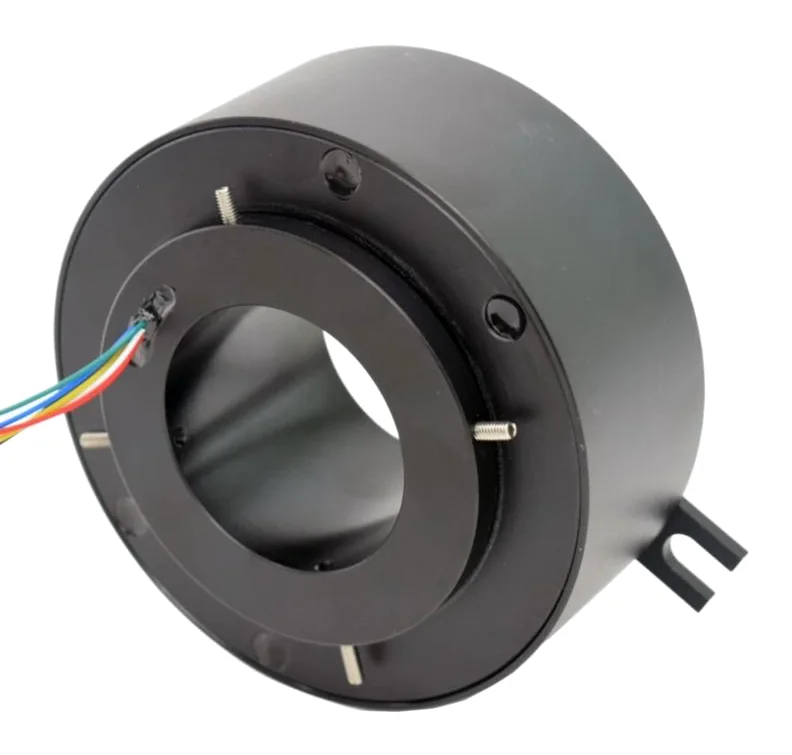
What the slip ring has to handle
- High channel counts for strain gauges, thermocouples and other sensors
- Very low contact noise for millivolt-level bridge signals
- High rotational speed: thousands up to around 20,000 rpm for EV motor and powertrain testing
- End-of-shaft mounting with low mass
- EMI mitigation near high-power motors and drives
- Thermocouple-compatible materials or rotor-side signal conditioning to avoid junction errors
- Low or no routine maintenance between test campaigns
Typical figures
| Speed | End-of-shaft example 4,000 rpm; powertrain instrumentation assemblies up to 20,000 rpm |
|---|---|
| Circuits | 45 or 60 circuits (example) |
| Current | 250 mA per circuit (example) |
| Signals | Strain gauge, thermocouple, torque |
Example figures from the published sources listed below. Your requirement may differ; an engineer will confirm against your duty cycle.
Recommended slip ring types
Standards to consider
- IEC 60584 - thermocouple tables and tolerances, relevant when routing thermocouples through rings
The complete system
A slip ring rarely works alone. For rotating test rigs & dynamometers it is usually specified together with:
- torque transducer
- strain gauge amplifier
- dynamometer motor
- drive
- encoder
- telemetry system
Specifying these together avoids mismatched connectors, cable routes and feedback interfaces, and gives you one point of contact for the whole axis.
Common problems to design out
- Signal noise and offset on strain channels
- Thermocouple errors from dissimilar-metal junctions in the ring
- Brush wear at high speed
- EMI from drive motors
Series used in this application
Frequently asked questions
Slip ring or telemetry for torque measurement?
Slip rings are simple and cost-effective for low-to-medium speeds and short tests but wear and need maintenance. Telemetry suits high speeds and long-term monitoring at the cost of more integration work.
How fast can instrumentation slip rings run?
End-of-shaft instrumentation rings commonly run to a few thousand rpm; one published 60-circuit design is rated at 4,000 rpm. Specialist assemblies for EV motor and powertrain testing have been developed for up to 20,000 rpm.
Can thermocouples go through a slip ring?
Yes, but the ring creates extra metal junctions that add offset errors unless materials are matched or the signal is conditioned on the rotor. A rotor-side transmitter producing 4-20 mA is a common workaround.
Sources
- https://www.michsci.com/high-channel-count-slip-ring-assemblies-fan-turbine-measurements/
- https://testingexpo-europe.com/innovation-showcase-62/instrumentation-of-high-speed-rotating-powertrain-components-using-slip-ring-assemblies
- https://www.althensensors.com/blog/torque-measurement-on-rotating-shafts-methods-challenges-and-smart-solutions/
- https://industrialmonitordirect.com/blogs/knowledgebase/j-type-thermocouple-slip-ring-selection-for-rotating-equipment