
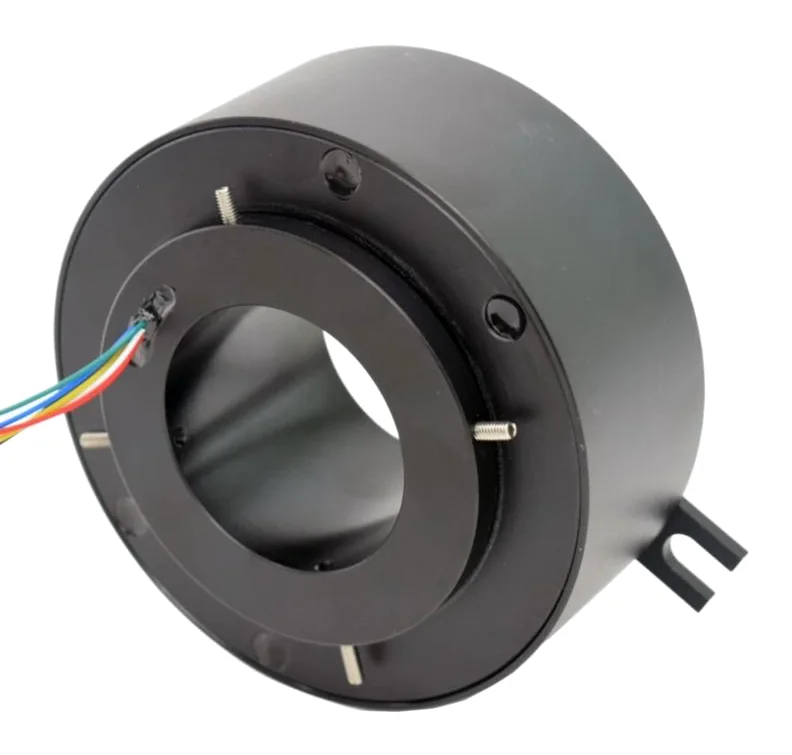
What the slip ring has to handle
- High-current power circuits, from tens to several hundred amps per ring, with inrush allowance
- Control circuits and CAN bus / RS485 / Ethernet, layered and shielded away from power rings
- Large through-bore for hydraulic swivels or cabling
- High ingress protection (IP67, IP68 for mining and wading machines)
- Vibration and shock resistance with sprung brushes and robust bearings
- Low-speed continuous rotation with long revolution life
- Medium-voltage options for large port and mobile harbour cranes
Typical figures
| Current | Ship-to-shore example: ten 600 A and six 240 A power circuits; electrified excavators 30-200 A continuous with 600 A starting peaks |
|---|---|
| Circuits | Ship-to-shore example: 71 circuits including 25 control and 30 RS485/Ethernet |
| Voltage | Crane slip rings available with MV components up to 30 kV |
| Bore | 80-200 mm on excavator rings; contact-plate designs with free bore up to 950 mm |
| Ingress protection | IP54-IP65 contact-plate rings; IP67/IP68 for construction machinery |
| Temperature | -40 C to +80 C (construction machinery example) |
| Vibration | 10 g vibration impact (construction machinery example) |
Example figures from the published sources listed below. Your requirement may differ; an engineer will confirm against your duty cycle.
Recommended slip ring types
Standards to consider
- IEC 60204-32 - electrical equipment of hoisting machines
- EN 13001 series - crane design and safety
- IEC 60529 - IP code for slewing ring enclosures
The complete system
A slip ring rarely works alone. For cranes & slewing machinery it is usually specified together with:
- slewing bearing
- slew drive motor
- planetary gearbox
- servo or VFD drive
- absolute encoder
- slew brake
- hydraulic rotary joint
Specifying these together avoids mismatched connectors, cable routes and feedback interfaces, and gives you one point of contact for the whole axis.
Common problems to design out
- Water ingress causing short circuits
- Overheating and arcing on high-current rings
- CAN or bus signal dropouts from EMI
- Dust-induced binding and brush wear
Series used in this application
Frequently asked questions
Can an electric excavator use the same slip ring as a hydraulic one?
Electrified machines need far higher current on the slewing axis, typically 30-200 A continuous with peaks up to around 600 A. Split electrical rings can be added around an existing hydraulic swivel, or an integrated electro-hydraulic unit used on new designs.
What IP rating does a crane slip ring need?
Indoor or sheltered cranes can use around IP54-IP65. Construction and mining machines exposed to water and mud usually call for IP67, and IP68 where wading is possible.
How are control signals kept clean next to high-current rings?
Power, control and bus rings are separated into layers with shielding between them, and twisted, shielded pairs are used for CAN, RS485 or Ethernet. This limits interference from motor currents.