
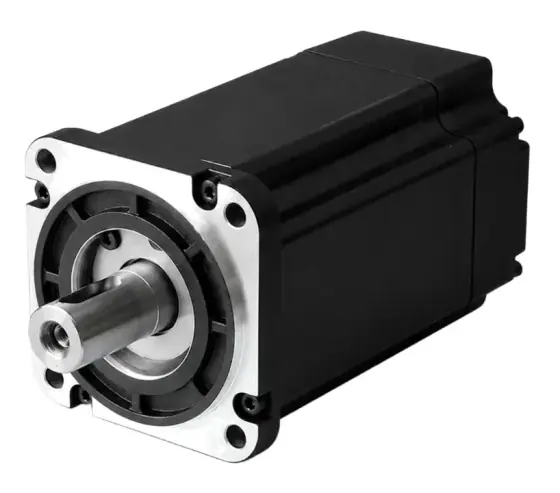
Brushed vs brushless: the short answer
The difference is where the commutation happens. A brushed DC motor reverses the current in its rotating coils mechanically, through brushes sliding on a segmented commutator. A brushless motor puts the coils in the stator and the magnets on the rotor, and an electronic drive switches the current from a rotor position signal. Brushes are simple and cheap but wear; brushless lasts longer and runs faster, but always needs a drive.
For most continuous-duty industrial axes the answer is brushless. Brushed motors remain the sensible choice for low-hour, cost-sensitive, battery-powered or very simple drives. This page explains why, and where the exceptions are. For choosing within each type, see how to select a DC motor.
How each one works
Brushed DC. Permanent magnets, or on larger motors a field winding, sit in the stator. The rotor (armature) carries the winding. As it turns, the brushes contact successive commutator segments, so current in each coil reverses at the right moment to keep torque in one direction. Apply DC and it runs; reverse the polarity and it reverses; vary the voltage and speed follows almost linearly. maxon notes brushed motors run directly from a DC supply or battery (maxon).
Within brushed motors there are two rotor constructions:
- Iron-core: the winding sits in slots in a laminated rotor. Robust and cheap, but with cogging and higher rotor inertia.
- Ironless (coreless): a self-supporting copper basket with no iron. No cogging, very low inertia and no iron losses in the rotor, so very responsive. Less thermal mass, so less tolerant of overload.
Brushless (BLDC and PMSM). The magnets are on the rotor and the three-phase winding in the stator. The drive must know where the rotor is to energise the right phases. maxon lists the options as sensorless block commutation, block commutation from Hall sensors, and sinusoidal commutation from Halls with or without an encoder. Six-step commutation from Halls updates every 60 electrical degrees and produces six torque ripples per electrical cycle; sinusoidal commutation from an encoder is continuous and greatly reduces ripple (Motion Control Tips). Servo motors are brushless motors with sinusoidal windings and high-resolution feedback, covered in how servo motors work.
Brushed vs brushless compared
| Brushed DC | Brushless (BLDC/PMSM) | |
|---|---|---|
| Commutation | Mechanical: brushes and commutator | Electronic: drive plus Halls, encoder or sensorless |
| Typical service life | About 1,000–3,000 h, limited by brushes (maxon) | Tens of thousands of hours, limited by bearings |
| Speed | Up to about 18,000 rpm in maxon’s range, limited by brushes and bearings (Eureka) | Continuous to 120,000 rpm in maxon’s ECX range |
| Drive electronics | None needed for basic running; simple H-bridge for reversing or speed control | Always needs a commutating drive |
| System cost | Lowest | Higher: drive, sensors, cabling |
| Heat path | Copper in the rotor, heat must cross the air gap | Copper in the stator, heat conducts to the housing |
| Electrical noise | Brush arcing creates interference; suppression often needed | No arcing; switching noise from the drive |
| Maintenance | Brushes wear, dust is produced | Essentially bearings only |
| Low-speed smoothness | Good, especially ironless | Good with sinusoidal or FOC control; six-step has ripple |
| Hazardous or clean areas | Sparks and brush dust are a concern | Preferred |
Service life: the deciding factor for most designs
Brush life depends on current, speed, duty, temperature and brush material, so treat headline figures as orders of magnitude. maxon’s split is clear, though: around 1,000 to 3,000 hours for brushed motors on average, and tens of thousands of hours for brushless, where the bearings become the limit (maxon). Eureka Magazine quotes about 20,000 hours for brushless motors operated within specification.
Brush material matters. maxon recommends graphite brushes for start-stop duty under severe load and bidirectional motion with high current spikes, and precious-metal brushes for continuous running at lower current, such as blowers. Graphite produces dust, which rules it out of optical systems. Precious-metal brushes are more sensitive to arcing; maxon’s CLL design adds an RC network across the commutator segments to suppress brush sparking, which also reduces electromagnetic emissions (maxon).
Efficiency is not a foregone conclusion
It is often said brushless motors are always more efficient. maxon’s own comparison says otherwise for its products: its ironless brushed motors are more efficient than its brushless motors, because brushless motors have eddy-current losses in the stator iron that grow with the square of speed. At very high speed that can tilt the balance towards an ironless brushed motor if life is not the constraint. Compare at your real operating point and include drive losses.
Control, feedback and noise
- Speed control. A brushed motor’s speed is roughly proportional to voltage, so a PWM H-bridge is all you need for open-loop speed control. Brushless needs a commutating drive anyway, and most add speed control at no extra cost.
- Positioning. Either can be a servo with an encoder. Brushed DC servos with tachogenerators are still made and suit retrofits of existing brushed servo drives. New positioning designs are usually brushless.
- Sensorless brushless. Back-EMF estimation needs speed to work. Texas Instruments’ sensorless FOC application note uses an observer to replace the position sensor in low-cost designs and notes the encoder becomes optional (Texas Instruments), but at standstill and very low speed there is little back-EMF to measure. For fans and pumps that is fine; for hoists and positioning it is not.
- EMC. Brush arcing is a broadband interference source. Brushless motors move the problem to the drive’s PWM switching, which is easier to contain with screened cables and filtering at the drive.
Environment and special cases
- Vacuum. Graphite brushes need oxygen and humidity to form a commutator patina, which will not form in vacuum; precious-metal brushes need lubricant removed, shortening life. Eureka suggests a modified brushless motor or a precious-metal-brush motor (Eureka).
- Potentially explosive atmospheres. A commutator sparks in normal running, so brushed motors are generally avoided; whichever type you use must be certified for the zone.
- Clean rooms, optics and medical devices. Brush dust is a contamination source; brushless is the usual answer.
- Sealed or enclosed motors. Because a brushless motor’s heat is in the stator, it conducts straight to the housing and flange. A brushed motor must lose rotor heat across the air gap, which limits continuous torque in a sealed case.
Worked example: counting the hours
Two 24 V products, same torque and speed, motor costs to be decided.
Product A: a portable sampling pump. Runs about 2 hours a day, 250 days a year, design life 5 years.
- Running hours: 2 × 250 × 5 = 2,500 hours
- That sits inside the 1,000–3,000 hour range maxon quotes for brushed motors. A brushed motor, ideally with precious-metal brushes for continuous running at low current, can work if the supplier confirms life at your load. It runs straight from the battery through a simple speed controller, saving the cost and board space of a commutating drive.
- Risk: the figure is near the top of the range. Ask for a life test at your current and temperature, or plan brush or motor replacement at service.
Product B: an enclosure cooling fan or recirculating pump. Runs continuously, design life 5 years.
- Running hours: 24 × 365 × 5 = 43,800 hours
- Roughly 15 to 40 times the brushed range. Even the 20,000-hour figure Eureka quotes for brushless is exceeded, so bearing life and grease life become the limit to check.
- Choice: brushless, with a bearing life calculation (L10) at the real load and temperature, or a design where the bearings are serviceable. A sealless wet-rotor brushless pump avoids shaft seals altogether.
The lesson. Work out running hours before arguing about cost. The brushless premium is often smaller than the cost of one warranty replacement.
When to choose brushed, when to choose brushless
| Your situation | Lean towards |
|---|---|
| Fewer than about 1,000–2,000 running hours over life | Brushed |
| Battery-powered, simple on/off or speed control, lowest bill of materials | Brushed |
| Very high speed, intermittent duty, efficiency critical | Ironless brushed, compare with brushless |
| Continuous duty or thousands of hours per year | Brushless |
| Speeds above about 15,000–20,000 rpm continuously | Brushless |
| Precise positioning, high dynamics, servo axis | Brushless servo |
| Retrofitting an existing brushed servo drive | Brushed DC servo |
| Clean room, optics, medical, or low electrical noise | Brushless |
| Sealed enclosure, heat must leave through the housing | Brushless |
| Vacuum | Modified brushless, or precious-metal brushed; ask the maker |
Products in our range to consider
- DINGS ZYT brushed DC motors: 8–80 mm, 12/24 V, up to 0.25 Nm continuous, with encoder, brake and planetary gearbox options.
- D-Series coreless DC motors: ironless brushed motors, 13–40 mm, 3–48 V, up to 15,200 rpm, cog-free and low inertia.
- ZYT PMDC brushed geared motors: 30–110 mm permanent-magnet brushed motors to about 1.5 kW at 12–48 V, with worm gearboxes and parking brakes.
- BDS brushed DC servo motors: 82 and 102 mm frames, 0.5–4.5 Nm continuous stall and peaks to 22 Nm, with a 9.5 V/krpm tachogenerator.
- DINGS ZWWC slotless brushless motors: 10–42 mm, 12–48 V, up to about 51,000 rpm with no cogging, Hall or encoder options.
- Leadshine ELVM low-voltage servo motors: brushless PMSM servos for 24–60 V buses, 33 W to 2 kW.
- Kinco iSMK integrated servo motors: brushless motor and drive in one unit, 100–750 W on 24–60 VDC, CANopen, Modbus RTU or EtherCAT.
- Novanta Everest servo drives: compact 8–72 VDC servo drives to 45 A continuous, with Hall, incremental and BiSS-C feedback inputs.
Checklist
Send these to our engineers, or enter them in the spec builder:
- Running hours per day and design life, so total hours can be calculated
- Duty: continuous, intermittent or start-stop, and reversing or not
- Torque and speed at the operating point, and peak torque
- Supply: battery or DC bus voltage, and current limit
- Control needed: on/off, speed, torque or position
- Feedback available or required: none, Hall, encoder, tacho
- Environment: temperature, IP rating, vacuum, hazardous area, clean room
- EMC limits on the product
- Space for drive electronics, and cable lengths
- Serviceability: can brushes or motors be replaced in the field?
- Annual volume and target cost per unit
For the wider family, see servo and stepper motors, and for drive choice, servo drives and how to select a PCB-mount servo drive.
Frequently asked questions
What is the main difference between brushed and brushless motors?
A brushed DC motor switches current between its rotor coils mechanically, with carbon or precious-metal brushes rubbing on a commutator. A brushless motor puts the coils in the stator and the magnets on the rotor, and an electronic drive switches the current using rotor position from Hall sensors, an encoder or back-EMF sensing. Removing the brushes removes the main wear part, but adds a drive.
How long do brushed DC motors last compared with brushless?
maxon puts the average service life of brushed motors at about 1,000 to 3,000 hours, limited by brush wear, and brushless motors at tens of thousands of hours, limited mainly by the bearings. A Eureka Magazine article quotes about 20,000 hours for brushless motors run within specification. Actual life depends heavily on load, speed, duty and temperature, so ask for life data at your operating point.
Are brushless motors more efficient than brushed motors?
Not always. Large iron-core brushed motors lose energy at the brushes and commutator, and brushless motors usually win there. But maxon notes its ironless brushed motors are more efficient than its brushless motors, because brushless motors have eddy-current losses in the stator iron that rise with the square of speed. Compare efficiency at your actual operating point, including the drive.
Can a brushed motor be used as a servo?
Yes. Brushed DC servo motors with a tachogenerator or encoder were the standard before brushless servos and are still made, for example 82 and 102 mm frames with 9.5 V/krpm tachos in our range. They suit retrofits of existing brushed servo drives and simple low-voltage machines. For new designs with high duty, brushless servos are usually the better long-term choice.
Do brushless motors need Hall sensors?
Not always. Hall sensors give a simple, robust commutation signal and are standard on many BLDC motors. Sensorless drives estimate rotor position from back-EMF, which works well at speed but poorly at very low speed and start-up under load. For smooth low-speed torque or positioning, use Halls plus an encoder, or an encoder alone with a drive that supports it.
Which motor should I use in a vacuum?
Neither standard version is ideal. Graphite brushes need oxygen and some humidity to form the patina on the commutator, which will not form in vacuum, and precious-metal brushes need their lubricant removed, which shortens life. Eureka Magazine suggests a modified brushless motor or a precious-metal-brush motor. Check outgassing of insulation, lubricants and adhesives with the maker.
Sources
- maxon (drive.tech): Brushed vs. brushless DC motors
- maxon (drive.tech): Precious metal vs. graphite brushes
- Eureka Magazine: Choosing a brushed or brushless DC motor
- Motion Control Tips: What are ways to avoid torque ripple in DC motors?
- Texas Instruments: Sensorless field oriented control of 3-phase PMSMs (SPRABY9)
Figures are summarised from the sources above and from manufacturers' published data on the date shown. Always confirm against the current datasheet for your exact part.