
Skip to content

Application guide

Slip rings for stage revolves & entertainment

A theatre revolve carries lighting, sound, video and automation that need power and data while the stage rotates slowly through many turns. Large diameters, low installation height and silent operation matter in a performance space. Show data increasingly runs on Ethernet and fibre, which must cross the rotating interface without dropouts.

Slip ring

Pricing and availability

Tell us what the slip ring needs to do

Send us a part number, or tell us what the machine needs to do. Our UK engineers will come back with the right product, pricing, lead time and delivery, whether that is the original part, a checked alternative or a complete axis.

  • Original parts or a checked alternative
  • Pricing, lead time and delivery in one reply
  • Components, complete axes and ongoing support

No obligation. Add what you know and an engineer will help with the rest. Prefer to configure it? Build a specification.

Add quantity, timing or application notes (optional)

Spec builder

Configure a slip ring for stage revolves & entertainment

Select every part you need and answer the questions an applications engineer would ask. Our engineers use your specification to come back with the right products, pricing and lead times. You see your summary before we ask for any details.

Already know the part number? Send it to us directly.

  1. 1Products
  2. 2Performance
  3. 3Environment
  4. 4Volumes
  5. 5Your spec
Step 1 of 5

What are you specifying?

Select everything you need. A motor, drive and gearbox can be specified together as one axis.

1 selected: Slip ring

What the slip ring has to handle

  • Power circuits for onstage lighting and equipment
  • Data for lighting control, audio and video, typically Ethernet or fibre
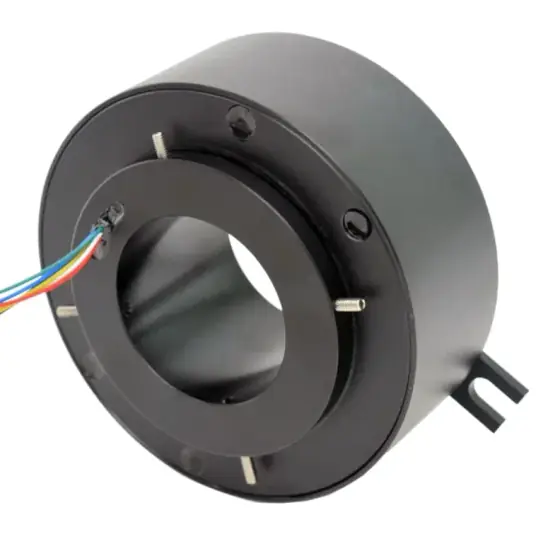
  • Large through-bore, low-profile construction under the stage
  • Quiet operation during performances
  • Fibre optic rotary joints (multimode or singlemode)
  • Low speed with frequent start-stop

Typical figures

DataRotary data transmission up to 1 Gbps
Fibre1 to 9+ channel fibre rotary joints; multimode G50/125 and G62.5/125, singlemode E9/125
Ingress protectionIP54 to IP68 across fibre rotary joint range

Example figures from the published sources listed below. Your requirement may differ; an engineer will confirm against your duty cycle.

Recommended slip ring types

Standards to consider

  • BS 7909 - temporary electrical systems for entertainment (UK)
  • IEC 60204-1 - electrical equipment of machines (stage machinery)

The complete system

A slip ring rarely works alone. For stage revolves & entertainment it is usually specified together with:

  • revolve drive
  • VFD or servo drive
  • absolute encoder
  • brake
  • show-control system

Specifying these together avoids mismatched connectors, cable routes and feedback interfaces, and gives you one point of contact for the whole axis.

Common problems to design out

  • Data dropouts on show-control networks
  • Noise from brushes during quiet scenes
  • Contact wear from repeated rehearsal cycles

Frequently asked questions

Can a stage revolve carry Ethernet or DMX?

Yes. Revolve systems use rotary data transmission up to 1 Gbps, and fibre rotary joints are common for bandwidth and noise immunity.

What fibre types do stage rotary joints support?

Both multimode (50/125 and 62.5/125 um) and singlemode (9/125 um) fibre joints are available. Channel counts run from a single fibre to more than nine, so lighting, audio and video networks can share one joint.

Why use a pancake slip ring on a revolve?

A revolve has very little depth beneath the stage floor but needs a large central opening. Flat pancake or contact-plate designs keep installation height low while leaving that bore free for cabling.

Sources

Engineer support

Get your products sourced with UK engineering support

Tell us the part or application, quantity and timing. Our UK engineers will come back with the right product, pricing, lead time and delivery.

  • Reviewed by an engineer, not an autoresponder
  • Like-for-like and better-fit alternatives
  • Standard, modified and custom options

Prefer to configure it? Use the spec builder.

We use your details to answer this enquiry and share them only with the engineering and supply team handling it. Read our terms and privacy notice.

How it works

From enquiry to delivery

Send a part number or describe the application. Our engineers take it from there: the right product, a clear quotation, and delivery and support arranged.

  1. Tell us what you needSend a part number, or configure the application, quantities and timing.
  2. An engineer reviews itWe check the specification and find the original part, a checked equivalent or a complete axis.
  3. Receive your quotationProducts, pricing, lead time and compatibility notes in one reply.
  4. Order and deliveryWhen you are happy, the order is placed and delivery and after-sales support are arranged.