
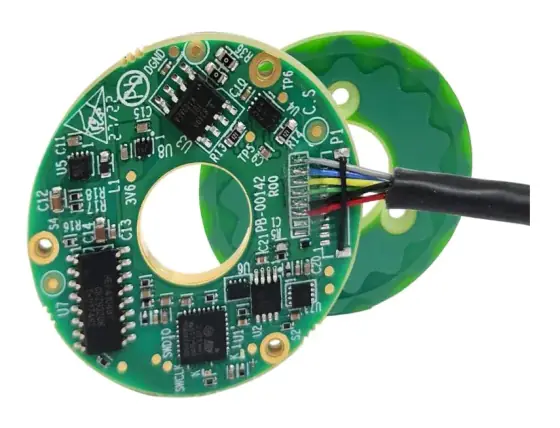
In short:Optical encoders give the highest accuracy and resolution but need a clean optical path and tight mounting. Magnetic encoders are the rugged, low-cost choice that shrugs off oil and dirt but are less accurate and can be disturbed by nearby magnetic fields. Capacitive encoders sit between them: thin, light, hollow, low-power and contamination-tolerant, with accuracy good enough for most robot joints and gimbals.
The short comparison
All three technologies do the same job: they turn a pattern on a moving scale or rotor into position. What differs is the pattern and how it is read, and that decides accuracy, robustness and cost.
| Optical | Magnetic | Capacitive | |
|---|---|---|---|
| How it reads | Light through or reflected from a fine graduated scale onto photodetectors | Hall or magnetoresistive sensor reads a magnetised ring or tape | Electrodes on rotor and stator; position from changes in capacitance |
| Best accuracy (published examples) | ±1 arcsec rotary (Renishaw REXA30, ≥100 mm, two heads); ±1 µm/m linear (RELA30) | Tens to hundreds of arcsec on rings; ±3 to ±100 µm/m on tape, by class | ±3 arcsec (Netzer VLZ); ±0.006° (≈22 arcsec) on general-purpose hollow rings |
| Resolution | Highest; to 1 nm linear (RESOLUTE) | High-end absolute heads reach 20 to 24 bits (Bogen AKS16, AKS17), but accuracy is far coarser than the resolution | High; 23 bits on Netzer VLX, 26 bits on VLZ |
| Contamination | Needs a clear optical path; sealed housings for dirty machines | Unaffected by oil, dirt and moisture | Tolerates dust, dirt and oil better than optical |
| External magnetic fields | Not affected | Susceptible near motors, brakes, high-current cables | Immune |
| Shock and vibration | Glass scales vulnerable; steel scales better | Rugged | Better than optical |
| Mounting tolerance | Tight: ride height 0.8 ± 0.15 mm on REXA30 | Moderate; small gaps on tape heads | Generous on whole-circumference designs (±0.3 mm on Netzer VLX) |
| Power | Higher; Design World cites upwards of 100 mA | Low to moderate | Low; Design World cites 6 to 18 mA |
| Profile and mass | Moderate; read head plus scale or ring | Small, simple | Very thin, light, large bore |
| Relative cost | Highest at high accuracy | Lowest | Middle |
Sources: technology behaviour from Design World (written by a capacitive encoder maker, so weigh it accordingly); optical figures from Renishaw REXA30 and Renishaw RESOLUTE; capacitive figures from Netzer. Relative cost is a broad market pattern, not a published figure; real prices depend heavily on size, accuracy grade and quantity.
How each technology works, and why it behaves the way it does
Optical
A light source shines through or onto a scale with very fine lines, typically tens of microns apart; Renishaw’s RESOLUTE scales use a 30 µm pitch. Photodetectors in the read head see the light pattern change as the scale moves, and interpolation divides each period into thousands of steps. Fine lines are why optical encoders reach the highest resolution and accuracy. They are also why dust, oil films and condensation degrade them: anything on the scale changes the light pattern.
Two practical forms:
- Exposed (open) systems: a read head over a tape, spar or ring with no contact. Best accuracy and speed (Renishaw quotes RESOLUTE up to 100 m/s), but they need a clean environment and careful alignment.
- Enclosed (sealed) systems: scale inside an aluminium extrusion with sealing lips, read by a carriage connected to the machine. HEIDENHAIN’s LC 115 and LC 415, for example, use double sealing lips with compressed air fed between them to keep chips and coolant off the graduation, and are cited at accuracy grade 3 µm over measuring lengths up to 4,240 mm (Power Transmission Engineering).
Magnetic
A ring or tape is magnetised with alternating poles, typically 0.5 to 5 mm apart (Bogen’s scales are offered from 0.5 to 20 mm), and a Hall or magnetoresistive sensor reads the field. Interpolation divides each pole pair. Coarser poles and the natural variation of magnetisation mean lower accuracy than optical, but the field passes straight through oil, dust, water and many non-magnetic covers.
Accuracy on rings depends heavily on size and installation. RLS gives eccentricity error as ±0.114 × e / D degrees, with eccentricity e in µm and ring diameter D in mm (RLS). On a 50 mm ring, 10 µm of eccentricity costs about ±82 arcsec, before the scale’s own accuracy class. Bogen’s RMSI rings, in our range, default to a 600 arcsec class with tighter classes down to ±25 arcsec depending on diameter.
The weakness is external fields. Motor magnets, brakes and high-current cables near the read head can corrupt the reading, so placement matters.
Capacitive
Patterned electrodes on a rotor and stator form a variable capacitor. An excitation signal is applied and the received signal changes with position. Designs that read the whole circumference average out eccentricity and local errors, which is why they tolerate mounting error far better than single-head ring encoders. Netzer, for example, scans and averages the full rotor and allows eccentricity plus air-gap error of up to ±0.3 mm on its VLX range (Netzer).
Capacitive encoders are immune to magnetic fields, draw little power and can be made very thin with large bores. Their limits are that accuracy is below the best optical systems in small sizes, they need a controlled air gap, and the low signal levels demand good cable shielding and grounding.
A note on inductive
Inductive encoders use printed coils and AC fields. Celera Motion states its IncOder range is unaffected by dirt, oil, mud, condensation and DC magnetic fields, with operation at wide temperature extremes (Celera Motion). They suit harsh outdoor, defence and subsea axes. Accuracy improves with diameter: under 353 arcsec on a 37 mm unit, much better on larger sizes.
Choosing between them
Work through these questions in order:
- What accuracy do you need at the load? Below about 10 arcsec rotary, or a few µm over a metre linear, optical is usually the only practical answer. From tens of arcsec, capacitive and inductive become strong options. From a few hundred arcsec, magnetic is often enough.
- How dirty is it? Oil mist, coolant, dust, condensation and washdown point to magnetic, capacitive or inductive, or to an enclosed optical encoder.
- What magnetic sources are close? Brakes, motor end-turns and power cables beside the read head point away from magnetic.
- What can the mechanics hold? If you cannot hold a few microns of eccentricity or a ±0.15 mm ride height through temperature and load, choose a whole-circumference capacitive or inductive design, or a housed encoder with its own bearings.
- Size, mass and power? Thin joints, gimbals and battery-powered systems favour capacitive.
- Cost at volume? For motor feedback and long axes in production quantities, magnetic is usually cheapest.
For the full selection process, including interfaces, absolute vs incremental and mounting, see how to select an encoder and our absolute vs incremental guide.
Worked example: output encoder for a cobot joint
Requirement: A collaborative robot joint with a frameless motor, a strain-wave gear and a holding brake. The output encoder sits beside the brake, needs a 40 mm through-bore for cabling, an envelope no thicker than 12 mm, absolute single-turn position, and output accuracy of ±0.01° (±36 arcsec). The joint is sealed but not to optical cleanliness, and the bearings can hold about 20 µm of run-out under load.
Optical ring: an optical ring would meet the accuracy easily on paper. But on a ring around 60 mm diameter, RLS’s formula gives 20 µm eccentricity as ±0.114 × 20 / 60 ≈ ±0.038°, or ±137 arcsec, far outside budget with one read head. Two heads would cancel it, at extra cost, space and an alignment step, and the joint would still need an optically clean interior.
Magnetic ring: rugged and cheap, but the same eccentricity applies to a single-head magnetic ring, the default accuracy class of a small ring (600 arcsec on Bogen RMSI) is far outside budget, and the holding brake sits right beside it.
Capacitive hollow ring: Netzer’s VLX is listed at up to ±0.006° (about 22 arcsec), accepts eccentricity plus air-gap error to ±0.3 mm, is immune to the brake’s field and is very thin. With 22 arcsec for the encoder, 14 arcsec remains for structure and thermal effects.
Choice: a hollow-shaft capacitive absolute encoder with BiSS-C, in a size with a bore over 40 mm, with the published accuracy for that size checked against the budget. A low-cost magnetic encoder remains a good choice for the motor-side commutation and velocity feedback, mounted away from the brake.
Products in our range to consider
- Netzer VLX: ultra-thin hollow-shaft capacitive absolute encoder, up to 23 bits and ±0.006°, SSI or BiSS-C.
- Netzer VLZ: ultra-high-precision capacitive encoder, ±3 arcsec, up to 26 bits.
- Netzer DS: encapsulated, factory-assembled version of the VLX, 16 to 130 mm OD, for easier installation.
- Netzer VLP: harsh-environment hollow-shaft capacitive encoder with higher shock and vibration tolerance, tested to MIL-STD-810.
- Bogen AKS16: absolute magnetic sensing head for linear and rotary scales, up to 20 bits, BiSS-C, SSI or ABZ, IP67.
- Bogen RMSI: incremental magnetic ring scales, 14 to 72 mm OD, accuracy classes to ±25 arcsec depending on size.
- Bogen IKS11: compact incremental magnetic head rated −40 to +125 °C, RS422 or TTL.
- Novanta Midi Ultra IncOder: inductive absolute encoder, 75 to 300 mm OD, up to 22 bits, accuracy to ≤19 arcsec depending on size.
- Kappasense FREEe: capacitive absolute linear encoder, ±5 µm accuracy, passive 3 g read head.
What else the build needs
- Drive that reads the encoder’s protocol natively. See servo drives.
- Motor, and a decision on motor-side vs load-side feedback. See servo and stepper motors and frameless torque motors.
- Gearing if the joint is geared. See gearboxes and harmonic vs planetary vs cycloidal.
- Bearings and structure that hold the mounting tolerance under load and temperature.
- Shielded cabling, especially for capacitive and long serial runs.
- Slip ring with data-rated circuits if feedback must cross continuous rotation. See slip rings.
Things that catch engineers out
- Comparing resolution instead of accuracy. A 23-bit magnetic and a 23-bit optical encoder are not equally accurate.
- Eccentricity on single-head rings. It often dominates on small diameters.
- Magnetic encoders beside brakes.
- Optical encoders in “clean enough” machines that later see oil mist or condensation.
- Poor shielding on capacitive encoders, giving noisy readings that look like a faulty sensor.
- Ignoring thermal mismatch between scale and structure.
- Choosing on unit price without counting installation time, calibration and second read heads.
Checklist
Send these to our engineers, or enter them in the spec builder:
- Rotary or linear; motor-side or load-side
- Accuracy and repeatability needed at the load, and the radius or length
- Resolution needed for the control loop
- Contamination: oil, coolant, dust, condensation, washdown
- Nearby magnetic sources and their distance from the read head
- Mounting tolerances the mechanics can hold (eccentricity, air gap, ride height)
- Bore, OD, thickness and mass limits
- Interface and drive model
- Speed, temperature range, shock and vibration
- Quantities and target cost
For the wider family, see our encoders overview.
Frequently asked questions
Which encoder technology is the most accurate?
Optical, in general. Renishaw's REXA30 optical ring system reaches ±1 arcsec installed on rings of 100 mm and above with two read heads. The best capacitive designs are close behind in larger sizes: Netzer's VLZ is listed at ±3 arcsec. Magnetic ring encoders are usually tens to hundreds of arcseconds, depending on ring size, accuracy class and installation.
Are magnetic encoders affected by motors and brakes?
They can be. A magnetic encoder reads a magnetic pattern, so strong external fields from motor magnets, holding brakes or high-current cables near the read head can disturb the reading. Design World's comparison notes magnetic encoders are susceptible to interference from electric motors. Keep distance, follow the maker's shielding guidance, or choose capacitive or inductive, which are not affected by static magnetic fields.
Which encoder is best in oil, dust and moisture?
Magnetic, capacitive and inductive encoders all tolerate oil, dust and moisture far better than exposed optical encoders, which rely on a clear line of sight to the scale. Optical encoders can still work in dirty machines when sealed in a housing, sometimes with compressed-air purging, as on enclosed machine tool linear encoders, but that adds size and cost.
Why are capacitive encoders used in robot joints?
Because they are thin, light and hollow, draw little power and tolerate mounting error and contamination. Netzer's VLX range, for example, accepts eccentricity plus air-gap error of up to ±0.3 mm and is listed at up to ±0.006° accuracy. They are also immune to magnetic fields, which helps when the encoder sits beside a frameless motor and a brake inside a compact joint.
Is a magnetic encoder good enough for servo motor feedback?
Often yes. Motor-side feedback mainly needs resolution for the velocity loop and enough accuracy for commutation, not arcsecond accuracy, especially behind a gearbox that divides motor-side errors by its ratio. Magnetic encoders are widely used on servo motors, AGV wheels and long linear axes. Use optical or capacitive load-side feedback where the load position itself must be accurate.
How do inductive encoders compare?
Inductive encoders sense position from coupling between printed coils, with no optics and no magnets. Celera Motion states its IncOder range is unaffected by dirt, oil, condensation and static magnetic fields, with wide temperature ranges. They tolerate mounting error well and suit harsh outdoor and defence axes, with accuracy that improves with diameter, for example under 353 arcsec at 37 mm and down to about 19 arcsec on larger sizes.
Sources
- Design World (J. Smoot, CUI): Capacitive, magnetic and optical encoders, comparing the technologies
- Renishaw: REXA30 absolute angle encoder data sheet
- Renishaw: RESOLUTE absolute encoder with RTLA30 linear scale (product page)
- RLS: Accuracy of the ring encoder
- Netzer Precision: Product catalogue 2025 (distributor copy)
- Celera Motion (Zettlex): IncOder product guide MINI, Rev 4.11.6 (Kollmorgen copy)
- Power Transmission Engineering: HEIDENHAIN encoders protect against contamination
Figures are summarised from the sources above and from manufacturers' published data on the date shown. Always confirm against the current datasheet for your exact part.