
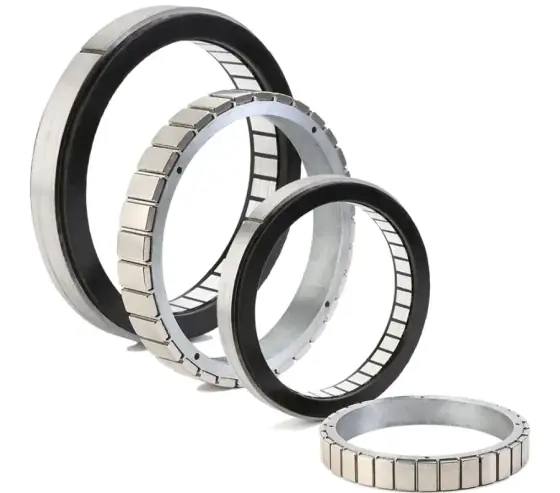
In short:Use a frameless rotor and stator kit when the motor can become part of your machine's structure, sharing its bearings and housing, and you need the shortest, lightest and stiffest axis with a hollow centre. Use a housed motor, either a conventional servo or a housed direct-drive torque motor, when you want bearings, encoder and thermal rating delivered aligned and tested, and less design work and risk in-house.
Frameless vs housed: the direct answer
A housed motor arrives as a complete machine element: rotor, stator, shaft, bearings, housing, encoder and connectors, aligned and tested, with a datasheet rating you can rely on. You bolt it on and couple it to the load. A frameless motor arrives as two parts, a rotor and a stator, and your machine supplies everything else (Kollmorgen).
Choose frameless when the motor genuinely becomes part of the structure: a robot joint, gimbal, rotary table, spindle, pump or actuator where you already have precise bearings and a housing, and where length, mass, a hollow centre or stiffness justify the extra design work. Choose housed when time to market, low volumes or in-house mechanical capacity make integration risk the bigger cost.
There is a middle option: the housed direct-drive torque motor, a large-diameter motor with its own bearings and encoder that drives the load without a gearbox. It gives most of the stiffness benefit of frameless with little of the integration work. This page compares all three. Once you have decided, how to select a frameless torque motor covers sizing, Km, tolerances and commutation.
What changes when you take the frame away
Removing the housing moves four responsibilities from the motor maker to you (Automation World):
- Mechanical: shaft, bearings and housing, machined to hold the air gap concentric. Kollmorgen’s frameless mounting guidance quotes concentricity of 0.002 in between rotor bore and stator OD on many motors and warns that a worst-case tolerance stack can exceed it (Kollmorgen).
- Feedback and control: choosing and fitting the encoder, Hall sensors or resolver, and setting up commutation and the drive.
- Thermal: the stator’s heat must flow into your housing and away. The motor’s continuous rating depends on it.
- Environmental protection: your enclosure has to keep out washdown, dust and fluids.
In return you get rid of the motor’s own housing, end bells, bearings and coupling, and often the gearbox, belts and pulleys too.
Frameless vs housed motors compared
| Frameless kit | Housed direct-drive motor | Housed servo + coupling or gearbox | |
|---|---|---|---|
| What you receive | Rotor and stator | Complete motor with bearings and encoder | Complete motor; gearbox and coupling separate |
| Bearings | Yours, shared with the machine | Motor’s own, sized for its load rating | Motor’s own, plus gearbox bearings |
| Feedback | You add it | Integrated, aligned | Integrated, aligned |
| Axial length | Shortest | Short | Longest |
| Mass | Lowest | Moderate | Highest for the torque |
| Hollow centre | Large bore possible, set by rotor ID | Through-hole, usually smaller | Rarely, unless hollow-shaft gearbox |
| Stiffness and backlash | Highest; no coupling or gear | High; no gear | Limited by coupling and gearbox |
| Continuous rating | Depends on your housing | Published for the motor | Published for the motor |
| Design and assembly effort | High | Low | Low |
| Integration risk | Highest | Low | Low |
| Best for | Robot joints, gimbals, spindles, OEM volume products | Index and rotary tables, metrology, low-volume precision axes | General automation |
Stiffness and bandwidth: the main performance reason
Every coupling, belt and gear adds compliance, which lowers achievable servo bandwidth and lengthens move and settle times (Kollmorgen). A direct-drive axis, frameless or housed, has the rotor rigidly on the load. Advanced Motion Controls puts typical servo systems below about 15 Hz of bandwidth and direct-drive systems up to about 50 Hz (A-M-C).
A frameless kit can go further than a housed DD motor in one respect: the rotor sits on the machine’s own shaft and bearings, so there is no second bearing set and no interface between motor and machine to deflect. A housed DD motor bolted to a machine has a short, stiff flange interface but still has two structures in series.
Size, mass and the hollow centre
A frameless motor’s torque comes from a large air-gap diameter, so ring-shaped kits with big bores are normal. In our range, the ADR-P kits reach a 229 mm rotor bore and the TI Series in-runner motors up to 290 mm. Housed DD motors of similar size have smaller through-holes, because bearings and encoder take up the space: the ADR-A housed motors in the same 110–360 mm frames go up to a 60 mm bore. Those bores carry slip rings, rotary unions, cables, optics or beam paths through the axis; see how to select a slip ring if anything rotates continuously.
Mass and length savings come from what is left out: housing, end bells, a second bearing set, a coupling and often a gearbox. They matter most where the motor is itself carried, as in robot arms, gimbals and drones, which is why frameless motors dominate robot joints.
Heat: the rating you must re-check
A housed motor’s continuous torque is published for a stated flange and ambient. A frameless kit cannot be rated that way on its own, so makers rate it on a test fixture. Kollmorgen’s TBM data assumes the motor is housed and mounted to a 3.5 × 3.5 × 0.25 in heat sink for the 60 mm frame, and a 7.0 × 7.5 × 0.375 in heat sink for the 76 and 129 mm frames, at 25°C ambient, with “hot” constants at 155°C winding temperature (Kollmorgen TBM).
Your housing may be better (a large aluminium casting, liquid cooling) or worse (a thin carbon-fibre tube, a sealed plastic enclosure). Kollmorgen notes liquid cooling can substantially increase available continuous torque. Because copper loss scales with torque squared, allowable continuous torque scales roughly with the square root of the heat your housing can remove at the permitted temperature rise. The worked example below shows the effect.
Integration risk and how to manage it
The usual problems with frameless designs, all avoidable at the drawing stage:
- Air gap and eccentricity. Machine to the maker’s drawing, check the tolerance stack, and measure parts before final machining. An eccentric rotor causes unbalanced magnetic pull, torque ripple and in the worst case a rub.
- Rotor fixing. Kollmorgen recommends bonding with a retaining compound plus a dowel, or a clamp ring, and does not recommend shrink or press fits.
- Assembly. The rotor’s magnets pull strongly towards the stator; use an insertion fixture or protective film thinner than the air gap, as Kollmorgen describes.
- Feedback. Choose an encoder that fits the bore and tolerates your bearing runout. See magnetic vs capacitive vs optical encoders.
- Bearings. They now carry the magnetic pull as well as the load; size them for both.
A housed DD motor sidesteps all of these, which is why it is often the right first answer for low-volume machines.
Worked example: rotary inspection table
Requirement. A rotary inspection table with a 0.05 kg·m² platter, a 60 mm through-hole for cables and a camera, continuous torque of 6 Nm with peaks of 20 Nm, and fast settling after each index.
Option 1: housed servo, 10:1 planetary gearbox and coupling. Torque at the motor is a modest 0.6 Nm continuous, but the gearbox adds backlash and compliance, and there is no through-hole without a hollow-shaft gearbox. Illustrate the stiffness issue with an assumed coupling and gearbox torsional stiffness of 5,000 Nm/rad at the output and reflected motor-side inertia of 0.2 kg·m² (0.002 kg·m² × 10²). The two-mass resonance is:
f = (1 ÷ 2π) × √(k × (J₁ + J₂) ÷ (J₁ × J₂)) = (1 ÷ 2π) × √(5,000 × 0.25 ÷ (0.05 × 0.2)) ≈ 56 Hz
A resonance that low forces the loop gains down well below it, which caps settling performance.
Option 2: housed direct-drive motor. No gearbox and no coupling compliance between motor and platter; the resonance is set by the platter and motor structure, typically far higher. Check the through-hole: a 60 mm bore is available in the larger ADR-A frames. Bearings, encoder and continuous rating come with the motor. Least design effort.
Option 3: frameless kit in the table’s own housing. Shortest stack and largest bore, sharing the table’s precision bearing. Suppose the chosen kit is rated at 7 Nm continuous on the maker’s test heat sink, but thermal analysis shows the table housing has 1.5 times the thermal resistance of that fixture. Allowable copper loss falls to 1 ÷ 1.5 of the rated value, so continuous torque falls to about 7 × √(1 ÷ 1.5) ≈ 5.7 Nm, short of the 6 Nm requirement. Either improve the heat path (thicker aluminium, a thermal interface to the base) or step up a stack length.
Result. For a single inspection machine, Option 2 is the pragmatic choice. For a product built in volume, where the table’s own bearing is already precise and every millimetre of height matters, Option 3 is worth the engineering, provided the thermal path is designed in.
Products in our range to consider
- Akribis ADR-F frameless motors: 48 VDC rotor and stator kits, 45–90 mm OD, up to 3.75 Nm continuous and 11.22 Nm peak.
- Akribis ADR-P frameless motors: 600 VDC kits, 110–360 mm OD, up to 365 Nm continuous with bores to 229 mm and integrated Hall sensors.
- TI Series in-runner frameless torque motors: 65–410 mm stator OD, 8–64 poles, through-holes to 290 mm, windings tailored to target speed.
- Akribis ADR-A housed direct-drive motors: iron-core, with bearings and optical encoder, 110–360 mm, up to about 1 kNm peak.
- Akribis AXD-ERA housed direct-drive motors: low-profile housed motors with a 23-bit BiSS-C absolute encoder, 120–400 mm.
- Akribis ACD ironless direct-drive motors: housed, zero cogging, for very smooth low-speed rotation, up to 9.22 Nm continuous.
- Netzer VLX hollow-shaft encoders: ultra-thin capacitive absolute encoders that fit frameless joint bores.
- LeaderDrive LHS/LHSG hollow-shaft strain-wave gears: for frameless joints that still need reduction, with a large central bore.
Checklist
Decide with these answers, and send them to our engineers or enter them in the spec builder:
- Continuous and peak torque at the load, and top speed
- Envelope: maximum OD, axial length and required through-bore
- Whether the machine already has precision bearings and a housing that can hold the air gap
- Heat path: housing material, wall thickness, mounting and ambient temperature; cooling options
- Required stiffness, bandwidth and settling time
- Feedback: resolution, absolute or incremental, and space for the encoder
- Commutation: Halls required by the drive, or encoder-based
- Brake requirement and where it fits
- Environment: IP rating, washdown, vacuum, temperature range
- In-house capacity for precision machining, assembly fixtures and testing
- Production volume, which decides whether integration effort pays back
For the family overview see frameless torque motors, and for the motor physics behind it, how servo motors work.
Frequently asked questions
What is a frameless motor?
A frameless motor is just the electromagnetic parts: a wound stator and a permanent-magnet rotor, supplied as two separate pieces. Kollmorgen describes it as a motor without the shaft, bearings, housing, feedback or end bells. The stator is fixed into your housing and the rotor onto your shaft, so the machine's own bearings hold the air gap and its structure carries the heat.
What is the difference between a frameless motor and a housed direct-drive motor?
Both drive the load directly without a gearbox. A housed direct-drive (DD or torque) motor adds its own bearings, housing and usually an encoder, aligned and tested at the factory, and bolts onto the machine. A frameless kit leaves those to you. Housed is faster to integrate and lower risk; frameless is shorter, lighter and can share the machine's bearings and bore.
Is a frameless motor cheaper than a housed motor?
The kit itself usually is, because there is less in it, but the system cost may not be. You pay instead for machining a housing and shaft to tight tolerances, choosing and fitting bearings, integrating an encoder and commutation, bonding or clamping the rotor, and testing. At low volumes housed motors are often cheaper overall; at production volumes, or where frameless removes a coupling and gearbox, frameless can win.
Why are frameless motors used in robot joints?
They let the motor, strain-wave gear, brake and encoders sit concentrically in one compact joint with a hollow centre for cables. Removing a separate motor housing and coupling saves length and mass, which matters in every joint of an arm because each one carries the next. Our guide on frameless motor sizing for robot joints works through a cobot shoulder example.
How is the continuous torque of a frameless motor rated?
On a stated test mounting, because the kit has no housing of its own. Kollmorgen's TBM data, for example, assumes the motor is housed and mounted to a 3.5 × 3.5 × 0.25 in (about 89 × 89 × 6 mm) heat sink for the 60 mm frame, at 25°C ambient. If your housing removes heat less well, continuous torque falls, roughly with the square root of the heat it can dissipate.
Does a frameless motor need its own encoder?
Yes, it has none. You add a feedback device to the machine shaft, typically a hollow-shaft or ring encoder that fits the same bore, and many kits offer factory-aligned Hall sensors for commutation. With an absolute encoder, most drives commutate from the encoder after a one-off phase offset. See our guide to selecting a frameless torque motor for the integration steps.
Sources
- Kollmorgen: Three design considerations that indicate a machine needs a frameless motor
- Automation World (Tom S. Wood, Kollmorgen): The case for frameless motors in high-performance applications
- Kollmorgen: Mounting design and installation of frameless motors
- Kollmorgen: TBM frameless motor selection guide
- Advanced Motion Controls: What is servo bandwidth?
Figures are summarised from the sources above and from manufacturers' published data on the date shown. Always confirm against the current datasheet for your exact part.