
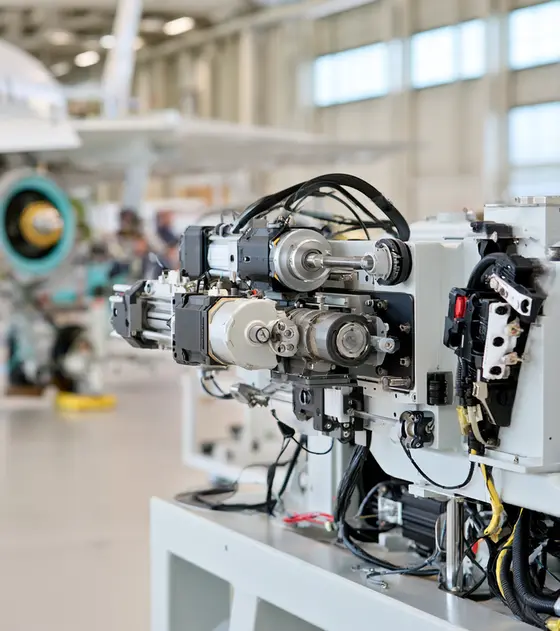
In short:Aerospace motion splits into two jobs: equipment that flies, where weight, temperature range, fault tolerance and DO-160G qualification drive every choice, and the ground test rigs and assembly cells that prove and build it. Electric actuation is taking over secondary flight functions, test benches and riveting, but a jam-tolerant design and documented qualification matter more than raw force.
Typical requirements
| Airborne equipment environmental tests | RTCA DO-160G: temperature, humidity, vibration, power input, RF and lightning sections |
|---|---|
| Electromechanical actuators in service | Secondary functions, e.g. A380 slats and horizontal stabiliser, four of 14 spoilers and wheel brakes on the 787 |
| Hollow-shaft encoder temperature range | -55 to +125 °C (published aerospace capacitive encoder range) |
| Strain-wave gear service life (manufacturer statement) | About 30 years installed in an aircraft wing |
| Full-scale fatigue test (one published programme) | 3 lifetimes for monitored airframes, 5 for non-monitored; about 10 min of test per flight hour |
| Test-rig slip ring speed | Up to 15,000 rpm for high-speed instrumentation rings |
Machinery we specify motion for
- Flight control and utility actuators
- eVTOL tilt-motor and flap actuators
- Helicopter rescue hoists
- Helicopter EO/IR sensor turrets
- Inflight entertainment systems
- ATC and tracking radar
- Automated riveting and drilling cells
- Automated fibre placement
- Aerospace component and structural test rigs
What aerospace motion has to deliver
Aerospace motion control covers two very different kinds of machine. The first is equipment that flies: actuators, hoists, sensor turrets, radar and cabin systems, where every gram counts, temperatures swing from well below freezing to hot-soak, and the equipment must pass environmental qualification and fit a safety case. The second is the equipment on the ground that builds and proves the aircraft: test rigs, iron birds, drilling and riveting cells and fibre placement machines. These are industrial machines with aerospace-grade demands on accuracy, data and traceability.
In the UK the sector is large enough to have its own trade body: ADS represents more than 1,700 member companies across aerospace, defence, security and space. Most engineers specifying motion components here work for a tier-one or tier-two supplier, a test house or an automation integrator, and the first question we ask is always: does it fly?
Where motion components sit in aerospace
| Machine | Motion | Components that matter |
|---|---|---|
| Flight control and utility actuators | Linear or rotary positioning under load | Motor, screw or strain-wave gear, absolute encoder, brake, drive |
| eVTOL tilt and flap actuators | Rotary positioning, high torque in a small envelope | Frameless motor, strain-wave gear, encoder |
| Helicopter rescue hoists | Winching with a high reduction | Motor, compact gearing, brake |
| EO/IR sensor turrets | Two-axis stabilised pointing | Direct-drive motors, encoders, slip ring with video or fibre |
| ATC and tracking radar | Continuous azimuth rotation | Large-bore slip ring with RF, drive, encoder |
| Inflight entertainment | Rotating screens and mounts | Small slip rings carrying power and network |
| Riveting, drilling and fibre placement | Multi-axis positioning with force | Servo motors, actuators, controllers |
| Test rigs | Programmed loads and motion | Servo actuators, load cells, slip rings, test controller |
Harmonic Drive lists helicopter rescue hoists and eVTOL tilting motors and jet flaps among its aviation applications. Schleifring describes slip rings in ATC and tracking radar, helicopter EO/IR sensors and inflight entertainment.
Electromechanical actuators for aircraft: the jamming question
The “more electric aircraft” replaces hydraulic actuators with electromechanical actuators (EMAs) to save weight, remove hydraulic lines and allow condition monitoring. Progress has been steady but selective. A review of EMA jamming mitigation lists EMAs on the A380’s slats and horizontal stabiliser, and on four of the 787’s 14 spoilers and its wheel brakes, all classed as secondary functions.
The reason is jamming. A ball screw that seizes is a single point of failure, and the review identifies friction build-up, debris contamination and spalling of the screw surface as the precursors. Onset tends to be abrupt, which makes it hard to predict. Mitigations described include:
- Redundant actuation: two EMAs summed onto one surface through a lever.
- Fault-tolerant motors and drives: dual or triple lanes, multi-phase machines and independent converters.
- Anti-jam mechanisms: decoupling the nut from the output so the surface returns to a safe position.
- Health monitoring: combining model-based and data-driven methods to spot rising friction early.
For a component specifier, this means the motor, gear and encoder choices follow from the actuator’s failure strategy, not the other way round. Read our guide to moving from hydraulic to electric actuators and the ball screw vs roller screw comparison before fixing the screw type.
Strain-wave gears, frameless motors and encoders
Rotary actuators for tilt mechanisms, hoists and pointing combine a frameless torque motor with a strain-wave gear and an output encoder, the same packaging logic as a robot joint. Harmonic Drive notes that its gears flew on the Apollo missions and that one installation has been in an aircraft wing for about 30 years. Compare reducer types in harmonic vs planetary vs cycloidal and browse gearboxes.
Feedback must work across the airborne temperature range. Capacitive encoders such as the Netzer VLT, published at -55 to +125 °C, mount around a hollow shaft without bearings. Inductive designs such as the Celera Motion Mini Ultra IncOder are non-contact and sealed. See absolute vs incremental encoders.
Slip rings for radar, EO/IR turrets and cabin systems
Any axis that rotates continuously needs a slip ring or contactless link. Schleifring lists the environment as severe temperature swings, shock, vibration and, for space and some radar, radiation, and requires EMC performance, qualification, certification and full traceability. Airborne rings are usually developed to order. Ground radar and test equipment can often use catalogue designs such as a fibre optic integrated slip ring for electro-optical pods, or the RR Series RF rotary joint. Our pages on slip rings for radar antennas and gimbals cover the detail.
Aerospace test rigs and assembly
Large structural tests are mostly hydraulic. A Moog account of aircraft structural testing describes one full-scale programme running 83 hydraulic and 7 pneumatic channels with a 1,200-channel data system, testing to three lifetimes for monitored airframes and five for non-monitored ones, with about 10 minutes of testing per flight hour. In Belfast, Moog supplied a 24-channel test system for fatigue testing the CSeries carbon fibre wing, with an active load abort system that unloads the structure if the primary loading fails.
Component and subsystem rigs are where electric actuation has moved in: actuator endurance rigs, landing-gear and door rigs, seat tests and rotating rigs. Rotating rigs need instrumentation slip rings; Michigan Scientific, for example, quotes end-of-shaft rings up to 12,000 rpm with precious-metal contacts for low noise. See slip rings for test rigs.
Worked example: sizing an actuator for a load rig
A rig must load a control-surface actuator with ±20 kN while moving it ±25 mm at 2 Hz (sinusoidal), for a 1-million-cycle endurance test.
- Peak velocity: 2π × 2 × 0.025 = 0.31 m/s.
- Peak acceleration: (2π × 2)² × 0.025 = 3.9 m/s². With a 50 kg moving mass that adds about 200 N, small next to the load.
- Peak power: at worst, 20 kN × 0.31 m/s is about 6.3 kW at the screw, so the motor and drive are in the 7–10 kW class once efficiency is included.
- Screw speed: with a 10 mm lead, 0.31 m/s is about 1,880 rpm.
- Duration: 1 million cycles at 2 Hz is about 139 hours of running, so screw life at the RMS load is the real check. A roller screw is the usual answer at this force and duty.
- Control: the rig needs force control from a load cell, not just position control, and a defined abort that unloads the unit under test.
An actuator in the class of the Tolomatic RSX (published to 294 kN and 760 mm/s) covers this envelope. Confirm with the supplier’s life calculation; our linear actuator sizing guide explains the method.
Qualification and documentation
Airborne equipment is tested to RTCA DO-160G, which covers temperature, humidity, vibration, water, power input, voltage spikes, RF susceptibility and emissions, lightning and electrostatic discharge. Programmable electronics fall under DO-178C (software) and DO-254 (hardware). Suppliers to the sector usually work to EN 9100 / AS9100. Catalogue industrial components are normally used on ground equipment, test rigs and prototypes. For flight hardware, plan qualification and any custom build with the supplier from the start.
Typical pitfalls
- Treating a flight actuator like an industrial axis. The failure strategy drives the design.
- Forgetting temperature at the low end. Lubricants, seals and encoders often limit cold performance before the motor does.
- Under-sizing rig actuators on peak force when months of cycling make RMS load and screw life the limit.
- Leaving the abort behaviour undefined on test rigs, so a fault damages the test article.
- Late documentation requests. Traceability and qualification data are hard to add after the order.
Tell us whether your part flies, its loads, envelope and environment, and our specialist engineering and supply partners can propose actuators, gears, encoders, drives and slip rings to suit.
Linear actuators for aerospace test rigs and riveting
On the ground, electric rod actuators load control-surface actuators, landing-gear parts and seats on endurance rigs, and drive clamping, drilling and riveting heads in assembly cells. Specify peak and RMS force, stroke, the test waveform (frequency and amplitude), required life in cycles and any side load. Roller screws carry more load and life than ball screws in the same envelope, which matters on rigs that run for months. Ask for a load cell or force feedback option where the test needs closed-loop force control. Large full-scale structural tests still mostly use hydraulic servo actuators; electric actuators suit component and subsystem rigs where cleanliness, energy use and quiet running count.
- Actuator endurance rigs: apply a programmed aerodynamic load to the unit under test
- Landing gear and door rigs: cycle mechanisms for life testing
- Riveting and drilling cells: clamp, feed and upset with controlled force
- Seat and cabin equipment tests: repeated load and abuse cycles
Available through our supply network
All linear actuators →Specify linear actuators for aerospace and aviation →
Slip rings for aerospace radar, EO/IR turrets and test rigs
Slip rings pass power, video and data across continuously rotating axes: ATC and tracking radar pedestals, helicopter EO/IR turrets, inflight entertainment and rotating test rigs. Specify circuit count and current, data type (Gigabit Ethernet, HD-SDI, fibre or RF), speed, temperature range, vibration and shock levels, and the EMC requirements of the platform. Airborne units are usually custom-developed and qualified with the aircraft equipment, so documentation and traceability need agreeing early. Test rigs on rotors, propellers and gearboxes need low-noise precious-metal contacts for strain-gauge signals and high speed ratings, often several thousand rpm.
- Tracking and ATC radar: power plus RF and data through the pedestal
- Helicopter EO/IR turret: HD video and fibre across the azimuth axis
- Rotor and propeller rigs: strain-gauge and thermocouple signals at speed
- Inflight entertainment: power and network across rotating parts
Available through our supply network
All slip rings →Specify slip rings for aerospace and aviation →
Encoders for aircraft actuators and sensor turrets
Actuator position feedback must survive the full airborne temperature range, vibration and condensation while staying thin and light. Hollow-shaft capacitive and inductive absolute encoders fit around the actuator or gimbal shaft, read without bearings or optics, and tolerate contamination better than open optical rings. Specify the temperature range (-55 °C is a common lower limit), resolution and accuracy at the output, interface (SSI or BiSS-C), supply voltage, shock and vibration levels, and whether redundant channels are needed for a fault-tolerant actuator. For safety-related functions, ask for failure-rate data to feed the system safety assessment.
- Electromechanical actuators: absolute output position
- EO/IR turrets: azimuth and elevation angle
- eVTOL tilt mechanisms: tilt angle feedback
- Test rigs: rotary position for the controller
Available through our supply network
All encoders and feedback →Specify encoders and feedback for aerospace and aviation →
Strain-wave gears for aerospace rotary actuators
Strain-wave gearing gives a high ratio with zero backlash in one short stage, which suits rotary actuators, hoists, tilt mechanisms and sensor pointing where mass and envelope are tight. Ultra-flat and hollow-shaft sets leave room for cables and a second encoder. Specify ratio, repeated peak and momentary torque, torsional stiffness, the temperature range of the lubricant, and how a jam or overload is handled, because a strain-wave gear's ratcheting torque must never be exceeded. Integrated harmonic actuators with motor, encoder and brake suit ground equipment, test fixtures and demonstrators.
- eVTOL tilt-motor and flap actuators: compact high-ratio rotary drive
- Rescue hoist drives: reduction in a short envelope
- Sensor turrets: zero-backlash pointing
- Test fixtures: precise rotary positioning of the unit under test
Available through our supply network
All gearboxes and harmonic drives →Specify gearboxes and harmonic drives for aerospace and aviation →
Frameless torque motors for aircraft actuators and gimbals
A frameless rotor and stator built into the actuator housing removes a second set of bearings and a housing, which saves mass and length, and leaves a hollow centre. Torque rises steeply with air-gap diameter, so flat, large-diameter motors suit direct-drive gimbals and short rotary actuators. Specify continuous and peak torque, bus voltage (aircraft DC buses differ from industrial ones), winding temperature class, cooling path and mass budget. For fault-tolerant designs, discuss segregated or dual windings with the supplier early, because they change the stator design.
- Rotary EMAs: motor built into the actuator body
- EO/IR turrets: direct-drive azimuth and elevation
- Test rigs: direct-drive rotary loading
Available through our supply network
All frameless and torque motors →Specify frameless and torque motors for aerospace and aviation →
Servo drives for aerospace actuation and test benches
Drives for airborne and vehicle use need high power density, wide DC input ranges and support for the feedback the actuator uses. Test benches need fast current loops, an EtherCAT or CANopen link to the test controller and Safe Torque Off. Specify bus voltage, continuous and peak current, feedback type (resolver, BiSS-C, EnDat), fieldbus, cooling and the environment. Board-level drives reduce wiring but move the qualification burden to the host electronics. On rigs, check that the drive's regeneration handling copes with an actuator being back-driven by the unit under test, since energy flows back into the DC bus on every cycle.
- Electric actuators: compact DC-bus motor control
- Test benches: closed-loop force or position control
- eVTOL and UAV demonstrators: power-dense drive electronics
Available through our supply network
All servo drives →Specify servo drives for aerospace and aviation →
Servo motors for aerospace assembly and eVTOL demonstrators
Assembly automation for aerostructures (drilling, riveting, fibre placement, jig positioning) runs on mainstream AC servo motors with multi-turn absolute encoders, so axes know their position at power-up across very large work envelopes. For eVTOL and heavy-lift UAV demonstrators, high-power permanent-magnet propulsion motors with matched controllers are a starting point before flight-qualified parts are designed. Specify torque, speed, inertia ratio, encoder resolution, brake and IP rating for factory axes, and thrust, voltage and mass for propulsion. Remember that a demonstrator motor is not a certified propulsion unit; plan the route to qualified hardware with the supplier if the programme goes ahead.
- Riveting and drilling end effectors: spindle and feed axes
- Automated fibre placement: head and tow-feed axes
- eVTOL demonstrators: lift and propulsion motors
Available through our supply network
All servo and stepper motors →Specify servo and stepper motors for aerospace and aviation →
Motion controllers for aerospace test rigs and assembly cells
Test rigs and assembly cells need a controller that synchronises many axes with data acquisition and runs safe abort sequences. EtherCAT controllers programmed in IEC 61131-3 handle multi-axis loading profiles, logging and interlocks. Specify axis count, cycle time, analogue inputs for load cells, how test profiles are imported, and what must happen on an abort, so the structure is unloaded safely rather than simply stopped. Check that the controller can log at the rate the test needs and time-stamp motion and sensor data together, because rig results are only useful if load, position and strain line up exactly.
- Endurance rigs: run load spectra and log results
- Assembly cells: coordinate clamp, drill and rivet axes
- Abort handling: controlled unloading on a fault
Available through our supply network
All controllers and plcs →Specify controllers and plcs for aerospace and aviation →
Standards to have in view
- RTCA DO-160G (environmental conditions and test procedures for airborne equipment)
- RTCA DO-178C (software considerations in airborne systems)
- RTCA DO-254 (design assurance for airborne electronic hardware)
- SAE ARP4754 (development of civil aircraft and systems)
- SAE ARP4761 (safety assessment process for civil airborne systems)
- EN 9100 / AS9100 (quality management for aviation, space and defence organisations)
Which standards apply depends on the end product and its market. Your engineer will confirm what the component itself needs to meet.
Frequently asked questions
Are electromechanical actuators used for primary flight controls?
Mostly not yet. A review in the International Journal of Prognostics and Health Management lists EMAs on secondary functions such as A380 slats and the horizontal stabiliser, and four of the 14 spoilers and the wheel brakes on the Boeing 787. Ball-screw jamming is a single point of failure, which is the main reason EMAs are kept out of primary controls unless the design adds redundancy or anti-jam features.
What is DO-160G and does it apply to motion components?
RTCA DO-160G sets environmental test conditions and procedures for airborne equipment, covering sections such as temperature, humidity, vibration, power input, voltage spikes, RF susceptibility and emissions, and lightning effects. It applies to the equipment that is installed on the aircraft. A motor or encoder inside an actuator is tested as part of that equipment, so ask suppliers for data at the levels your equipment specification calls up.
Why are strain-wave gears popular in aerospace actuators?
They give a high reduction ratio with zero backlash in one compact, light stage, and the hollow versions leave room for cables. Harmonic Drive says its gears have flown since the Apollo missions and that one installation has been in an aircraft wing for about 30 years. The trade-offs are limited torsional stiffness at low load and a ratcheting torque limit that must be designed around.
Can industrial actuators be used on aerospace test rigs?
Yes. Ground test rigs, fixtures and assembly cells are industrial machinery, so industrial servo actuators, drives and controllers are normal there. Specify the test waveform, force, life in cycles and the safety behaviour on abort. Very large full-scale airframe fatigue tests still mostly use hydraulic servo actuators because of the number of channels and forces involved.
What do aircraft slip rings need that industrial ones do not?
Lower weight, wider temperature ranges, higher vibration and shock resistance, EMC performance to the platform's requirements, and full documentation, qualification and traceability. Schleifring notes that aerospace slip rings are typically developed to order, from concept through prototyping and qualification to series production. Industrial catalogue rings suit ground radar, test rigs and prototypes.
What should I send for an aerospace motion enquiry?
Say whether the part is airborne, ground support or test equipment. Then send loads and duty (or the test profile), stroke or angle, speed, envelope and mass budget, bus voltage, feedback interface, temperature, vibration and shock levels, DO-160G categories if airborne, quality requirements such as AS9100 and documentation, expected quantities and timescales.
Sources
- Harmonic Drive: Aviation and space
- Schleifring: Aerospace applications
- IJPHM: A review of techniques to mitigate jamming in electromechanical actuators for safety critical applications
- A.T.E.: RTCA DO-160 compliance overview
- Moog: Aircraft structural testing
- Aerospace Manufacturing and Design: Bombardier selects Moog test system for carbon fibre wing
- Michigan Scientific: End of shaft slip rings
- ADS Group: About
Figures are summarised from the sources above and from manufacturers' published data on the date shown. Always confirm against the current datasheet for your exact part.