
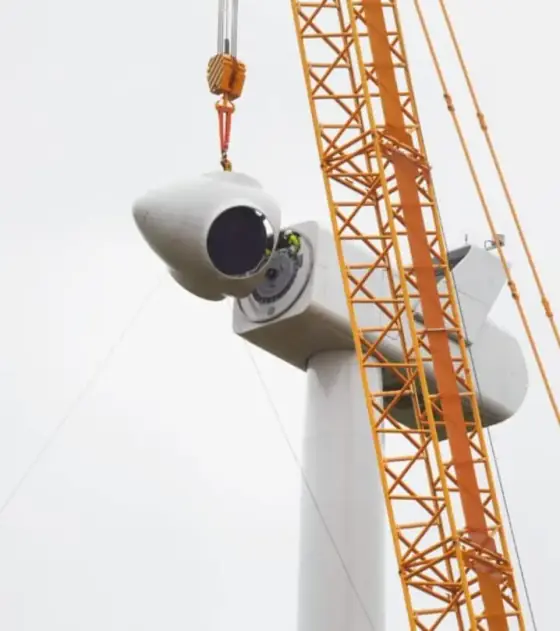
What the slip ring has to handle
- Mixed power and control: pitch motor bus (commonly 400-690 V AC or a DC bus) alongside 230 V auxiliary and 24 V control circuits in one unit
- Fieldbus or Ethernet for the pitch controller (CAN, PROFIBUS or Ethernet), routed on shielded, impedance-controlled rings kept apart from power rings
- Low rotor speed but continuous duty: hub speed is only tens of rpm, so life is driven by total revolutions and environment rather than speed
- Sealed housing against moisture, dust and salt mist, with cold-start capability for offshore and northern sites
- Vibration resistance and correct shaft alignment, because hub vibration and misalignment accelerate brush wear
- Serviceability: brush replacement without removing the whole unit, with multi-year service intervals
- Contact materials matched to duty: precious-metal (e.g. gold-on-gold) for signal rings, silver-graphite for medium-current rings
Typical figures
| Circuits | 12 to 60+ circuits on utility-scale pitch rings; example 2-3 MW unit has 30 channels |
|---|---|
| Current | Example pitch ring: 5 x 80 A at 400 V AC main power plus 25 A, 5 A and 2 A auxiliary/control circuits |
| Voltage | Pitch motor bus typically 400-690 V AC or DC; 24 V control and 230 V auxiliary |
| Speed | Example pitch ring rated 0-30 rpm |
| Data | CAN bus, PROFIBUS or Ethernet; Gigabit Ethernet (1 Gbps) designs use controlled impedance and shielded pairs |
| Ingress protection | IP65 on example pitch ring |
| Temperature | Example pitch ring -40 C to +80 C |
| Service interval | Onshore pitch rings often run 5-10 years between major brush services (manufacturer guidance) |
Example figures from the published sources listed below. Your requirement may differ; an engineer will confirm against your duty cycle.
Recommended slip ring types
Standards to consider
- IEC 61400-1 - design requirements for wind turbines, including internal electrical systems and control/protection functions
- IEC 61400-3-1 - additional design requirements for fixed offshore wind turbines
- IEC 61400-2 - design requirements for small wind turbines (relevant where yaw slip rings are used)
- IEC 60529 - IP code used to specify enclosure ingress protection
The complete system
A slip ring rarely works alone. For wind turbines (pitch & yaw) it is usually specified together with:
- pitch drive motor
- pitch servo drive / converter
- absolute encoder
- pitch gearbox
- holding brake
- backup battery or ultracapacitor pack
Specifying these together avoids mismatched connectors, cable routes and feedback interfaces, and gives you one point of contact for the whole axis.
Common problems to design out
- Intermittent CAN or fieldbus errors from contact noise or poor shielding/grounding
- Brush wear debris building up and causing tracking or shorts between rings
- Moisture or salt ingress leading to corrosion and insulation breakdown
- Vibration and shaft misalignment shortening brush and bearing life
Series used in this application
Frequently asked questions
Do wind turbines use a slip ring for yaw as well as pitch?
Usually only on small turbines where the generator sits in the rotating head. Most utility-scale turbines let the cable twist through a loop and then unwind it automatically, so the slip ring is concentrated on the pitch system in the hub.
Can a pitch slip ring carry Ethernet as well as motor power?
Yes. Modern pitch rings combine motor power, auxiliary supplies and CAN, PROFIBUS or Ethernet in one assembly, with data rings shielded and separated from power. Gigabit designs rely on controlled-impedance, shielded ring pairs.
How often does a wind turbine pitch slip ring need servicing?
Manufacturer guidance for onshore pitch rings is typically several years, often five to ten, between major brush services, depending on environment and duty. Designs that allow brush blocks to be changed in place cut downtime considerably.
Sources
- https://www.bt-slipring.com/info/wind-turbine-slip-rings-types-failure-selectio-103498345.html
- https://www.ingiant-slipring.com/30-circuits-wind-turbine-pitch-slip-ring-5x80a-400vac-power-signal-hybrid-rotary-joint-ip65-for-2-3mw-wind-turbines-product/
- https://www.sis.se/en/produkter/energy-and-heat-transfer-engineering/wind-turbine-systems-and-other-alternative-sources-of-energy/iec-61400-12019/
- https://stemmann.com/pl/products/slip-ring-assemblies/lp-series-bako-r