
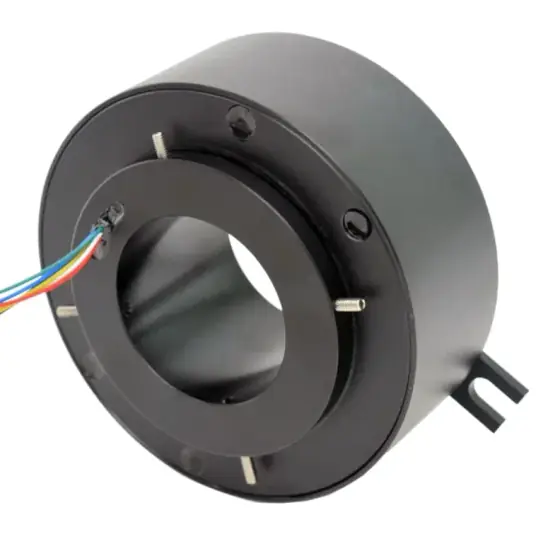
What the slip ring has to handle
- Rotary weld ground rated for welding current (hundreds of amps)
- Low and stable contact resistance to avoid arc fluctuation
- Through-bore for cables, air and sensor lines to fixtures
- Slow rotation (single-digit rpm)
- Heat dissipation for continuous high current
- Spatter and dust protection
- Coordination with robot controller and servo axes
Typical figures
| Current | Rotary ground devices 400-1500 A; example robot slip ring 450 A |
|---|---|
| Voltage | 0-380 V AC/DC (example) |
| Speed | Max 6 rpm (example) |
| Bore | 50 mm (example) |
| Ingress protection | IP51 (example) |
| Temperature | -30 C to +80 C (example) |
Example figures from the published sources listed below. Your requirement may differ; an engineer will confirm against your duty cycle.
Recommended slip ring types
Standards to consider
- IEC 60974 series - arc welding equipment safety
- IEC 60204-1 - electrical equipment of machines
- ISO 10218 - robot safety where positioners work with robots
The complete system
A slip ring rarely works alone. For welding positioners & turntables it is usually specified together with:
- servo motor
- servo drive
- gearbox
- absolute encoder
- brake
- robot controller
Specifying these together avoids mismatched connectors, cable routes and feedback interfaces, and gives you one point of contact for the whole axis.
Common problems to design out
- Arcing and pitting on ground contacts
- Overheating at high current
- Spatter contamination
- Inconsistent weld quality from resistance drift
Series used in this application
Frequently asked questions
How is welding current earthed on a rotating positioner?
A rotary ground device or high-current slip ring carries the return current across the rotating axis. Ratings typically range from about 400 A up to 1500 A.
Can sensor and air lines pass through a positioner?
Yes. Positioner slip ring kits route sensor, control cables and air lines to tooling without twisting.
Why does contact resistance matter on a welding positioner?
Varying resistance in the return path can cause arc fluctuation and weld defects. Precious-metal or copper-alloy contacts and correct sizing help keep it stable.
Sources
- https://shop.holstongases.com/tweco-roto-ground-rg-240-ground-clamp-device-800-amps--15
- https://www.ingiant-slipring.com/50mm-bore-1-circuit-450a-high-current-slip-ring-h62-body-steel-locking-ring-precious-metal-contact-for-welding-robot-rotary-power-supply-product/
- https://www.motoman.com/en-us/products/peripherals/positioners