
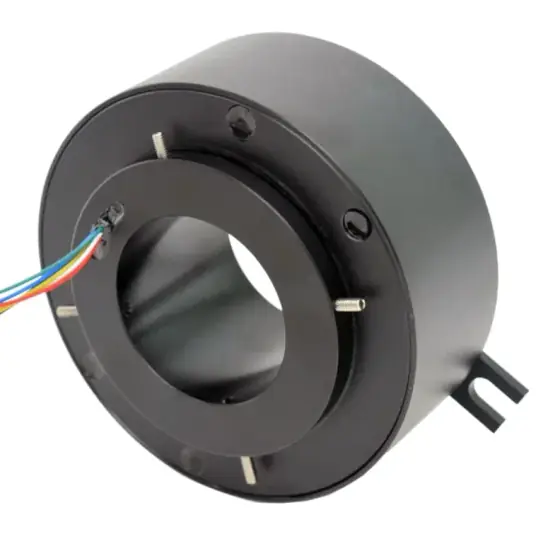
What the slip ring has to handle
- Miniature capsule format with very small diameter and length
- High circuit count (tens of circuits) for sensors, motors and video
- Low current per circuit (under 1 A typical)
- Low electrical noise on signal circuits
- Low starting torque so stabilisation motors are not loaded
- Power through the slip ring so the payload needs no separate battery
- Life measured in millions of revolutions
Typical figures
| Circuits | 16-95 circuits in miniature capsules |
|---|---|
| Current | 0.8 A per circuit (example 95-ring capsule) |
| Size | 0.68 in barrel x 2.0 in long (80-ring example); 1.5 in x 3.3 in (95-ring example) |
| Speed | Up to 40 rpm |
| Noise | 15 milliohm per circuit pair typical, 30 milliohm max |
| Life | Several million revolutions |
| Payload | Example drone gimbal carries payloads up to 800 g with slip ring power feed |
Example figures from the published sources listed below. Your requirement may differ; an engineer will confirm against your duty cycle.
Recommended slip ring types
Standards to consider
- MIL-STD-810 - environmental test methods, often applied to military UAV payloads
- RTCA DO-160 - environmental conditions for airborne equipment
The complete system
A slip ring rarely works alone. For gimbals & drones it is usually specified together with:
- gimbal BLDC motors
- gimbal controller
- IMU
- absolute encoder
- video transmitter
Specifying these together avoids mismatched connectors, cable routes and feedback interfaces, and gives you one point of contact for the whole axis.
Common problems to design out
- Signal noise on fine-gauge circuits
- Wire breakage at leads from vibration
- Wear at high revolution counts
- Excess torque disturbing stabilisation
Series used in this application
Frequently asked questions
How small can a gimbal slip ring be?
Miniature capsules exist with around 80 circuits in a barrel roughly 0.68 in across and 2 in long. Ring-to-ring spacing can be as small as a few hundredths of an inch.
Can a drone gimbal slip ring carry power to the camera?
Yes. Some gimbals route camera power through the slip ring so the payload does not need its own battery, while signal circuits carry control and video.
What current can miniature slip ring circuits carry?
Fine-gauge capsule circuits are typically rated below 1 A each, for example 0.8 A. Higher loads are handled by paralleling circuits or choosing a larger unit.
Sources
- https://www.moog.com/products/slip-rings/aerospace-military-slip-rings/miniature-slip-ring-capsules/rk4288.html
- https://www.moog.com/content/dam/moog/literature/products/slip-rings/moog-ac6292-minature-slip-rings-datasheet.pdf
- https://www.unmannedsystemstechnology.com/company/hd-air-studio/infinity-mr-s2/