
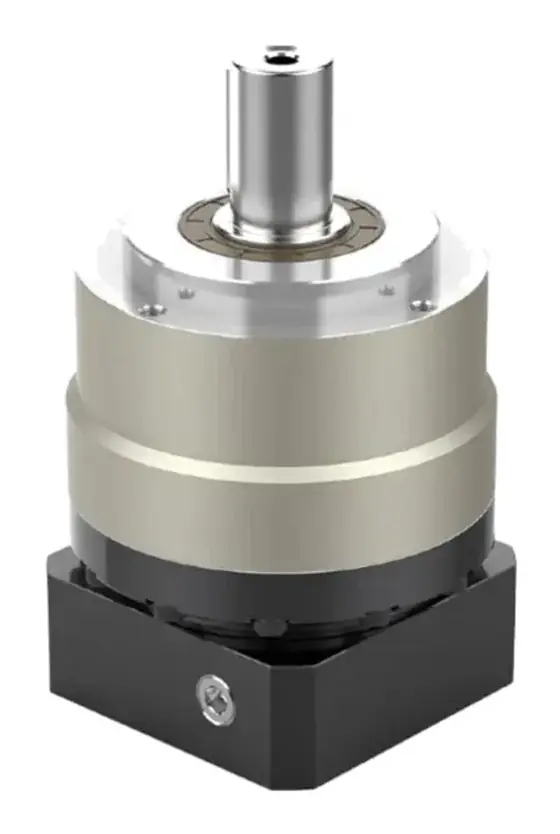
In short:Use a planetary gearbox for inline servo axes needing high efficiency, low backlash and high torque density; a worm gearbox for low-cost, quiet right-angle drives at modest duty where low efficiency is acceptable; and a spiral bevel or hypoid stage, usually combined with planetary stages, for right-angle servo axes that need planetary-class efficiency and precision.
Planetary vs worm vs bevel: the short answer
The three gearbox types solve different problems:
- Planetary: inline, efficient, compact for its torque and available to precision backlash classes. The default for servo and stepper axes.
- Worm: right-angle, a high ratio in one stage, quiet and cheap, but inefficient and prone to wear. Good for modest-duty drives; poor for high-duty servo axes.
- Bevel (straight, spiral bevel or hypoid): right-angle with rolling contact and high efficiency. In motion control it usually appears as the input stage of a right-angle planetary.
Most specification mistakes in this area come from choosing a worm gearbox because a right angle is needed, then discovering that half the motor’s power is turning into heat.
Comparison table
| Factor | Planetary (inline) | Worm | Spiral bevel / hypoid (incl. bevel-planetary) |
|---|---|---|---|
| Shaft arrangement | Coaxial | 90°, non-intersecting | 90°; intersecting (bevel) or offset (hypoid) |
| Ratio per stage | About 3:1 to 10:1 | 5:1 to 60:1 | Hypoid alone up to about 10:1; with helical or planetary stages up to about 120:1 (hypoid) or 200:1 (bevel-planetary) |
| Efficiency | About 95% one stage, 92% two stage | About 40% at 60:1 to 85% at 10:1 | Hypoid 95–99%; bevel-planetary close to inline planetary |
| Tooth contact | Rolling, load shared across planets | Sliding | Mostly rolling, some sliding (hypoid) |
| Backlash | 1–3 arcmin precision; under 1 arcmin best | Not usually sold to a tight class; grows with wear | A little above inline planetary |
| Self-locking | No | Possible at small lead angles; not guaranteed | No |
| Heat | Low | High at high ratio | Low |
| Running-in | None | Bronze wheel needs break-in | None (hardened steel) |
| Torque density | Highest | Lower | High |
| Noise | Low to moderate (helical quieter) | Very quiet | Low |
| Cost | Moderate to high (precision) | Lowest | Highest at the precision end |
Sources: planetary efficiency from the Apex Dynamics AE/AER catalogue; worm and hypoid efficiency, ratios, break-in and heat from Oriental Motor; self-locking from Boston Gear; gear type definitions from KHK. Bevel-planetary figures from the published data of the series listed at the end of this guide.
How each type works, and why it behaves that way
Planetary gearboxes
A central sun gear drives three or more planet gears, which roll inside a fixed ring gear and carry an output carrier round with them. Load is shared between the planets, so a small gearbox carries a lot of torque, and the input and output are on one axis. All the contacts roll, which is why one stage reaches about 95% efficiency. Each stage is limited to about 10:1 because the sun gets too small, so higher ratios stack stages, losing a few per cent of efficiency and adding backlash each time. Our guide on how to select a planetary gearbox covers backlash classes and frame sizing.
Worm gearboxes
A screw-like worm drives a wheel whose axis is at 90° to it, without the axes crossing. One start on the worm moves the wheel one tooth per turn, so a 40-tooth wheel gives 40:1 in a single, compact stage. The cost is that the worm thread slides across the wheel teeth rather than rolling. KHK describes worm pairs as quiet and smooth with “a very large gear ratio in a single mesh”, but with poor transmission efficiency (KHK). Worm drives also produce a significant thrust load on the worm shaft, which its bearings must carry (Boston Gear).
Bevel and hypoid gearboxes
Bevel gears are cones with teeth, meshing with intersecting shafts, most often at 90°. Spiral bevel teeth are curved so several teeth share load and engagement is gradual. Hypoid gears offset the pinion below the wheel centre, which allows a bigger, stronger pinion and higher ratio. Oriental Motor quotes hypoid efficiency of about 95 to 99%, with ratios up to 10:1 from the hypoid mesh alone and up to 120:1 when combined with helical stages (Oriental Motor). KHK notes that bevel efficiency drops if the gears are mounted off their correct cone position, so the housing and shimming matter.
In servo applications the common form is the bevel-planetary: a spiral bevel input stage turning the drive through 90°, followed by planetary stages that provide most of the ratio.
Worm gear efficiency and self-locking: the numbers
Worm efficiency depends on the lead angle γ of the worm thread and the friction coefficient f. Boston Gear gives the estimate (Boston Gear):
E = tan γ × (1 − f tan γ) / (f + tan γ)
with f of about 0.03 to 0.05 for a hardened steel worm on a bronze wheel. Lead angle falls as ratio and worm diameter increase, so “for maximum efficiency the ratio should be kept low”. Working the formula through:
| Lead angle γ | f | Efficiency E |
|---|---|---|
| 3° | 0.05 | 51% |
| 5° | 0.05 | 63% |
| 10° | 0.04 | 81% |
| 20° | 0.03 | 91% |
These are mesh efficiencies only; bearing and seal losses come on top, and efficiency is lower at start-up and before running-in.
Self-locking comes from the same physics. A worm theoretically will not back-drive if the friction angle exceeds the lead angle. Boston Gear says there is a “reasonable expectation of self-locking” below about 5° and that back-driving may be expected above about 11°, but also that worm sets “under no condition should be considered to hold a load when at rest” (Boston Gear). Notice the link: the lead angles that self-lock are the same ones with around 50–60% efficiency. You cannot have a reliably self-locking worm and an efficient one.
Heat, wear and life
Lost power becomes heat in the gearbox. In a comparison test published by Oriental Motor, a worm and a hypoid gearmotor started at 20 °C; after 100 minutes the worm unit reached about 66 °C and the hypoid about 52 °C, and with the same motor and load the worm delivered about 15 Nm against the hypoid’s 23 Nm. A study cited in the same paper found a 0.37 kW hypoid gearmotor matched a 0.75 kW worm gearmotor at 60:1 (Oriental Motor).
Heat matters beyond efficiency: it ages the lubricant and seals and reduces life. Worm wheels in bronze also need a break-in period to work-harden before they reach full efficiency, and as the bronze wears, backlash grows. Planetary and bevel gears in case-hardened steel run in no break-in and hold their backlash far longer.
Worked example: right-angle drive for an indexing conveyor
Requirement: A servo-driven conveyor head shaft, mounted alongside the frame so the motor must sit at 90°. Output 60 rpm, 40 Nm continuous through the cycle, motor speed 3,000 rpm, so the ratio is 50:1. Two shifts a day. Stopping accuracy at the product is moderate (a few arcmin is fine).
Output power: P = T × ω = 40 × (2π × 60 / 60) = 251 W.
Option A: single-stage worm, 50:1. At 50:1 expect efficiency towards the low end of Oriental Motor’s 40–85% range. Taking 50–60%:
- Motor torque = 40 / (50 × 0.55) ≈ 1.45 Nm (1.33 to 1.60 Nm across the range)
- Input power 419–503 W, so 168–251 W of heat in the gearbox
Option B: right-angle bevel-planetary, 50:1, two stage. Taking 92% for two stages:
- Motor torque = 40 / (50 × 0.92) = 0.87 Nm
- Input power 273 W, so 22 W of heat
What the numbers mean: Option A needs a servo motor with roughly 1.5 to 1.8 times the continuous torque of Option B, a drive to match, and a gearbox dissipating up to a quarter of a kilowatt for two shifts a day. The worm will run hot, its backlash will grow with wear, and its low efficiency also makes servo tuning less predictable because friction varies with temperature. The bevel-planetary costs more as a gearbox, but the smaller motor and drive usually recover much of that, and it holds its accuracy.
Choice: a right-angle bevel-planetary at 50:1, sized so that 40 Nm continuous and the acceleration peaks sit within its rated and peak output torque. A worm would be reasonable only if the duty were light and intermittent, for example a few adjustment moves an hour.
If the conveyor were inclined, neither option replaces a brake: the planetary will back-drive, and the worm is not guaranteed to hold.
When to use each gearbox type
| Use | Best fit | Why |
|---|---|---|
| Inline servo axis, gantry, rack and pinion | Planetary | Efficiency, torque density, backlash class |
| Right-angle servo axis, high duty | Bevel-planetary | Planetary-class efficiency and precision at 90° |
| Low-cost right-angle drive, light duty | Worm | Price, one-stage ratio, quietness |
| Small DC motor actuators, valves, gates | Worm | Compact high ratio; some friction resists back-driving |
| Very high ratio and zero backlash | Strain-wave or cycloidal | See strain-wave vs planetary vs cycloidal |
| AGV wheel drives | Planetary or bevel-planetary | Efficiency for battery life |
Products in our range to consider
These gearboxes are available through our supply network:
- Apex AE / AER: helical planetary in inline (AE) and right-angle (AER) forms, ratios 3:1 to 200:1, AER at ≥95% one stage and ≥92% two stage; stainless washdown versions.
- Apex AD / ADR / ADS: high-precision short helical planetary with a published accuracy of less than 1 arcmin.
- Wanshsin WSH: high-rigidity inline planetary, ratios 3:1 to 100:1, up to 2,400 Nm rated, backlash classes down to 1.5 arcmin.
- Wanshsin WSHR: right-angle WSH with a spiral bevel stage, ratios up to 200:1, up to 1,400 Nm rated.
- Wanshsin WAER: right-angle precision planetary with a spiral bevel input stage, ratios 3:1 to 200:1.
- Wanshsin WVRBR: heavier-duty right-angle planetary in larger frames, up to 2,000 Nm rated.
- Compact worm wheel gearboxes for DC motors: die-cast aluminium or composite housings with plastic, bronze or steel gearing, ratios 12:1 to 60:1.
For the full selection procedure, see how to select a gearbox.
Checklist
Send these to our engineers, or enter them in the spec builder:
- Inline or right-angle, and the space envelope
- Motor type, frame and speed range
- Required ratio, or output speed range
- Torque cycle: continuous, acceleration and emergency-stop torques with durations
- Duty: hours per day, cycles per hour, ambient temperature
- Backlash and stiffness needed at the output
- Whether the axis is vertical or back-driven by the load, and the brake arrangement
- Radial and axial loads on the output shaft
- Efficiency or heat limits, for example battery-powered or enclosed machines
- Washdown, food-grade lubricant or IP rating
- Target cost and annual volume
For the wider family, see our gearboxes overview.
Frequently asked questions
Why is a worm gearbox less efficient than a planetary?
Worm gears transmit torque by sliding the worm thread across the wheel teeth, while planetary and bevel gears mostly roll. Sliding friction turns input power into heat. Efficiency depends on the worm lead angle and friction coefficient, and falls as the ratio rises. Oriental Motor quotes typical worm efficiencies of about 40% at 60:1 to 85% at 10:1, against roughly 95% per stage for a precision planetary.
Is a worm gearbox self-locking?
Sometimes, but never rely on it. Boston Gear's engineering data says a worm with a lead angle under about 5° can reasonably be expected to self-lock, and one above about 11° can be expected to back-drive, but that worm sets should not be considered to hold a load at rest. Vibration and wear can let a 'self-locking' worm creep. Use a brake on vertical or safety-related axes.
What is the difference between a bevel and a hypoid gearbox?
Both turn the drive through 90°. In a bevel gear set the shaft axes intersect; spiral bevel teeth are curved for smoother, stronger contact than straight bevels. In a hypoid set the pinion axis is offset from the wheel axis, which allows a larger pinion, higher ratio per stage and more contact. Oriental Motor quotes hypoid efficiencies of about 95 to 99%, with some sliding.
Can I get a right-angle planetary gearbox?
Yes. Most precision right-angle servo gearboxes put a spiral bevel stage at the input and one or two planetary stages behind it. That keeps the planetary's torque density and low backlash while turning the drive through 90°. Published examples in our range quote 95% efficiency for one stage and 92% for two, with ratios up to about 200:1.
Which gearbox type has the least backlash?
Precision planetary gearboxes are typically 1 to 3 arcmin, and the best are under 1 arcmin. Right-angle bevel-planetary units are usually a little higher because the bevel stage adds play. Worm gearboxes for general industrial use are not usually sold to a tight backlash class, and backlash grows as the bronze wheel wears. Strain-wave and cycloidal reducers go lower still if the axis needs it.
When is a worm gearbox the right choice?
A worm gearbox suits low-cost right-angle drives at moderate duty: conveyors, gates, small DC-motor actuators, mixers and positioners where efficiency and precision matter less than price, quietness and a high ratio in one compact stage. It is a poor choice for high-duty servo axes, where its losses force a bigger motor and the heat shortens lubricant and seal life.
Sources
- Oriental Motor / Brother: Hypoid vs worm gearing
- Boston Gear: Engineering information, worms and worm gears
- KHK Gears: Gear technical reference, types of gears
- Apex Dynamics: AE/AER series catalogue (ManualMachine copy)
Figures are summarised from the sources above and from manufacturers' published data on the date shown. Always confirm against the current datasheet for your exact part.