
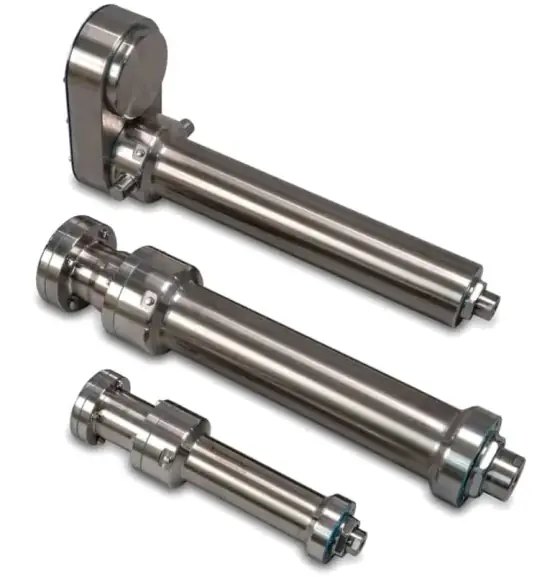
In short:An electric linear actuator turns a motor's rotation into straight-line motion, usually through a screw and nut (lead, ball or roller screw) or a toothed belt; a linear motor skips the conversion and drives the load directly. The mechanism sets force, speed, stroke, efficiency and whether the load can back-drive the motor, while the motor and feedback set how precisely it is controlled.
What an electric linear actuator is
An electric linear actuator produces straight-line push, pull or positioning from an electric motor. Almost every industrial design has the same chain:
- Motor: brushed DC, stepper, or brushless servo.
- Reduction (optional): a gearbox, worm gear or belt-and-pulley stage between motor and screw.
- Rotary-to-linear mechanism: a screw and nut, or a toothed belt and pulleys.
- Output: a rod that extends from a tube, or a carriage that runs along the body.
- Guidance and bearings: a thrust bearing to take the screw’s axial load, and guides that take side load.
- Feedback: limit switches, a potentiometer, Hall sensors or an encoder.
A linear motor is the exception: it creates force directly on the moving part, with no screw or belt.
The choice of mechanism fixes most of the actuator’s behaviour: force, speed, stroke, efficiency, accuracy, life and whether it holds position without power. For hands-on sizing, use how to size a linear actuator; this guide explains the mechanisms.
Lead screws, ball screws and roller screws compared
A screw converts one motor revolution into one lead of travel. A 10 mm lead screw moves the nut 10 mm per turn. Force and torque are linked by the lead and efficiency: drive torque T = F × P / (2000 × π × η), with F in N, lead P in mm and T in Nm (Linear Motion Tips).
| Lead (acme/trapezoidal) screw | Ball screw | Planetary roller screw | |
|---|---|---|---|
| How the nut works | Slides on the thread (plastic or bronze nut) | Rolls on recirculating balls | Threaded rollers orbit between screw and nut |
| Efficiency | 20–80% (Thomson); about 40% for acme (Moog) | Above 90% (Thomson); 85–95% (Moog) | 75–90% (Moog) |
| Back-driving | Resists below about 50% efficiency | Back-drives; needs a brake on vertical axes | Back-drives; needs a brake |
| Duty cycle | Plastic and stainless typically to 50% at rated load; bronze can fall to 10% | Practically unlimited | Continuous, heavy duty |
| Load capacity | Plastic nuts light; bronze to several thousand pounds | Equal or better than lead screws | Highest for size; Moog’s 25 mm, 2 mm lead screw is rated 64 kN dynamic |
| Noise | Very quiet | Noisier, from ball recirculation | Moderate |
| Typical use | Low-cost, intermittent, self-locking axes | General industrial positioning | High force, shock and high-cycle axes |
Lead screws suit low-cost DC actuators, medical and furniture products, and set-up axes. Friction heats the nut, which is why duty cycle is limited: Thomson notes bronze-nut assemblies may drop as low as 10% duty under heavy load.
Ball screws are the industrial default for servo and stepper actuators. Higher efficiency means a smaller motor and cooler running. Long screws are limited by critical speed (screw whip), which falls with unsupported length.
Roller screws carry more load in the same diameter because the rollers give many more contact points, which Moog links to higher load capacity, longer life and higher axial stiffness. They are the usual route for replacing hydraulic cylinders; see hydraulic to electric actuator and ball screw vs roller screw.
Belt-driven actuators
A timing belt runs between a drive pulley and an idler, with the carriage clamped to it. Travel per motor revolution equals the pulley’s pitch circumference, typically 60 to 170 mm, so belts are fast but need more torque (or a gearbox) for a given force.
Tolomatic’s own comparison of its screw and belt rodless actuators (Tolomatic):
| Screw drive | Timing belt drive | |
|---|---|---|
| Speed | Up to about 1.3–1.5 m/s, limited by critical speed | Up to about 5 m/s |
| Stroke | Up to about 3 m | Over 5 m standard |
| Thrust | Up to about 12 kN | Up to about 1.4 kN |
| Unidirectional repeatability | ±0.013 mm | ±0.05 mm |
| Back-driving | With some leads | Always |
Glikin at Tolomatic sums it up: belts for long stroke, high velocity and high acceleration; screws for moderate stroke and speed where accuracy matters (Tolomatic blog). More in rodless belt vs screw actuators.
Linear motors: direct drive
A linear motor is a servo motor unrolled flat (or into a tube). The coil assembly, or forcer, rides on the carriage, and the magnet track lies along the stroke. With no mechanical transmission there is no backlash, and Parker’s engineers say response can be more than 100 times that of a mechanical transmission, with typical speeds of 3 m/s at 1 micron resolution (Process Online).
The trade-offs:
- Force density is low. Parker gives the example of a linear motor producing about 65 N continuous in a 50 × 40 mm cross-section, while a 10 mm ball screw produces over 400 N.
- Heat goes into the load, because the forcer is attached to the carriage.
- Iron-core motors give the most force and cost least but have cogging and a magnetic attraction of up to about ten times continuous thrust, which the bearings must carry. Ironless (air-core) motors have no cogging or attraction but less force and poorer thermal performance.
- No holding force when de-energised, so vertical axes need a brake or counterbalance (Machine Design).
Linear motors pay off on fast, light, precise axes such as pick-and-place, inspection and semiconductor stages. See how to select a linear motor.
Rod vs rodless actuators
- Rod actuators push and pull through a rod extending from a sealed tube, like a pneumatic or hydraulic cylinder. They suit pressing, lifting, clamping and anything reaching into a machine. The rod should be guided externally if side loads are present.
- Rodless actuators drive a carriage along the body. Tolomatic notes that the stroke lies entirely within the body length, giving a smaller working footprint, and that rodless actuators carry the load rather than push it, which can remove separate guides (Tolomatic). Check pitch, roll and yaw moments on the carriage bearings: Tolomatic’s example is a 30 lb load at 3 in offset giving a 90 in-lb pitch moment.
Motors and feedback
| Motor | Typical feedback | Where it fits |
|---|---|---|
| Brushed DC (12/24 V) with gearbox | Limit switches; potentiometer or Hall sensor option | Low-cost OEM, mobility, agricultural, marine, medical |
| Stepper (often integral to the screw) | Open loop, or encoder for closed loop | Short-stroke, low-to-moderate speed positioning |
| Brushless servo | Motor encoder; optional linear encoder | Industrial positioning, force control, high duty |
| Integrated servo | Built-in encoder and drive | Compact servo axes with less cabinet wiring |
For DC actuators, Progressive Automations explains the options: potentiometers give absolute position at start-up but have sliding contacts that wear; Hall-effect sensors count pulses from a magnet on a gear, giving finer resolution but needing a homing run; limit switches stop the motor at the ends but give no position in between (Progressive Automations).
Duty cycle matters most on DC actuators. Thomson’s Electrak HD, for example, is rated at 25% full-load duty at 25 °C on most models (Thomson). Servo actuators are usually rated for continuous duty within their thermal limits. See servo vs stepper for the motor choice.
Efficiency and back-driving
Efficiency decides two things: how much motor torque you need, and whether the load can drive the motor backwards when power is off.
- Thomson: a lead screw becomes back-drivable once its efficiency exceeds 50%; ball screws are back-drivable because of their high efficiency (Thomson).
- Tolomatic: belt drives always back-drive, and vertical belt drives need brakes (Tolomatic).
Rule of thumb: never rely on screw friction to hold a suspended load where a drop would hurt someone or damage the machine. Vibration can creep a nominally self-locking screw, and lubricant changes friction. Specify a spring-applied brake, sized on the back-driving torque, and treat the screw’s resistance as a bonus.
Worked example: a vertical lift axis
Duty: lift a 50 kg tool vertically at 200 mm/s, accelerating at 2 m/s². Stroke 400 mm.
Force: gravity 50 × 9.81 = 490.5 N; acceleration 50 × 2 = 100 N; total 590.5 N during the upward acceleration.
Ball screw, 10 mm lead, η = 0.9:
- Torque T = 590.5 × 10 / (2000 × π × 0.9) = 1.04 Nm
- Screw speed = 200 / 10 = 20 rev/s = 1,200 rpm
- Mechanical output 590.5 × 0.2 = 118 W; motor output about 131 W
- At rest, gravity alone back-drives the screw with roughly 490.5 × 10 × 0.9 / (2000 × π) ≈ 0.7 Nm at the motor. A brake is mandatory.
Lead screw, 10 mm lead, η = 0.35:
- Torque = 590.5 × 10 / (2000 × π × 0.35) = 2.69 Nm, about 2.6 times the ball screw
- Motor output about 337 W, of which some 219 W becomes heat in the nut. At that loss, duty cycle limits bite hard.
- At 35% efficiency it should resist back-driving, but add a brake anyway for a suspended tool.
Belt drive: fast enough, but it always back-drives and has limited thrust. Brake essential, and check belt stretch under a hanging load.
Linear motor: it must produce 490.5 N continuously just to hover, all of it as heat in the carriage. That exceeds the continuous rating of many compact iron-core motors, so a pneumatic counterbalance and a brake would be needed.
Verdict: a ball screw rod or rodless actuator with a servo motor, a holding brake sized above 0.7 Nm with margin, and a check of the screw’s critical speed at 1,200 rpm over a 400 mm stroke.
Products in our range to consider
These are available through our supply network:
- Tolomatic RSA-ST: general-purpose rod actuator with lead, bronze or ball screws, up to about 17.9 kN and 1,524 mm stroke.
- Tolomatic RSA-HT: high-thrust version with planetary roller screw options, up to 58 kN.
- SRB Linear Servo Actuator: ball-screw servo electric cylinder in seven frame sizes, up to about 49 kN.
- Tolomatic B3W: belt-drive rodless actuator for strokes to 14.6 m and speeds to 5 m/s.
- LB Belt-Drive Linear Actuator: steel-belt module to 3,050 mm stroke and 2,000 mm/s.
- LA In-line Linear Actuators: 12/24 V DC lead-screw actuators up to 6,000 N, IP66 standard.
- DINGS captive linear stepper: hybrid stepper with integral anti-rotation lead screw, NEMA 11 to 34, up to 2,400 N.
- Akribis AJM iron-core linear motor: compact iron-core motor, up to 446.8 N continuous and 5 m/s.
Things that catch engineers out
- Sizing on average force and missing acceleration or process peaks.
- Forgetting the brake on a vertical ball screw or belt axis.
- Exceeding a lead screw’s duty cycle and cooking the nut.
- Side-loading a rod actuator that has no external guide.
- Long screws at high speed: critical speed falls with length.
- Linear motors on vertical axes without a counterbalance.
Checklist
Send these to our engineers, or enter them in the spec builder:
- Force: static, dynamic and peak, and direction (push, pull or both)
- Moving mass, orientation (horizontal, vertical, inclined) and any side or moment loads
- Stroke, speed, acceleration and move profile
- Duty cycle: moves per minute and hours per day
- Accuracy and repeatability required
- Whether the load must hold without power, and the consequences if it does not
- Supply: 12/24/48 V DC or mains AC; control interface
- Feedback needed: end of stroke, absolute position, encoder
- Environment: IP rating, washdown, temperature, dust
- Mounting: rod or rodless, envelope and fixing
For the full family, see the linear actuators hub and how to select a linear actuator.
Frequently asked questions
How does an electric linear actuator work?
An electric motor turns a screw, or a pulley driving a belt, and a nut or carriage on that screw or belt converts the rotation into linear travel. On a rod actuator the nut pushes a rod in and out of a tube; on a rodless actuator it drives a carriage along the body. Gearing between motor and screw trades speed for force, and feedback devices report position to the controller.
What is the difference between a lead screw and a ball screw actuator?
A lead screw nut slides on the thread, so friction is high: Thomson puts lead screw efficiency at 20 to 80%, depending mainly on helix angle. A ball screw nut rolls on recirculating balls, typically above 90% efficient, and runs at practically unlimited duty cycle. Lead screws are quieter, cheaper and can resist back-driving; ball screws need less motor torque, run cooler and last longer under load.
Can an electric linear actuator hold its position without power?
It depends on the screw. Thomson notes a lead screw becomes back-drivable once its efficiency exceeds 50%, so low-efficiency lead screws tend to hold a load. Ball screws are back-drivable because they are efficient, and belt drives always back-drive, so both need a motor brake for vertical or inclined axes. Linear motors have no holding force when de-energised.
When should I use a roller screw instead of a ball screw?
Use a planetary roller screw when force, shock or life requirements exceed a practical ball screw in the space available. Moog says roller screws have a higher dynamic load rating than ball screws in smaller sizes, from a larger number of contact points, with efficiency of 75 to 90% against 85 to 95% for ball screws. They suit press-fitting, hydraulic replacement and high-cycle heavy axes.
Are belt-driven actuators accurate?
They are repeatable but less accurate and stiff than screws. Tolomatic quotes unidirectional repeatability of about ±0.05 mm for its timing belt actuators against ±0.013 mm for screw drives, and lead accuracy of 0.25 to 0.38 mm per foot (305 mm) for belts. Belts win on speed and stroke, reaching about 5 m/s and strokes over 5 m, with no screw critical speed limit.
What feedback do electric linear actuators use?
Simple DC actuators use end-of-stroke limit switches, with a potentiometer for absolute position or a Hall-effect sensor counting pulses, which needs a homing run. Stepper-driven actuators often run open loop or add an encoder. Servo-driven actuators use the motor encoder, or a linear encoder on the carriage when the screw's own error must be removed from the measurement.
Sources
- Thomson: Why lead screws are the best fit for many linear motion applications
- Moog: Planetary roller screws catalogue
- Tolomatic: Screw vs belt actuators
- Tolomatic: Electric rodless actuator tips
- Tolomatic (Igor Glikin): Selecting a rodless electromechanical actuator, belt vs screw
- Process Online (Parker): Linear motors complement today's linear motion technologies
- Machine Design (Matt Johnson): Applying tubular motors in traditional ballscrew applications
- Linear Motion Tips (Danielle Collins): How to calculate motor drive torque for ball screws
- Progressive Automations: Types of linear actuator feedback
- Thomson: Electrak HD linear actuators
Figures are summarised from the sources above and from manufacturers' published data on the date shown. Always confirm against the current datasheet for your exact part.