
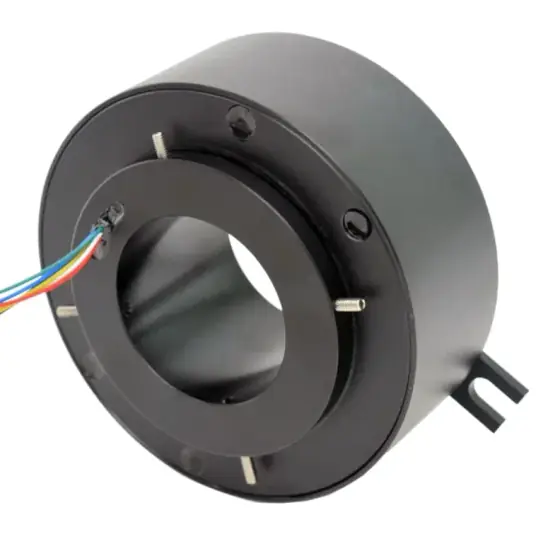
What the slip ring has to handle
- Heater power circuits on rotating drums or rolls
- Thermocouple or RTD signal circuits with appropriate contact materials or rotor-side transmitters
- Explosion-proof (ATEX/IECEx) designs for dust or gas zones
- Sealing and anti-condensation measures
- Low speed continuous duty
- Shielding and grounding for low-level signals
Typical figures
| Current | Up to 34 A per ring (ATEX example); 20 A heater circuits (thermocouple ring example) |
|---|---|
| Speed | Max 50 rpm (ATEX example) |
| Atex | Zones 21 and 22 (combustible dust) |
| Ingress protection | IP65 (ATEX example) |
| Circuits | Up to 32 rings (ATEX); up to 50 thermocouple channels (example) |
Example figures from the published sources listed below. Your requirement may differ; an engineer will confirm against your duty cycle.
Recommended slip ring types
Standards to consider
- ATEX Directive 2014/34/EU - equipment for explosive atmospheres
- IECEx - international certification for explosive atmospheres
- IEC 60584 - thermocouples
- IEC 60529 - IP code
The complete system
A slip ring rarely works alone. For mixers & process vessels it is usually specified together with:
- gear motor
- VFD
- temperature transmitter
- rotary union for heating media
- encoder
Specifying these together avoids mismatched connectors, cable routes and feedback interfaces, and gives you one point of contact for the whole axis.
Common problems to design out
- Thermocouple offset errors from dissimilar-metal junctions
- Noise on low-level signals
- Ingress of dust or moisture
- Brush wear in continuous operation
Frequently asked questions
Can thermocouples go through a slip ring on a mixer?
Yes, but standard copper rings with carbon brushes introduce offset errors. Match ring materials to the thermocouple type or fit a rotor-side transmitter.
Do process slip rings need ATEX certification?
In explosive dust or gas zones, yes. Explosion-proof slip rings are available for zones 21 and 22, with IP65 sealing and anti-condensation heaters.
Are wireless sensors an alternative?
For low-rate temperature monitoring, wireless sensors can replace slip ring signal circuits. Heater power still needs a slip ring.
Sources
- https://www.b-command.com/en/products/atex-iecex-products/slip-ring-exd/
- https://www.moflon.com/showen66.html
- https://industrialmonitordirect.com/blogs/knowledgebase/j-type-thermocouple-slip-ring-selection-for-rotating-equipment
- https://bannerengineering.com/ca/en/solutions/other/slip-ring-replacement-with-wireless-solutions.html