
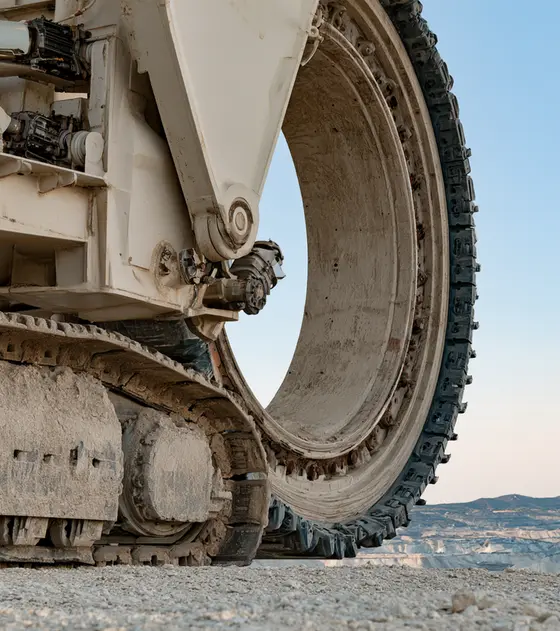
In short:Mining and construction machines need motion components that survive dust, water jets, shock and −40 °C starts while running from a 12/24 V battery or a site supply. Electric linear actuators are replacing small hydraulic cylinders on mobile machines, heavy slip rings carry power across slewing superstructures and cable reels, and every safety-related motion now has to be justified under ISO 19014.
Typical requirements
| Rugged mobile actuator (published example) | Up to 10 kN, 1,000 mm stroke, IP69K static, −40 to +85 °C (Thomson Electrak HD) |
|---|---|
| Mobile machine supply and bus | 12/24 V DC battery; SAE J1939 CAN on many actuators |
| Slip ring sealing for heavy plant | Up to IP68 for dusty, exposed sites |
| Heavy carbon-brush slip ring (catalogue example) | Up to 500 A per circuit, 20 kV, about 10 rpm |
| Bucket wheel machine slew bearings | Up to 8,000 mm solid or 12,000 mm segmented |
| Underground coal mines | ATEX/UKEX Group I, category M1 or M2 equipment |
| Control system functional safety | Machine performance level (MPL) under ISO 19014 |
Machinery we specify motion for
- Bucket wheel excavators and reclaimers
- Stackers and slewing conveyor plant
- Excavators and other slewing superstructures
- Bulldozers and earth-moving vehicles
- Roadwork and construction equipment
- Motor cable reels on mobile mining plant
- Aggregates and crushing plant
- Construction material test rigs
What motion in mining and construction has to survive
Mining and construction machines put motion components through some of the harshest duty in industry: abrasive dust, pressure washing, mud, shock from digging and tracking, temperature swings from a frozen start to a hot engine bay, and a supply that is often a 12 or 24 V battery. Downtime is expensive and the machine may be hours from a workshop, so robustness and easy diagnosis matter more than the last few percent of efficiency.
Component makers do publish for this sector, though usually at the level of the vehicle rather than the machine function. Thomson lists bulldozers among the vehicles it supplies actuators for. Kollmorgen describes motors for moving earth and positioning heavy materials in its mining and construction material. The detail below sticks to machines and figures we could check in public sources.
Where each motion component sits on the machine
| Machine | Motion | Usual component |
|---|---|---|
| Excavators, mobile cranes, slewing superstructures | Power and signals across continuous rotation | Slip ring at the slew centre |
| Bucket wheel excavators, stackers, reclaimers | Slew and cable reel power | Heavy slip rings, slew drives, cable reels |
| Earth-moving and roadwork vehicles | Hatches, vents, adjustments, small implements | 12/24 V electric linear actuators |
| Battery-electric machines and attachments | Auxiliary and robotic axes | Low-voltage servo motors and drives |
| Crushing, screening and conveying plant | Gate, gap and feed adjustment | Linear actuators, gearmotors, encoders |
| Material test rigs | High-force loading | Roller-screw servo actuators |
Slewing machines and slip rings
rotarX describes slip rings at the centre of rotation between the upper and lower structures of mobile cranes, excavators and fire appliances, and on bucket wheel excavators in opencast mining, with sealing up to IP68 for dusty, exposed sites. On a bucket wheel reclaimer the SOE notes slewing rings of around 20 m diameter, slew bearings up to 8,000 mm solid or 12,000 mm segmented, and slip ring bodies inside motor cable reels that suffer from corrosion and wear. That is the real failure mode to design against: not speed, which is slow, but water, dust and vibration getting into the contacts.
For high currents a frameless carbon-brush unit such as the BHR Series (catalogue figures up to 500 A per circuit, 20 kV, about 10 rpm) is the usual starting point. For mixed power and signals through a large bore, look at the Large Size Slip Ring range. See also large-diameter slip rings, high-current slip rings and slip rings for cranes and slewing.
Electric actuators on mobile machines
A rugged mobile actuator now covers a lot of ground. Thomson’s Electrak HD is published at up to 10 kN, 1,000 mm stroke and 75 mm/s, with IP69K, IP67 and IP66 ratings, −40 to +85 °C, 200 hours salt spray, optional SAE J1939 CAN, and roadwork and construction equipment among its stated uses. That sets a useful benchmark for what to ask of any off-highway actuator. See linear actuators and our guide on hydraulic to electric actuator conversion.
On fixed plant and in test labs the forces climb. Tolomatic lists a construction material test mechanism built on its RSX roller-screw actuator, and our RSX and RSA-HT records cover that class of hydraulic replacement.
Motors, drives and feedback
Battery-electric machines and electrified attachments use low-voltage servo motors and drives built for vehicle buses. Extended-environment drives such as ADVANCED Motion Controls’ FlexPro (−40 to +95 °C models) and the vehicle-mount versions of DigiFlex Performance are designed for that setting. For feedback on booms, slews and cylinders, prefer non-contact inductive or capacitive encoders, such as the Midi Ultra IncOder for large bores, over optical designs. Read absolute vs incremental encoders before choosing.
How to specify components for mining and construction
- Start from the supply. A nominal 24 V system can dip well below that during cranking and spike on load dump. Get the real range from the vehicle maker and check the actuator and drive both work and survive across it.
- State the ingress rating properly. IP69K covers close-range high-pressure hot water jets; IP67 covers temporary immersion. Ask for both if the machine is washed and works in standing water, and ask whether the rating is static or dynamic.
- Size for the worst case. Use breakout friction, ice, mud and shock, not the nominal load. A rule of thumb for screw actuators: pick a rated load at least 1.5 times the worst steady load, then check the shock rating separately.
- Decide on back-driving. Acme screws usually hold load when unpowered; ball screws usually do not and need a brake.
- Plan the safety case. Under ISO 19014-1, each safety-related control function on earth-moving machinery gets a machine performance level (MPL) from a control system safety analysis. It replaced ISO 15998 and ISO/TS 15998-2. Ask suppliers for failure data on any component in a safety function.
- Check hazardous areas. Underground mines with firedamp or coal dust need Group I equipment, category M1 (stays energised) or M2 (de-energised when an explosive atmosphere is detected). Group II equipment must not be used there.
EMC, vibration and cabling on mobile plant
Earth-moving machines have their own EMC standard, ISO 13766, published in two parts, and a machine maker will expect any drive or encoder to pass with the cabling you supply. In practice that means screened cables terminated the way the drive maker specifies, short high-current runs from drive to motor, and connectors rated for the same IP code as the device. Vibration is the other silent killer: crimped connections, unsupported cable loops and heavy connectors fatigue long before the actuator wears out. Ask for the vibration and shock profile the supplier has tested to, and compare it with what your machine actually sees.
Worked example: replacing a small hydraulic cylinder on a 24 V machine
A screening plant needs a gate adjuster: 4 kN worst-case load, 200 mm stroke, 10 mm/s, moved a few times an hour, running from 24 V.
- Mechanical power: 4,000 N × 0.010 m/s = 40 W.
- Screw choice: an acme screw holds the gate unpowered but is inefficient; assume about 35% for screw and gearing together, so the motor delivers about 115 W. A ball screw at about 80% needs about 50 W but needs a brake to hold.
- Current: with a motor efficiency of about 70%, the acme version draws roughly 165 W, or about 7 A at 24 V. Size cabling and fusing for the stall current, which can be several times that.
- Duty: many DC actuators are rated at 10–25% duty. A few moves an hour is fine; continuous hunting from a level controller is not.
- Environment: IP69K static and IP66 dynamic, −30 °C start, and a sealed connector.
The outcome is a 6 kN class 24 V acme actuator with built-in limit switches and position feedback. If the gate must move continuously, the answer changes to a ball-screw servo actuator with a brake and a drive.
Typical pitfalls
- Specifying IP67 when the machine is jet-washed. IP67 says nothing about high-pressure water.
- Ignoring cranking voltage. Drives that reset during engine start cause intermittent faults that are hard to trace.
- Slip rings without spare circuits. Electrification adds circuits; replacing a slew slip ring later means lifting the superstructure.
- Optical encoders on dirty axes. Use inductive, capacitive or magnetic sensing.
- Leaving the safety analysis until the end. Component choice depends on the MPL each function needs.
Send us the machine, axis, loads, supply and environment, and our specialist engineering and supply partners will propose matched actuators, slip rings, motors, drives and feedback.
Electric linear actuators for construction and mining machinery
Electric linear actuators take over small and medium hydraulic cylinders on mobile machines: vents, hatches, throttle and implement adjustment, plus heavy-thrust duties on fixed plant. On a vehicle, specify the battery voltage and its cranking dip, ingress rating (IP69K for jet washing), −40 °C start, shock, back-drive behaviour under load and whether you need J1939 or analogue feedback. On fixed plant and test rigs, roller-screw servo actuators replace hydraulics outright, at the cost of needing a servo drive and cooling at high duty. Size from the worst-case load including breakout and ice, not the nominal load.
- Earth-moving vehicles: hatch, vent and adjustment actuators on 12/24 V
- Crushing and screening plant: gate and setting adjustment
- Construction material test rigs: high-force servo loading
- Hydraulic replacement on fixed plant: no power unit or leaks
Available through our supply network
All linear actuators →Specify linear actuators for mining and construction →
Slip rings for excavators, slewing plant and cable reels
Any machine with a continuously rotating superstructure needs a slip ring at the centre of rotation: excavators, bucket wheel machines, stackers, reclaimers and the cable reels that feed them. Specify each power circuit's current and voltage, signal and bus channels, rotation speed (often only a few rpm), through-bore for hydraulics, and sealing for dust and washdown. Carbon-brush designs carry hundreds of amps at high voltage but need planned brush maintenance; precious-metal rings suit signals. Allow for corrosion, vibration and temperature swings outdoors, and say if the site is a hazardous area.
- Excavators: power and CAN across the slewing ring
- Bucket wheel machines: power to the superstructure and boom
- Cable reels: power and control to mobile mining plant
- Stackers and reclaimers: slew-axis power and signals
Available through our supply network
All slip rings →Specify slip rings for mining and construction →
Motors for mining and construction equipment
Battery-electric and hybrid machines use low-voltage brushless servo motors for auxiliary axes, robotic tools and electrified attachments, while fixed plant uses mains AC servo motors. Choose IP65 or IP67 sealing with shaft seals, a brake for any axis that holds load, and absolute feedback so the machine knows its position at power-up. Torque density matters where the motor sits on a boom or in a tool head. De-rate continuous torque for high ambient temperature and dust-clogged cooling fins, and check bearing loads if the motor drives a pinion or pulley directly.
- Electrified attachments and tool heads: compact low-voltage servo axes
- Construction field robots: wheel and arm drives
- Crushing and conveying plant: servo-controlled adjustment
- Test rigs: AC servo motors on loading frames
Available through our supply network
All servo and stepper motors →Specify servo and stepper motors for mining and construction →
Servo drives for mobile machinery
A drive on a mobile machine must run from a battery bus that sags during cranking and spikes on load dump, survive vibration and wide temperatures, and talk CANopen or EtherCAT to the machine controller. Vehicle-mount and extended-environment drives are built for this; panel drives in a cabinet are not. Specify the bus voltage range, continuous and peak current, feedback type, STO or other safety function and the fieldbus. Fit drives close to the motor to shorten high-current cables, and plan EMC to ISO 13766 from the start.
- Battery-electric machines: traction-adjacent and auxiliary servo axes
- Electrified attachments: drive in the tool or boom
- Construction robots: compact multi-axis low-voltage drives
- Fixed plant: AC drives for servo actuators
Available through our supply network
All servo drives →Specify servo drives for mining and construction →
Encoders for heavy equipment
Heavy equipment needs position feedback that tolerates shock, vibration, mud and loose mounting. Non-contact inductive and capacitive encoders have no optics to contaminate, and large-bore rings fit around slew bearings and hollow shafts. For linear axes, capacitive or magnetic scales with wide mounting tolerances work where optical scales foul. Specify absolute or incremental output, interface (SSI, BiSS-C, CANopen via a converter), bore, temperature range, IP rating and the accuracy you actually need at the tool, not at the sensor. Mount the sensor where it is shielded from impact.
- Slewing superstructures: absolute angle around the slew ring
- Booms and arms: joint angle for machine control
- Hydraulic or electric cylinders: stroke position
- Crushers: gap setting feedback
Available through our supply network
All encoders and feedback →Specify encoders and feedback for mining and construction →
Gearboxes for mining and heavy plant
Servo gearboxes on heavy plant see shock loads, high radial loads from pinions and sprockets, and long running hours. Pick a planetary rated for the peak and emergency-stop torque, check radial and axial load at the output against the pinion force, and specify IP65 sealing and a lubricant suited to the temperature range. Right-angle versions save length on booms and conveyors. For slew drives, the gearbox usually drives a pinion on a large slewing ring, so the system ratio is the gearbox ratio times the ring-to-pinion ratio.
- Slew drives: gearbox and pinion on a slewing ring
- Conveyors and feeders: servo-driven indexing
- Test rigs: high-torque rotary loading
- Tool heads: right-angle drives in tight envelopes
Available through our supply network
All gearboxes and harmonic drives →Specify gearboxes and harmonic drives for mining and construction →
Motion controllers for construction robots and test rigs
Multi-axis machines such as construction robots, automated plant and test rigs need a controller that coordinates axes over EtherCAT and runs IEC 61131-3 code. Specify the axis count, cycle time, I/O, fieldbus to the vehicle or plant system, and any remote diagnostics. On mobile machines the safety-related parts of the control system are assessed under ISO 19014, so keep safety functions in rated hardware rather than in the motion program. Choose a controller with remote access if the plant is far from support, and log axis faults with timestamps so intermittent problems on site can be traced.
- Construction material test rigs: synchronised load and displacement axes
- Automated aggregates plant: coordinated gates and feeders
- Construction field robots: multi-axis motion
Available through our supply network
All controllers and plcs →Specify controllers and plcs for mining and construction →
Standards to have in view
- ISO 19014 series (earth-moving machinery: functional safety, MPL), replacing ISO 15998 and ISO/TS 15998-2
- ISO 13766-1 and -2 (earth-moving machinery: electromagnetic compatibility)
- ISO 12100 (safety of machinery: risk assessment)
- ATEX 2014/34/EU and UKEX (Group I equipment for mines)
- EN 1710 (equipment and components in potentially explosive atmospheres in underground mines)
- IEC 60529 (IP codes) and ISO 20653 (IP6K9K-style codes for vehicle equipment)
Which standards apply depends on the end product and its market. Your engineer will confirm what the component itself needs to meet.
Frequently asked questions
Can electric actuators replace hydraulic cylinders on construction machinery?
For many auxiliary functions, yes. Rugged 12/24 V actuators now reach about 10 kN with IP69K sealing and −40 to +85 °C ratings, and they remove hoses, leaks and a pump running all day. Main digging, lifting and steering functions with tens or hundreds of kilonewtons and shock loads usually stay hydraulic on mobile machines. On fixed plant and test rigs, roller-screw servo actuators reach far higher forces.
What IP rating do I need for an actuator on mining equipment?
For equipment that is pressure-washed, specify IP69K, which covers close-range high-pressure, high-temperature water jets, together with IP67 for temporary immersion. Check whether the maker quotes the rating as static or dynamic, because seals behave differently when the rod is moving. Dust-tight (first digit 6) is the minimum for mines and quarries. Ask how the cable entry and connector are sealed, as they often fail first.
Do I need ATEX equipment for a mining machine?
Only if it works where an explosive atmosphere can occur. Underground mines with firedamp or coal dust need Group I equipment: category M1 stays energised in an explosive atmosphere, while M2 must be de-energised when one is detected. Surface plant with other gases or dusts uses Group II. Equipment certified Group II must not be used underground in a Group I mine.
What replaced ISO 15998 for earth-moving machine control systems?
ISO 19014. Part 1 sets out a machine control system safety analysis that rates each safety-related control function with a machine performance level (MPL), and it replaced ISO 15998:2008 and ISO/TS 15998-2:2012. Other parts cover architecture, environmental testing and software. Component suppliers should give you failure data and diagnostic information for anything that forms part of a safety function.
What slip ring suits an excavator or slewing machine?
A through-bore or frameless slip ring at the slew centre, sized for every power circuit's current and voltage plus spare circuits, with signal or bus channels for CAN or Ethernet. Rotation is slow, so speed is rarely the limit; sealing, vibration and corrosion are. Carbon-brush designs suit high currents. Leave room in the bore for hydraulic swivels and say whether the machine is washed down.
What should I send for a mining or construction motion enquiry?
Send the machine type and axis, load and stroke or torque and angle, speed and duty cycle, supply voltage and its range, control interface (J1939, CANopen, analogue), feedback needed, environment (IP, temperature, washdown, vibration, shock), any hazardous-area zone or Group I requirement, the safety function and MPL if known, envelope and mounting, and expected annual volume.
Sources
- Automation.com: Thomson introduces Electrak HD linear actuators
- Thomson: Industry applications
- rotarX: Slip rings in crane technology and heavy equipment
- Society of Operations Engineers: Bucket wheel reclaimers, maintenance and support
- SIS: ISO 19014-1:2018 Earth-moving machinery, functional safety, Part 1
- BSI: PD ISO/TS 15998-2 Earth-moving machinery machine control systems
- ATEXshop: Equipment groups I and II
- Kollmorgen: Mining and construction
- Tolomatic: Lumber and woodworking applications (construction material test mechanism)
Figures are summarised from the sources above and from manufacturers' published data on the date shown. Always confirm against the current datasheet for your exact part.