
In short:For splash, washdown and shallow immersion, a sealed slip ring rated IP67 or IP68 to a stated depth and time is enough. Below a few metres, or for continuous deep immersion, use a pressure-compensated, oil-filled design so the seals see almost no pressure difference, and choose housing materials and fasteners for seawater from the start.
Wet, submerged or deep: three different problems
“Waterproof slip ring” covers three quite different requirements, and most specification problems come from treating them as one:
- Wet but not submerged: rain, spray, condensation, washdown on food lines or decks. A sealed housing with an IP rating such as IP65 to IP67 handles it.
- Shallow or temporary immersion: equipment that may be flooded, fountains, tanks, tidal zones, splash zone on vessels. IP67 or IP68 to a stated depth and time.
- Deep or continuous subsea: ROV and AUV equipment, subsea tooling, manipulators, sensor heads. Here the water pressure, not just wetness, is the design driver, and pressure-compensated designs are usual.
This guide works through each. For the wider subsea system (thrusters, manipulators, tether management), see our subsea ROV and AUV page.
The decisions, in order
- Exposure: wet, temporary immersion, continuous immersion, and the maximum depth.
- Sealing approach: IP-rated sealed housing or pressure-compensated, oil-filled design.
- Seals: rotating shaft seals, static seals, cable and connector entries.
- Materials: housing, shaft, fasteners and contacts, for fresh water, seawater or chemicals.
- Electrical: power, signal and data circuits, and whether they must work in oil.
- Mechanics: speed, duty, envelope, mass and mounting.
- Testing: which pressure, immersion and electrical tests the unit must pass before shipping.
Step 1: what IP67 and IP68 actually mean
IEC 60529 defines the second IP digit for water. HELUKABEL’s summary of the standard (HELUKABEL):
| Code | Meaning | Test condition |
|---|---|---|
| IPX7 | Protected against temporary immersion | Enclosures under 850 mm tall: lowest point 1 m below the surface, for 30 minutes |
| IPX8 | Protected against continuous immersion | Conditions agreed between manufacturer and user, more severe than IPX7; depth set by the manufacturer, usually a maximum of 3 m |
Two consequences for slip rings:
- IP68 is not a depth rating. Two IP68 slip rings can have very different depth and time limits. Always ask for the actual depth, duration and whether the test was done rotating or stationary.
- IP tests are short and usually static. A rotating seal on a machine that runs for years behaves differently. Ask what life the supplier expects at your speed and water exposure.
Step 2: sealed housing or pressure-compensated?
Water pressure rises by roughly 1 bar for every 10 m of seawater. A sealed, air-filled slip ring at 100 m has around 10 bar trying to push water past its rotating shaft seal, and the seal friction, wear and leakage risk rise with that difference.
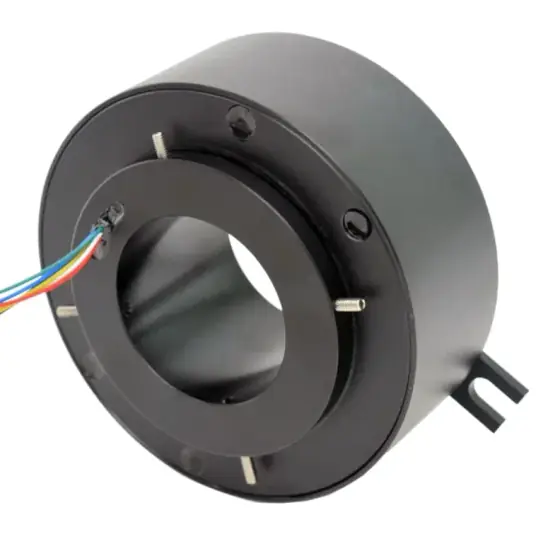
Sealed (air-filled) designs keep the slip ring dry inside with lip seals, O-rings and sealed cable entries. They are simpler, lighter and well suited to wet environments and shallow immersion. The waterproof slip ring in our range, for example, is rated from IP64 to IP68 for ships, harbour equipment and moist environments.
Pressure-compensated designs fill the slip ring with an insulating oil and connect it to a compensator, a flexible element that lets seawater pressure act on the oil. Internal and external pressures stay nearly equal at any depth, so the seals only have to keep water out, not hold back the depth pressure. Examples from public datasheets:
- Macartney’s Focal Model 176 slip ring is offered fluid-filled and pressure compensated, in 304 stainless steel with 316 as an option, rated to 50 rpm continuous, with fill fittings or factory filling (Macartney).
- UEA describes a winch slip ring where an oil-filled, pressure-balanced cable acts as the compensating reservoir, with valves keeping the unit about 5 to 10 psi above ambient so any leakage is oil going out rather than water coming in (UEA).
- Macartney’s fluid-filled, pressure-compensated FORJ Model 300 versions are rated to 10,000 psi (about 690 bar) (Macartney).
When to switch to compensation: as a rule of thumb, once the depth is beyond what the supplier will state for an IP68 unit with your duty cycle, or when the unit will be submerged continuously for long periods, specify compensation. In practice that means almost everything mounted on an ROV or AUV.
What compensation adds
- A compensator sized for the oil’s volume change with temperature and pressure. UEA notes the reservoir volume depends on operating depth and temperature range.
- A filling and bleed procedure: air left inside will compress at depth and draw water in.
- Oil-compatible materials for insulation, seals and wire.
- Electrical effects of the oil on contact behaviour and on data and video circuits, which should be tested in the final fluid.
- Pressure-balanced oil-filled (PBOF) cables or subsea connectors at the entries.
Step 3: seals
- Rotating shaft seal: the critical one. Ask for its type, material, rated pressure difference and expected life at your speed.
- Static seals: housing joints and covers, usually O-rings. Choose elastomers that suit seawater, the fill oil and the temperature range.
- Cable and connector entries: often the weakest point. Moulded or potted entries, subsea connectors or PBOF hoses, rather than standard glands on deep equipment. Macartney’s Model 176, for example, is sealed to IP66 except at the pigtail exits, which can be sealed, with IP67 or IP68 as an option (Macartney).
- Bearing protection: bearings in water-exposed designs need their own seals or corrosion-resistant materials.
Step 4: materials and corrosion
Seawater, splash zones and washdown chemicals are all aggressive. Things to settle with the supplier:
- Housing: 316 stainless steel is common on marine and subsea units (Moog’s FPS marine swivels have a stainless steel exterior, and its brochure lists seawater-resistant aluminium or stainless steel for rotary unions) (Moog). Titanium suits long immersion and weight-sensitive vehicles; hard-anodised aluminium suits lighter, shorter-duty equipment with good coatings.
- Galvanic corrosion: stainless fasteners in aluminium, or a stainless slip ring bolted to an aluminium frame, need insulation. Agree any cathodic protection or anodes with the vehicle designer.
- Crevice corrosion: stainless steels can corrode in tight, oxygen-starved gaps such as under seals and flanges in seawater. Design out crevices, or choose a more resistant alloy.
- Contacts: precious-metal contacts for signals; the supplier will choose the power contact materials to suit the fluid and current.
Step 5: electrical and data
- Power: current and voltage per circuit, as for any slip ring, but with heat dissipation limited when the unit is oil-filled or in a sealed housing. Macartney gives the Model 176 at 20 A per pass and 7,200 VAC maximum, with total current dependent on duty cycle, ambient temperature and configuration (Macartney).
- Data: Ethernet, video and serial links need rings designed and tested for them. For long tethers and high bandwidth, fibre is usual; see how to select a fibre optic rotary joint and Ethernet through slip rings.
- Insulation and leakage monitoring: on high-voltage tethers, ask how insulation resistance is tested and whether water ingress can be detected.
Worked example: a pan-and-tilt camera head on an inspection ROV
Requirement: An inspection ROV rated to 300 m carries a continuous-pan camera and light head. The pan axis needs 24 V power (two circuits at 3 A), an RS485 control pair and a 100 Mbit Ethernet link from an IP camera. Pan speed up to 30 rpm, intermittent. Seawater, −2 to +30 °C. Mass and size matter.
Depth pressure: 300 m × roughly 1 bar per 10 m ≈ 30 bar. That is far beyond what any supplier will state for a typical IP68 test, and the head will be submerged for whole dives.
Sealing approach: a pressure-compensated, oil-filled slip ring, with the compensator volume sized by the supplier for 300 m plus margin and the full temperature range.
Seals and entries: a single rotating seal that only needs to exclude water at near-zero pressure difference; subsea connectors or PBOF hose at both ends rather than glands.
Materials: the vehicle frame is aluminium and the head is hard-anodised aluminium, so either an anodised aluminium housing or a titanium housing with isolating washers, not bare stainless steel bolted to aluminium.
Circuits: 2 power, 1 RS485 pair, 2 pairs for 100 Mbit Ethernet, plus 2 spares: 9 circuits, with the Ethernet rings tested in the fill oil.
Specification to send: depth 300 m (with the proof-test pressure set by the vehicle’s test standard), oil-filled and compensated, 30 rpm intermittent, nine circuits as listed, subsea connectors, housing material and isolation stated, −2 to +30 °C, mass target.
Products in our range to consider
- Waterproof slip ring: sealed rings rated IP64 to IP68, up to 44 circuits, bores 8 to 127 mm, to 600 rpm, for ships, harbour equipment and moist environments.
- ER Series through-bore slip ring: through-bore rings with waterproofing to IP68 and corrosion-resistant options, bores 12.7 to 100 mm.
- AR/BR/CR Series capsule slip rings: compact capsules from 5.5 mm OD, IP51 standard with an IP68 option, for small sensor heads.
- FR Series fibre optic rotary joint: 1 to 50 optical channels, sealing up to IP68, for high-bandwidth tether data.
- BHR Series frameless carbon brush slip ring: heavy-current rings for offshore cranes, ship machinery and cable reels, with optional IP54.
- Ethernet slip ring: 100M or Gigabit channels with power, for deck equipment inside a sealed enclosure.
Depth-rated, pressure-compensated versions are specified per project; our engineers confirm what can be supplied for your depth.
What else the build needs
- Motor and drive, often pressure-compensated or in a sealed housing for subsea use. See servo and stepper motors, frameless torque motors and servo drives.
- Feedback that tolerates water, oil and shock, such as sealed magnetic, capacitive or inductive encoders. See encoders.
- Gearing, oil-filled or sealed. See gearboxes.
- Fibre optic rotary joint for high-bandwidth data across the rotation.
- Subsea connectors, PBOF hoses and compensators.
- Controller with leak and insulation monitoring. See motion controllers.
- Application context: slip rings for ROV and subsea and marine slip rings.
Things that catch engineers out
- Reading IP68 as a depth rating.
- IP tests done static, then the unit runs rotating for years.
- Air left in an oil-filled unit, which compresses at depth and draws water in.
- Compensator undersized for the temperature range as well as depth.
- Weak cable entries on an otherwise good housing.
- Dissimilar metals bolted together in seawater without isolation.
- Data rings not tested in oil.
- Deck equipment specified like vehicle equipment, or the reverse: winch slip rings need spray and UV resistance, not 300 m depth.
Checklist
Send these to our engineers, or enter them in the spec builder:
- Exposure: wet, temporary immersion or continuous subsea
- Maximum operating depth and test pressure
- Fresh water, seawater, chemicals or washdown agents
- Sealed or pressure-compensated preference; fill fluid if specified
- Circuits: number, current, voltage, signal and data types
- Speed (rpm) and duty: continuous, intermittent or oscillating
- Envelope, bore, mass limit and mounting
- Housing material preference and adjoining materials
- Connectors, PBOF hoses or pigtails, with lengths
- Temperature range in operation and storage
- Tests required: pressure, immersion, insulation, data
- Quantities and timing
For the wider family, see our slip rings overview.
Frequently asked questions
What is the difference between IP67 and IP68 for a slip ring?
Under IEC 60529, IPX7 means protected against temporary immersion, tested at 1 m below the surface for 30 minutes for most enclosures. IPX8 means protected against continuous immersion under conditions agreed between manufacturer and user that are more severe than IPX7. IP68 is therefore not a depth rating on its own: always ask the supplier for the depth and duration behind it.
How deep can an IP68 slip ring go?
Only as deep as the manufacturer states. IP68 conditions are agreed case by case, and HELUKABEL notes the depth specified is usually a maximum of 3 m. Rotating seals hold a pressure difference only up to a point and wear faster as it rises. For tens or hundreds of metres, specify a pressure-compensated design and a depth rating in metres or bar.
What is a pressure-compensated slip ring?
It is a slip ring filled with oil and connected to a compensator, such as a bladder, bellows, piston or oil-filled cable, that lets outside water pressure act on the oil. Inside and outside pressures stay almost equal at any depth, so the seals only have to exclude water rather than resist the full depth pressure. Many designs hold a small internal overpressure so any leakage is oil going out.
Which housing material is best for a subsea slip ring?
It depends on depth, life and what else is on the vehicle. 316 stainless steel is common, with titanium used where weight, long immersion or crevice corrosion matter, and hard-anodised aluminium on lighter, shorter-duty equipment. Whatever the choice, avoid mixing dissimilar metals without isolation, match fasteners to the housing, and agree any cathodic protection with the vehicle designer.
Can Ethernet or video pass through an oil-filled slip ring?
Yes, with circuits designed and tested for it. The oil changes contact behaviour and signal characteristics, so data rings for Ethernet or video in oil-filled units should be specified and tested in their final fluid. For high bandwidth over long tethers, fibre optic rotary joints are common; they can also be fluid-filled and pressure-compensated for subsea use.
Where are subsea slip rings used?
On ROV tether management systems and launch winches, subsea manipulators and pan-and-tilt camera or sonar heads, AUV and towed sensor systems, cable reels and swivels on offshore vessels, and rotating subsea tooling. The surface winch slip ring usually needs IP-rated sealing against spray and washdown; anything on the vehicle itself needs a depth-rated design.
Sources
- HELUKABEL: Water and dust IP ratings, what does IP68 mean? (IEC 60529 summary)
- Macartney (Focal): Electrical slip ring Model 176 data sheet
- Macartney (Focal): FORJ Model 300 data sheet
- Moog: Slip ring and rotary solutions for marine, brochure
- UEA: Pressure-compensated slip ring for underwater winches
Figures are summarised from the sources above and from manufacturers' published data on the date shown. Always confirm against the current datasheet for your exact part.