
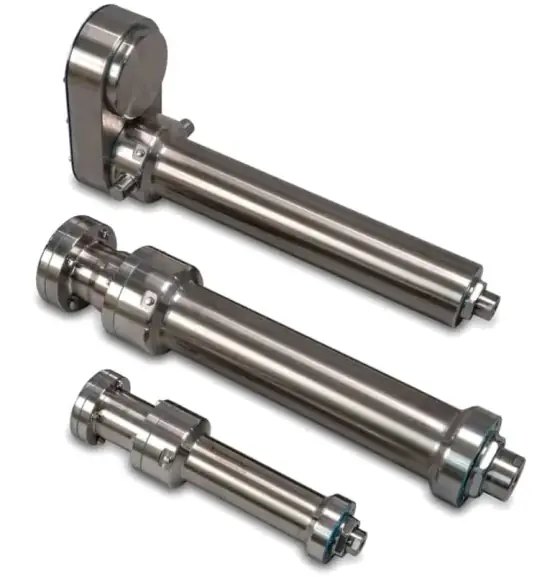
In short:Choose a voice coil when you need fast, smooth, cog-free motion over a few millimetres to a few tens of millimetres, or direct force control, because force is proportional to current. Choose a piezo motor when you need nanometre resolution, a position held with the power off and no heat at rest, or a non-magnetic or vacuum-compatible drive, and can accept lower force and speed.
Where these two technologies fit
Voice coils and piezo motors both sit at the precision, short-stroke end of linear motion, below linear motors and screw actuators. They solve different problems:
- Voice coil actuators are about dynamics and force: fast, smooth, cog-free motion and force set directly by current.
- Piezo motors are about resolution and stability: nanometre steps, positions held with the power off, no heat at rest and no magnetic field.
If the stroke is more than a few tens of millimetres, or the force is in the hundreds of newtons continuously, look at a linear motor or a screw actuator instead.
The selection sequence
- What matters most: speed and force control, or resolution and holding?
- Stroke and whether it is linear, rotary or limited-angle.
- Force: peak, continuous, and holding at rest.
- Resolution, repeatability and settling time.
- Environment: vacuum, cleanroom, magnetic fields, heat at the payload.
- Guidance and feedback: bearings or flexures, encoder or load cell.
- Drive and supply voltage.
Voice coil actuators
A voice coil is a coil in a permanent-magnet field. The Lorentz force is proportional to current and reverses with it, force is fairly constant along the stroke with minor drops at the ends, and there is no cogging, no commutation and very low hysteresis (Laser Focus World). Laser Focus World’s survey lists strokes up to about 134 mm and peak forces up to about 7 kN for moving-coil types, though most are much smaller.
Force and stroke
- Force: F = Kf × I, where Kf is the force constant in N/A. Check continuous force against the RMS of the cycle and peak force against the hardest acceleration or press, exactly as for any servo.
- Stroke: quoted stroke is usually the range over which force stays within a stated percentage of nominal. Leave margin at both ends.
- Heat: coil loss is approximately (F ÷ Km)², with Km the motor constant in N/√W (Machine Design). Holding a force continuously, even at zero speed, costs heat.
Moving coil vs moving magnet
Magnetic Innovations sets out the trade-offs (Magnetic Innovations):
| Moving coil | Moving magnet | |
|---|---|---|
| Moving mass | Lowest | Higher (magnets move) |
| Heat path | Coil heat goes into the payload; coil hard to cool | Static coil cooled through the housing |
| Cables | Flex with every stroke | Static |
| Sealing | Harder | Can be fully encapsulated |
| Typical uses | Optics, beam steering, fastest light-load moves | Valves, pumps, mechatronics, dirty or sealed environments |
In their example comparison of similar-stroke units, the moving-magnet unit had a thermal resistance of 2.0°C/W against 7.1°C/W for the moving-coil unit, so it could sustain more continuous force; treat that as one maker’s example, not a rule.
Flat (planar) voice coils are also made for integration into low-profile linear stages.
Guidance and feedback
A bare voice coil has no bearing. You need guidance: integral shaft bearings (common on moving-magnet units), linear guides, air bearings or flexures. PI offers both mechanical and wear-free flexure guiding on its voice coil stages (PI). Flexures remove friction and are ideal for very short, high-cycle strokes.
For position control, add a linear encoder. For force control, current alone often suffices because force is proportional to current; add a load cell where the tolerance is tight.
Piezo motors
A piezo motor uses piezoceramic elements that vibrate or step to drive a runner, rod or rotor by friction. Unlike a simple piezo stack, which moves only tens to hundreds of micrometres, a piezo motor gives long travel, limited by the runner. PI groups them into three principles (PI):
| Type | Speed | Force | Resolution | At rest |
|---|---|---|---|---|
| Ultrasonic (resonant) | Hundreds of mm/s | About 3–20 N | Sub-µm to nm | Self-locking |
| Stick-slip (inertia) | Up to about 10 mm/s | About 1–20 N | nm range | Self-locking |
| Stepping (walking) | About 1–60 mm/s | About 10–600 N | nm to pm range | Self-locking |
Resolution and holding
Piezo motors resolve to the nanometre, and PI states its stepping drives hold position to nanometre level in power-off mode, with no current and no heat at the target (PI brochure). That combination, a position held indefinitely without power, heat or servo dither, is what voice coils and linear motors cannot offer. Holding force is finite: PI’s compact ultrasonic motors list a few newtons to around 15 N, and its larger stepping drives up to hundreds of newtons.
Voltage and drive
Drive voltages vary by principle. PI’s ultrasonic motors run at about 120 to 200 V peak-to-peak from dedicated controllers, its stick-slip drives at under 50 V, and its stepping drives at 45 V and below (PI brochure). Some compact rotary piezo motors in our catalogue data run from 12 V. Piezo drivers generate specific waveforms, so treat the motor and driver as a matched pair.
Environment
PI describes its ultrasonic and stepping drives as non-magnetic and vacuum-compatible, producing no magnetic field and unaffected by one. That makes piezo motors a natural fit for electron microscopes, MRI-adjacent equipment, ultra-high vacuum and beam lines, where a magnet-based motor would disturb the process.
Limits
- Lower force and speed than electromagnetic motors of similar size
- Friction drive: performance depends on preload and contact surfaces; check life in your duty cycle
- Usually need an encoder for closed-loop positioning to the nanometre
- Small holding force compared with a brake on a screw axis
Voice coil vs piezo: decision guide
| If you need… | Choose |
|---|---|
| Fast step-and-settle over millimetres | Voice coil |
| Programmable force, soft landing, force testing | Voice coil |
| Oscillation, vibration, scanning at frequency | Voice coil |
| Nanometre positioning held for hours | Piezo motor |
| Position held with power off, no heat at rest | Piezo motor |
| Vacuum or strong magnetic field | Piezo motor |
| Lowest moving mass with high acceleration | Moving-coil voice coil |
| Sealed, heat-sensitive payload | Moving-magnet voice coil |
Worked example: a force-controlled test probe
Application: a vertical probe presses on a pressure-sensitive device under test. It moves down 5 mm in 20 ms, presses with 5 N for 100 ms, returns in 20 ms and waits 60 ms. Cycle 200 ms (5 per second). Moving mass (coil, shaft, probe) 50 g.
Technology choice: programmed force and fast cycling point to a voice coil. A piezo motor could manage the force but would need a separate load cell to control it, and friction drive wear at 10 moves a second would need checking.
Move profile (1/3 trapezoid):
- v = 1.5 × 0.005 ÷ 0.020 = 0.375 m/s
- a = 0.375 ÷ 0.00667 ≈ 56 m/s²
- Acceleration force: 0.05 × 56 ≈ 2.8 N; gravity: 0.05 × 9.81 ≈ 0.49 N
Motor forces (magnitude; gravity helps going down and opposes going up):
| Segment | Force | Time |
|---|---|---|
| Down, accelerate | 2.8 − 0.49 = 2.31 N | 6.7 ms |
| Down, cruise | 0.49 N (holding against gravity) | 6.7 ms |
| Down, decelerate | 2.8 + 0.49 = 3.29 N | 6.7 ms |
| Press | 5.0 − 0.49 = 4.51 N | 100 ms |
| Up, accelerate | 3.29 N | 6.7 ms |
| Up, cruise | 0.49 N | 6.7 ms |
| Up, decelerate | 2.31 N | 6.7 ms |
| Wait | 0.49 N | 60 ms |
RMS ≈ 3.4 N; peak ≈ 4.5 N (during the press, not the moves).
Selection: continuous force of at least about 4.2 N (25% margin on RMS, as a rule of thumb), peak comfortably above 5 N, and a stroke of 8 to 10 mm so the 5 mm move stays in the flat part of the force curve. That is a small cylindrical voice coil. With an assumed Km of 2 N/√W (use the datasheet value), coil loss is about (3.4 ÷ 2)² ≈ 2.9 W.
Coil or magnet moving? The probe touches the device, so heat into the probe matters; a moving-magnet unit keeps the coil heat in the housing. If the device were not heat-sensitive, a moving-coil unit would give lower moving mass.
Feedback and control: a linear encoder for the approach, then switch the drive to current (force) control for the press. Add a load cell if the force tolerance is tighter than the force constant’s variation over the stroke.
Guidance: a flexure or precision shaft bearing; friction directly offsets the applied force.
What changes the answer: if the probe instead had to hold a fixed height to 10 nm for hours with no heat, a piezo stepping or stick-slip motor with an encoder would be the choice.
Products in our range to consider
- Akribis AVM Standard: cylindrical moving-coil voice coils in 12–90 mm frames, up to 95.6 N continuous and 40 mm stroke.
- Akribis AVM High-Force: cylindrical voice coils from 14 to 250 mm, over 1.1 kN continuous and 4.7 kN peak.
- Akribis AVA: flat, low-profile voice coils with 20 mm stroke for integration into linear stages.
- Piezo Motion RBS Rotary Piezo Motor: compact 12 V rotary piezo motor with self-braking holding torque, up to 0.03 Nm and 100 rpm.
- Piezo Motion RAS Rotary Piezo Motor: rotary piezo motor from the same family, self-braking at rest; figures on request.
- Leadshine ELD3 miniature DC servo drives: 24–70 V DC drives supporting voice-coil, linear and brushed motors, with a second encoder input.
- Novanta Capitan servo drives: 18 g micro servo drive for 8–60 V DC, 10 A continuous and 20 A peak.
For linear piezo motors, tell us the stroke, force and resolution and our supply network will propose options.
What else the build needs
- Drive: a servo drive that supports single-phase voice coil motors and current-mode force control, or the matched piezo driver; see servo drives.
- Feedback: a linear or rotary encoder at the resolution you need; see encoders.
- Guidance: flexures, shaft bearings, crossed-roller or air bearings.
- Load cell for tight force control.
- Controller: for force-position switching or synchronised scanning; see motion controllers.
- Cabling: high-flex leads on moving-coil units; vacuum-rated cabling where needed.
- Power supply: low-voltage DC for most voice coil drives; the piezo driver’s own supply.
- For the wider family, see the linear actuators hub.
Things that catch engineers out
- Forgetting gravity on vertical voice coils, which must carry the moving mass continuously.
- Using the full catalogue stroke, where force has already dropped at the ends.
- Heat into the payload from moving-coil designs.
- Guidance friction spoiling force control.
- Expecting a piezo motor to hold a heavy load; holding forces are modest.
- Mixing piezo motors and drivers from different designs.
- Running a piezo friction drive at a high duty without checking its life.
- Confusing resolution with accuracy: both technologies need an encoder and a stable structure to deliver nanometre accuracy.
Checklist
Send these to our engineers, or enter them in the spec builder:
- Linear, rotary or limited-angle, and orientation
- Stroke or angle
- Moving mass and payload
- Move profile: distance, time, dwell, cycle rate
- Peak, continuous and holding force (or torque)
- Force control required, and tolerance
- Resolution, repeatability and settling time
- Power-off holding requirement
- Environment: vacuum, cleanroom, magnetic field, temperature, heat limit at payload
- Supply voltage, drive and interface preference
Frequently asked questions
What is the difference between a voice coil actuator and a piezo motor?
A voice coil is an electromagnetic Lorentz-force device: a coil in a magnet field, with force proportional to current, no cogging and strokes up to a few tens of millimetres or more. A piezo motor uses vibrating piezoceramic elements to drive a runner by friction, giving nanometre resolution and self-locking at rest, but generally lower force and speed. Voice coils suit dynamics and force control; piezo motors suit fine, stable positioning.
Should I choose a moving coil or moving magnet voice coil?
Moving coil designs have the lowest moving mass, which gives the highest acceleration, but the coil's heat flows into the payload and its leads flex. Moving magnet designs keep the coil and cables static, dissipate heat through the housing and often come with integral bearings, at a higher moving mass. Choose moving coil for the fastest light-load moves and moving magnet for heat-sensitive payloads and sealed or dirty environments.
Can a voice coil actuator control force without a load cell?
Yes, within limits. Because voice coil force is proportional to coil current and there is no cogging and very low hysteresis, the drive's current loop sets force directly. Accuracy is limited by the force constant's variation over the stroke, friction in the guidance, and temperature. For tight force tolerances, add a load cell or calibrate force against current across the stroke.
Do piezo motors hold position with the power off?
Most do. PI's comparison describes ultrasonic, stick-slip and stepping piezo motors as self-locking at rest, and its stepping drives hold position to nanometre level in power-off mode with no current and no heat. Holding force is limited, typically a few newtons to tens of newtons for compact motors and up to hundreds of newtons for larger stepping drives. Check the datasheet's holding force against your load.
What voltage do piezo motors need?
It varies with type. PI's ultrasonic motors are driven at around 120 to 200 V peak-to-peak by dedicated controllers, while its stick-slip drives need under 50 V and its stepping drives operate at 45 V and below. Some compact rotary piezo motors run from 12 V. Always use the maker's matched driver, because the drive waveform is specific to the motor's design.
What applications use voice coil and piezo motors?
Voice coils are used for lens focusing, proportional valves, ventilator valves, pick-and-place with soft landing, force testing, vibration and oscillation, and fast short-stroke stages. Piezo motors are used for optical alignment, microscopy, photonics packaging, wafer inspection, cell manipulation, lab automation and vacuum or strong-magnetic-field environments where electromagnetic motors are unsuitable.
Sources
- Laser Focus World: What is a voice-coil actuator?
- Magnetic Innovations: Voice coil actuator vs moving magnet actuator
- PI: Overview of different piezo motor design principles
- PI: Piezo motors and positioners brochure (PILine, PiezoWalk, PIShift)
- PI: Voice coil actuators with high dynamics and force control option
- Machine Design: How linear motors measure up
Figures are summarised from the sources above and from manufacturers' published data on the date shown. Always confirm against the current datasheet for your exact part.