
In short:Defence motion components are ordinary motors, slip rings, encoders and actuators built and proven for a harsher, longer life: wider temperature, shock and vibration, tighter EMC, military vehicle or ship power, and supply that must last for decades. Start from the platform's environmental and EMC specification, then choose components with test evidence against it.
Typical requirements
| Military vehicle power (MIL-STD-1275E) | 28 V DC nominal; 20–33 V steady state; ±250 V spike test |
|---|---|
| Operating temperature (examples) | −54 °C to +71 °C (direct-drive gimbal stage); −55 °C to +125 °C (extreme-temperature encoders) |
| Turret slip ring power rings | Up to 450 A per power ring at 28 VDC; up to 238 signal circuits |
| EO/IR slip ring data | Up to about 24 channels at over 400 Mbit/s each |
| Radar rotary joint speed and life (ATC examples) | Up to 60 rpm; 20–50 million revolutions |
| Encoder shock rating (example) | 100 g for 6 ms (IEC 60068-2-27) |
Defence platforms use the same families of motion components as industrial machines: brushless and frameless motors, slip rings and rotary joints, encoders, gearing, linear actuators and servo drives. The difference is what they have to survive and how long they have to stay in production. A pan axis on a vehicle sensor sees cold soak, rain, dust, shock and a noisy 28 V supply. A radar pedestal turns all day for years. A naval mount must keep working after high-impact shock. And the programme may need the same part number 20 years from now.
This page is the overview. Each platform has its own page, linked below, with the components, numbers and pitfalls specific to it.
Defence platforms and the motion they need
| Platform | Typical motion axes | Key components | Dedicated page |
|---|---|---|---|
| Military and tactical UAVs | Propulsion, control surfaces, gimbals, payload release | BLDC motors, servo actuators, capsule slip rings, encoders | Military drones and UAVs |
| UUVs, AUVs and unmanned surface vessels | Thrusters, fins, masts, tether winches | Pressure-compensated motors, fin actuators, marine slip rings, FORJs | Military underwater drones |
| Turrets and remote weapon stations | Azimuth and elevation drives | Large-bore slip rings, torque motors, gearing, absolute encoders | Turrets and remote weapon stations |
| EO/IR gimbals and sensor pods | Stabilised pan, tilt and inner axes | Frameless direct-drive motors, high-bandwidth slip rings, high-resolution encoders | EO/IR gimbals and targeting pods |
| Radar and antenna positioners | Continuous azimuth, elevation | Slip rings with RF rotary joints, gearing, encoders | Radar pedestals and antenna positioners |
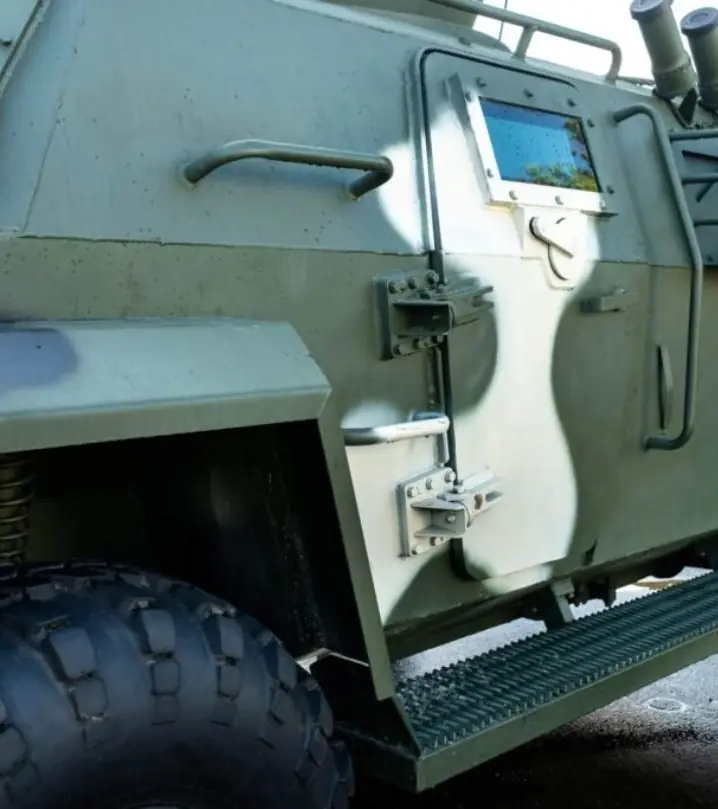
| Armoured and military vehicles | Hatches, ramps, masts, turret ring | Sealed linear actuators, mast drives, vehicular slip rings | Armoured vehicle systems |
| Naval and shipboard systems | Mast sensors, davits, winches, stabilised mounts | Marine slip rings, sealed motors, positioners | Naval shipboard systems |
| Counter-UAS sensor platforms | Fast-slewing pan and tilt | Direct-drive positioners, slip rings, encoders, drives | Counter-UAS systems |
Space ground segment equipment, such as satellite tracking antennas and teleports, uses the same pedestal technology as radar; see satellite antenna motion and slip rings for satellite antennas.
The component families and why defence picks them
Slip rings and rotary joints
Any axis that turns continuously and carries power or data needs a slip ring. Defence slip rings, often called rugged military slip rings, add environmental sealing, EMI shielding and qualified shock and vibration performance. Moog’s published vehicular and turret slip rings show the range: power rings up to 450 A at vehicle voltages, up to 238 signal circuits, MIL-STD-1553 data bus, RS-170 video and gigabit Ethernet, with NBC air channels on some models. Its EO/IR slip rings carry up to about two dozen channels at over 400 Mbit/s each. For radar, RF rotary joints and fibre optic rotary joints sit in the same assembly. Start with how to specify a slip ring, then the rugged military slip ring and defence turret pages.
Motors
Direct-drive frameless motors dominate stabilised axes because they remove gearbox backlash and compliance, and the kit builds into the structure to save mass. Housed rugged servo motors suit actuators and drives where a sealed unit is easier to qualify. Kollmorgen, for example, describes an IP67-sealed servo motor range with chemical agent-resistant paint for weapon station drives. See frameless torque motors, servo and stepper motors and frameless motor sizing.
Encoders and feedback
Stabilisation and pointing need absolute, high-resolution feedback mounted directly on the axis. Capacitive, inductive and optical ring encoders all appear; resolvers remain common on legacy and very high-temperature axes. Netzer’s catalogue rates its VLP harsh-environment encoders to 100 g for 6 ms shock and 20–2,000 Hz vibration, and its VLT to −55 °C to +125 °C. Compare technologies in absolute vs incremental encoders.
Gearing, actuators and drives
Large slow axes such as turrets and radar pedestals often combine a motor with a pinion on a ring gear, or strain-wave and planetary gearing; see harmonic vs planetary vs cycloidal and gearboxes. Electromechanical linear actuators increasingly replace hydraulics for hatches, ramps and masts; the hydraulic to electric actuator guide covers the trade-offs. Servo drives must accept the platform’s DC bus and its transients.
Qualification: the standards that drive the design
- MIL-STD-810H is a library of environmental test methods with a tailoring process, not a single test. Typical methods for motion components are high and low temperature (501, 502), salt fog (509), sand and dust (510), immersion (512), vibration (514), shock (516) and icing (521). Always ask which methods, procedures and levels a part was tested to.
- DEF STAN 00-35 is the UK MOD Environmental Handbook for Defence Materiel, in parts covering control and management, test methods, natural environments and induced mechanical and climatic environments. UK programmes use it alongside or instead of MIL-STD-810.
- MIL-STD-461 sets EMC limits for emissions and susceptibility. Revision H was released in April 2026 and supersedes 461G, though programmes already under contract may stay on G. DEF STAN 59-411 is the UK MOD equivalent for land, air and sea systems. Motor drives and long motor cables are the usual emission problem.
- MIL-STD-1275E defines 28 V DC input power for equipment on military ground vehicles: 20–33 V steady state and an injected ±250 V spike test, among other surge and starting events. DEF STAN 61-5 Part 6 covers UK military vehicle low-voltage supplies.
- MIL-DTL-901E (June 2017, superseding MIL-S-901D) covers high-impact shock for equipment on surface ships and submarines.
Obsolescence and long-term supply
Defence platforms often stay in service for decades, far longer than a commercial component series. IEC 62402:2019 sets out obsolescence management, including designing items to minimise future obsolescence. Practical steps for motion parts: choose series with a published roadmap; agree last-time-buy notice in the supply contract; avoid single-source custom windings or connectors where a standard option will do; and record enough interface data (mounting, electrical, feedback protocol) that a successor can be qualified without redesigning the axis.
Export control in brief
Many motion components are commercial items, but parts specially designed or modified for military use can be controlled under the UK Military List, and some others under dual-use controls. In the UK the Export Control Joint Unit administers licensing against the UK Strategic Export Control Lists; in the EU, Regulation (EU) 2021/821 sets the dual-use regime. US-origin parts may also carry US export rules; Moog’s catalogue states that its products are subject to US export regulations. Classification and licensing sit with the component maker and the exporter, but tell suppliers the end use and destination early so it does not hold up delivery.
Common pitfalls
- Accepting “MIL-STD-810 compliant” without the test report. The methods and levels are what matter.
- Designing the drive for 28 V and forgetting the transients. Spikes, surges and cranking dips are part of the specification, not an afterthought.
- Leaving EMC to the end. Shielded motor cables, filtering and drive switching choices are much cheaper at concept stage.
- Using a geared axis where stabilisation needs direct drive. Backlash and compliance limit loop bandwidth.
- Specifying a custom part without an obsolescence plan. Ask about life cycle before you freeze the design.
If you send your platform, environment, EMC and power requirements, our specialist engineering and supply partners can propose slip rings, motors, encoders and actuators with the test evidence to match.
Standards to have in view
- MIL-STD-810H (environmental engineering and laboratory tests)
- MIL-STD-461H (control of electromagnetic interference; supersedes MIL-STD-461G)
- MIL-STD-1275E (28 V DC input power to utilisation equipment in military vehicles)
- DEF STAN 00-35 (environmental handbook for defence materiel)
- DEF STAN 59-411 (electromagnetic compatibility)
- DEF STAN 61-5 Part 6 (low-voltage electrical power supply systems in military vehicles)
- MIL-DTL-901E (high-impact shock tests for shipboard equipment)
- IEC 62402:2019 (obsolescence management)
- IEC 60529 (IP codes)
Which standards apply depends on the end product and its market. Your engineer will confirm what the component itself needs to meet.
Frequently asked questions
What makes a slip ring or motor suitable for defence use?
Mostly evidence. A defence slip ring or rugged servo motor is designed for the platform's temperature range, shock, vibration, ingress and EMC, and the supplier can show test results against the standards your programme calls up, such as MIL-STD-810H and MIL-STD-461. Sealing, EMI shielding, gold-on-gold contacts, corrosion-resistant finishes and military connectors are common features. A long-term supply and obsolescence commitment matters as much as the datasheet.
Is MIL-STD-810H a pass or fail certification?
No. MIL-STD-810H is a set of test methods with a tailoring process. You define the life-cycle environment of your equipment and pick and tailor the relevant methods, such as vibration (Method 514), shock (516) and salt fog (509). A claim of 'MIL-STD-810 compliant' means little unless it states which methods, procedures and levels were applied. Ask suppliers for the test report, not just the statement.
What is the difference between MIL-STD-461 and DEF STAN 59-411?
Both set electromagnetic compatibility requirements for defence equipment: conducted and radiated emissions and susceptibility. MIL-STD-461 is the US Department of Defense standard, now at revision H (April 2026, superseding 461G). DEF STAN 59-411 is the UK Ministry of Defence EMC standard covering land, air and sea systems. Your contract decides which applies, and some programmes call up both, so confirm the standard and revision before EMC testing.
Do motion components need an export licence?
Some do. Items specially designed or modified for military use can fall under the UK Military List, and others under dual-use controls. In the UK, the Export Control Joint Unit administers licensing against the UK Strategic Export Control Lists; in the EU, Regulation (EU) 2021/821 sets the dual-use regime. US-origin parts may carry US export rules as well. The component maker and the exporter classify the item and handle any licence.
How do I manage obsolescence on a defence programme?
Assume the platform will outlive many of its components. IEC 62402:2019 sets out obsolescence management, from policy and planning through to designing items that minimise future obsolescence. In practice: ask suppliers for product life-cycle status and last-time-buy notice periods, prefer standard series over one-off parts where possible, keep form, fit and function data, and qualify a second source or a drop-in successor early.
What should I send for a defence motion component enquiry?
Send the platform type, the environmental specification (temperature, shock, vibration, ingress, salt fog), the EMC standard and limits, supply voltage and power standard, torque, speed and accuracy per axis, circuits and data that must cross any rotating joint, mass and envelope limits, the qualification evidence you need, expected production volume and support life, and any export or security constraints on the information.
Sources
- Moog: aerospace and defence slip ring product catalogue
- Interference Technology: review of MIL-STD-1275 requirements
- Systel: what is MIL-STD-810H?
- IB-Lenhardt: MIL-STD-461H published
- Element: DEF STAN 59-411 EMC testing
- PPI SE Goldmine: DEF STAN 00-35 Environmental Handbook for Defence Materiel
- EverySpec: MIL-DTL-901E shock tests, high-impact shipboard machinery
- Moog: rotary gimbal stage AC7332 datasheet
- SPINNER: air traffic control rotary joints catalogue
- Kollmorgen: motion solutions for weapon stations
- Netzer: product catalogue 2025
- VDE Verlag: IEC 62402:2019 obsolescence management (scope preview)
- GOV.UK: UK strategic export control lists
- European Commission: exporting dual-use items
Figures are summarised from the sources above and from manufacturers' published data on the date shown. Always confirm against the current datasheet for your exact part.