
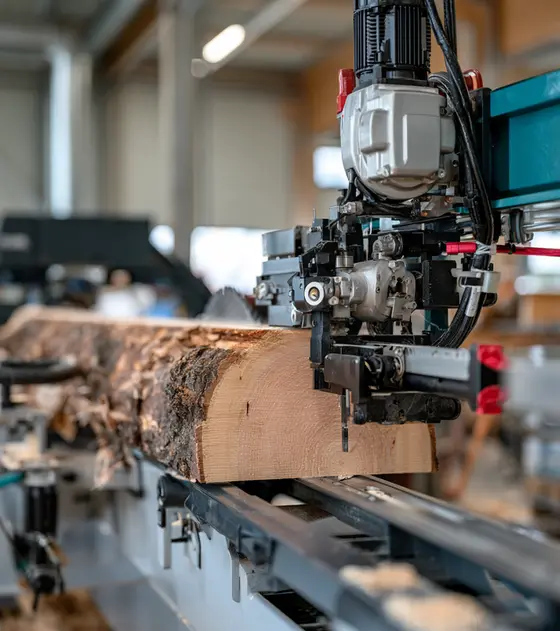
In short:Sawmills and woodworking plants are replacing hydraulic cylinders with electric rod actuators on saw blade, fence and roller positioning, gaining accuracy and removing leaks, while CNC routers, panel saws and flying cut-off saws run on servo motors and synchronised motion control. Specify for dust, wide temperature swings and shock, and remember that wood dust is both a health and an explosion hazard.
Typical requirements
| Electric vs hydraulic efficiency (fence guide example) | About 80% electric vs about 45% hydraulic |
|---|---|
| Fence guide actuator (published example) | 200 mm stroke, 0.25 m/s, 890 N (200 lbf), IP67 |
| Rod actuator thrust across one timber range | About 4.2 kN to 133 kN |
| Ingress protection | IP65 standard on many actuators; IP67 and IP69K options |
| Wood dust exposure limits (UK, 8 h TWA) | Hardwood 3 mg/m³; softwood 5 mg/m³ |
| Wood flour minimum explosible concentration | 60 g/m³ |
| Flying saw control (published example) | Synchronised to a master axis; 100 µs control cycles available |
Machinery we specify motion for
- Sawmill blade positioning
- Canter and edging saws
- Fence guides
- Timber planer roller positioning
- Kiln in-feed control
- Flying saw cut-off
- Veneer lathes
- CNC routers and wood machining centres
- Window and shutter production machines
- Panel sawing and furniture lines
What sawmills and woodworking machines demand from motion
Wood processing splits into two quite different worlds. Primary processing, in sawmills, planer mills and kilns, moves heavy logs and boards in cold, dusty, often unheated buildings, with shock loads every time a log hits a fence or a saw enters the cut. Secondary processing, in joinery, panel, window and furniture plants, runs CNC routers, panel saws and automated lines where speed, accuracy and synchronisation matter most. Both are moving from hydraulics and mechanics to electric motion, for different reasons.
Replacing hydraulic cylinders in sawmills
Tolomatic lists sawmill blade positioning on an RSA64, timber planer roller positioning on an RSA64 HT, kiln in-feed control on an RSX15, a fence guide on an IMA33 and flying saw cut-off on an MXB-U, several of them direct replacements for hydraulic cylinders. Curtiss-Wright Exlar names blade positioning, clamping, fence guides and canter and edging saws, and claims roller screw life up to 15 times that of ball screws. Its main arguments are the ones engineers hear from site: no pumps, reservoirs or hoses, no leaks, repeatable positioning that reduces waste, and IP65 protection against dust and water.
The best documented case is Tolomatic’s fence guide. Hydraulic cylinders positioning board alignment bumpers suffered seal wear, cold-start problems and lost performance in an unheated, dusty building. An IMA33 integrated servo actuator with a 5 mm lead ball screw and IP67 option took over, moving 200 mm at 0.25 m/s with 890 N (200 lbf) thrust, at about 80% efficiency against about 45% for the hydraulic system, with any board length now selectable in software.
| Sawmill machine | Motion | Typical electric solution |
|---|---|---|
| Saw blade positioning | Set saw position per log | Rod actuator, roller or ball screw, servo drive |
| Canter and edging saws | Saw and guide positioning | High-thrust roller-screw rod actuators |
| Fence guides and bumpers | Board alignment | Integrated servo rod actuator |
| Planer mills | Roller positioning | Heavy-duty rod actuator |
| Kilns | Cart in-feed rate | Roller-screw actuator with speed control |
| Veneer lathes | Positioning | Rod actuators |
| Flying saw cut-off | Carriage matches board speed | Belt-driven rodless actuator, synchronised servo |
Tolomatic’s timber processing brochure spans about 4.2 kN (GSA) to 133 kN (RSX) thrust, with IP65, IP67 and IP69K options, and lists veneer lathe positioning, “pineapple” roll positioning and adhesive dispensing for plywood alongside the applications above. Our records for the RSA-HT, RSX and IMA give current published figures. For the decision itself, read our hydraulic to electric actuator guide and ball screw vs roller screw.
Flying saws, CNC routers and secondary processing
A flying saw cuts a moving board or profile without stopping it: the saw carriage accelerates to line speed, locks to the material, cuts and returns. Beckhoff describes flying saw synchronisation to a master axis, CNC interpolation, camming, and control cycles down to 100 µs on its woodworking platform, along with sawmills and automated furniture lines. The mechanical side is usually a belt-driven rodless actuator such as the MXB or B3W (strokes beyond 10 m, up to about 5 m/s), driven by a servo and synchronised by a motion controller such as the MC500.
CNC routers and machining centres use AC servo motors on rack-and-pinion or ball-screw gantries, with planetary gearboxes and absolute encoders. LinMot adds linear motors for sawing, milling and positioning tasks. For long axes in dusty conditions, an absolute magnetic scale such as the LMSA (up to 32.7 m) keeps position through a power cut without homing. See servo vs stepper and servo and stepper motors.
Window, shutter and panel production
Secondary processing lines mix long, fast transfers with short precise moves. Tolomatic lists a shutter manufacturing machine built on its B3W belt-drive rodless actuator, and Beckhoff describes automated furniture lines that combine transport, feeding and stacking, edge processing, CNC machining and surface treatment. These lines are mostly indoors and heated, so the environmental demands drop, but cycle rates rise. Specify each axis by stroke, move time, settling accuracy and duty, and size motors on RMS torque over the real cycle rather than on peak torque.
How to specify motion for wood processing
- Start from today’s hydraulic figures. Bore, pressure and speed give the thrust and velocity the electric actuator must match. Size on the load the axis really sees, measured if possible, rather than on the cylinder’s maximum force, which is usually far higher than needed.
- Add shock and jams. Impacts and stalls set screw, bearing and gearbox life.
- State the building. Unheated mills see frost and condensation; specify grease, seals and electronics for the coldest start and the hottest summer day.
- Choose the screw. Roller screws for heavy shock and long life; ball screws for moderate steady loads; belts for long, fast, light strokes.
- Define feedback. Motor encoder plus screw lead for rod actuators; external absolute scales for long axes.
- Plan safety and dust. PUWER, ISO 19085, guarding, stopping performance, and any DSEAR zone.
Worked example: sizing the fence guide actuator
Using the published fence guide figures: 890 N thrust, 0.25 m/s, 200 mm stroke, 5 mm lead ball screw.
- Screw speed: 0.25 m/s ÷ 0.005 m/rev = 50 rev/s, or 3,000 rpm at the motor.
- Screw torque: T = F × L / (2π × η) = 890 × 0.005 / (2π × 0.9) ≈ 0.79 Nm, taking about 90% as a typical ball screw efficiency. Add acceleration torque for the moving mass and motor inertia.
- Mechanical power: 890 N × 0.25 m/s ≈ 222 W.
- Input power: at the published 80% electric efficiency, about 280 W; the hydraulic system at 45% needed about 490 W for the same work, before any idle running of the power unit.
- Shock: boards hitting the bumper load the screw and bearings. Check the actuator’s static and dynamic load ratings, not just its thrust rating, and consider a roller screw if impacts are heavy.
- Environment: IP67, wide temperature swings, dust; specify grease and seals for the coldest morning.
Safety, dust and explosion risk
Woodworking machinery in the UK falls under PUWER and the HSE ACOP L114, and HSE inspectors look specifically at braking, guarding, maintenance and competence. Machine design follows the ISO 19085 series, whose general part excludes machines for potentially explosive atmospheres.
Wood dust matters twice. HSE sets workplace exposure limits of 3 mg/m³ for hardwood and 5 mg/m³ for softwood (8-hour average), and gives the minimum explosible concentration of wood flour as 60 g/m³, noting that many fires start in extraction systems. For motion components, that means sealed housings, no dust traps on hot motor surfaces, and certified equipment wherever a DSEAR assessment identifies a hazardous zone.
Typical pitfalls
- Sizing on steady thrust only. Log and board impacts set bearing and screw life.
- Ignoring the cold. Unheated mills need grease, seals and electronics rated for the coldest start.
- Open optical scales on dusty axes.
- Dust on motors. Build-up insulates motors and is a fire risk.
- Keeping hydraulic thinking. Electric actuators can change position, speed and force per board; use that in the control design.
Send us the machine, axis, loads, speeds and what is fitted today, and our specialist engineering and supply partners will propose matched actuators, motors, drives and feedback.
Electric actuators for sawmills and woodworking machines
Electric rod actuators replace hydraulic cylinders for saw blade, fence, roller and kiln-feed positioning, giving programmable position and force without a power unit, hoses or leaks, and no cold-start problems in unheated buildings. Specify thrust including shock from logs and boards, stroke, speed, accuracy, duty, IP65 or IP67 sealing against dust and water, and temperature range. Roller screws carry high thrust and shock with long life; ball screws are cheaper for moderate loads. Belt-driven rodless actuators suit long, fast strokes such as flying saw carriages and transfers.
- Saw mills: saw blade positioning for log cutting
- Timber planers: roller positioning without hydraulics
- Kilns: in-feed rate control of lumber carts
- Fence guides: board alignment bumpers
- Flying saws: carriage travel on rodless actuators
Available through our supply network
All linear actuators →Specify linear actuators for woodworking and sawmills →
Servo motors for CNC routers and feed axes
CNC routers, machining centres, panel saws, edge banders and window production lines use AC servo motors on gantry, feed and tool-change axes. Specify torque and speed at the axis after the gearbox or rack, inertia ratio, encoder resolution, brake for vertical axes and IP65 or IP67 sealing with shaft seals against fine dust. Absolute multi-turn encoders avoid homing after a power cut. Closed-loop steppers suit lighter positioning axes such as stops, clamps and fences on smaller machines. Keep motor surfaces clear of dust build-up, which insulates the motor and raises winding temperature.
- CNC routers: X, Y and Z gantry axes
- Panel saws: saw carriage and pusher axes
- Window production: cutting and machining axes
- Edge banders and furniture lines: feed and trimming axes
Available through our supply network
All servo and stepper motors →Specify servo and stepper motors for woodworking and sawmills →
Servo drives for wood machining and saw lines
Servo drives on woodworking lines need fast EtherCAT communication for synchronised axes, safe torque off for guarding and maintenance, and enough peak current for rapid saw carriage moves. Specify supply voltage, motor power, encoder protocol, fieldbus, STO level and brake output. Drives with a second encoder input can close the loop on a linear scale on long axes, so belt or rack stretch does not become position error. Mount drives in a sealed, filtered cabinet away from extraction ducts, and check the drive's braking resistor rating for repeated rapid stops of heavy carriages.
- Flying saws: high-peak carriage acceleration
- CNC routers: multi-axis gantry control
- Setworks: servo positioning of saw and fence actuators
Available through our supply network
All servo drives →Specify servo drives for woodworking and sawmills →
Encoders for setworks and long-travel axes
Setworks and long woodworking axes need position feedback that ignores dust, resin and vibration. Magnetic tape scales and capacitive linear encoders tolerate contamination far better than open optical scales, and absolute versions know position at power-up. Specify measuring length, absolute or incremental, resolution and accuracy per metre, interface, IP67 read heads and temperature range. On rod actuators, a motor encoder with a known screw lead often gives enough accuracy without an external scale. Protect tape scales with a cover strip where chips and bark fall on the axis.
- Edgers and canters: saw position feedback
- Long gantry axes: absolute position over many metres
- Fence and stop positioning: linear feedback
- Kiln and transfer axes: travel position
Available through our supply network
All encoders and feedback →Specify encoders and feedback for woodworking and sawmills →
Gearboxes for saw feeds and router gantries
Planetary gearboxes match servo motors to feed rollers, rack-and-pinion gantries and rotary tables. Specify output torque including acceleration, ratio, backlash class for the positioning accuracy you need, radial load from pinions or pulleys, and IP65 sealing. Right-angle versions keep the motor clear of the gantry. Low-backlash classes matter on router gantries; standard classes are often enough on feed rollers. Check the gearbox for shock torque when a saw stalls in the cut or a board jams, because that peak can far exceed the acceleration torque. A torque limit in the drive protects the gearbox as well as the motor.
- CNC routers: rack-and-pinion gantry drives
- Saw lines: feed roller reduction
- Machining centres: rotary table indexing
Available through our supply network
All gearboxes and harmonic drives →Specify gearboxes and harmonic drives for woodworking and sawmills →
Motion controllers for flying saws and CNC woodworking
Flying saws, optimised cut-off lines and multi-axis machining centres need a controller that synchronises slave axes to a master encoder on the moving board, runs cam profiles and coordinates EtherCAT drives. Specify axis count, cycle time, synchronisation and camming functions, I/O, fieldbus and programming environment (IEC 61131-3 or CNC). Keep guard interlocks and stopping in rated safety hardware. Ask for the synchronisation error at line speed, since it sets cut-length accuracy, and for remote diagnostics if the line runs unattended shifts.
- Flying saws: carriage synchronised to the board
- Saw optimisation lines: coordinated positioning
- Window and furniture lines: multi-axis sequencing
Available through our supply network
All controllers and plcs →Specify controllers and plcs for woodworking and sawmills →
Slip rings for router heads and rotary tables
Rotary tables, turning heads, rotating clamps and continuously rotating tool heads on woodworking machines need slip rings to carry power, sensor signals and fieldbus across the axis, and often a rotary union for compressed air or vacuum. Specify circuits, current, speed, bore, data protocol and sealing against fine dust; quick-connect terminals help where units are changed often. Allow for the vacuum level and flow the clamping system needs when sizing the rotary union bore, and keep electrical and pneumatic channels separated so moisture in the air supply cannot reach the rings.
- Rotary tables: power and sensors across rotation
- Clamping heads: air and vacuum through a rotary union
- Turning heads: signals from rotating tooling
Available through our supply network
All slip rings →Specify slip rings for woodworking and sawmills →
Standards to have in view
- ISO 19085 series (woodworking machines: safety)
- PUWER 1998 and HSE ACOP L114 (safe use of woodworking machinery)
- ISO 13849-1 (safety-related parts of control systems)
- ISO 12100 (safety of machinery: risk assessment)
- DSEAR 2002 (UK dangerous substances and explosive atmospheres)
- IEC 60529 (IP codes)
Which standards apply depends on the end product and its market. Your engineer will confirm what the component itself needs to meet.
Frequently asked questions
Can an electric actuator replace a hydraulic cylinder in a sawmill?
Often, yes. Published examples include saw blade positioning, timber planer roller positioning, kiln in-feed control and fence guides, all moved from hydraulics to electric rod actuators. Benefits claimed are programmable positioning, no leaks or power unit, fewer cold-start problems and lower energy use. Very high continuous forces or extreme shock may still favour hydraulics, so size against real loads.
How much energy does electric actuation save over hydraulics?
It depends on duty, but Tolomatic's fence guide example puts electric actuator efficiency at about 80% against about 45% for the hydraulic system it replaced. On a 222 W mechanical duty, that is roughly 280 W of input power against about 490 W. A hydraulic power unit that runs between moves widens the gap further.
Roller screw or ball screw for timber processing?
Roller screws carry more load in the same size, cope better with shock and generally last longer; Curtiss-Wright Exlar claims up to 15 times the life of a ball screw. Ball screws are cheaper and fine for moderate thrust and steady loads. For saw and fence positioning with frequent shock from logs or boards, roller screws are the usual first choice.
What IP rating do actuators need in a sawmill?
At least IP65 to keep dust and water out of internal parts, which is a common standard rating on industrial rod actuators. Choose IP67 where equipment is washed or exposed to weather, and IP69K for high-pressure washing. Seal the motor, connectors and cable glands to the same level, and fit rod wipers or boots where resin and sawdust collect.
Is wood dust an explosion hazard for motion equipment?
Yes. HSE gives the minimum explosible concentration of wood flour as 60 g/m³ and notes that many fires start in extraction systems. Where a dust explosion risk assessment under DSEAR identifies a hazardous zone, any motor, actuator or encoder inside it needs suitable certification. Keep standard equipment outside such zones and control dust build-up on hot surfaces.
What should I send for a woodworking or sawmill motion enquiry?
Send the machine and axis, thrust or torque including shock, stroke, speed, accuracy, cycle rate, what is used today (hydraulic bore, pressure and speed help), supply voltage, controller and fieldbus, feedback needed, IP rating, temperature range of the building, any hazardous-area zone and the envelope and mounting.
Sources
- Tolomatic: Lumber and woodworking applications
- Tolomatic: Fence guide application
- Tolomatic: Timber processing brochure
- Curtiss-Wright Exlar: Forestry
- LinMot: Industry solutions (wood processing)
- Beckhoff: Woodworking machines
- HSE: Woodworking risk management
- HSE: Wood dust
- HSE: Woodworking fire and explosion
- Standards.ie: ISO 19085-1 Woodworking machines, safety, Part 1
Figures are summarised from the sources above and from manufacturers' published data on the date shown. Always confirm against the current datasheet for your exact part.