
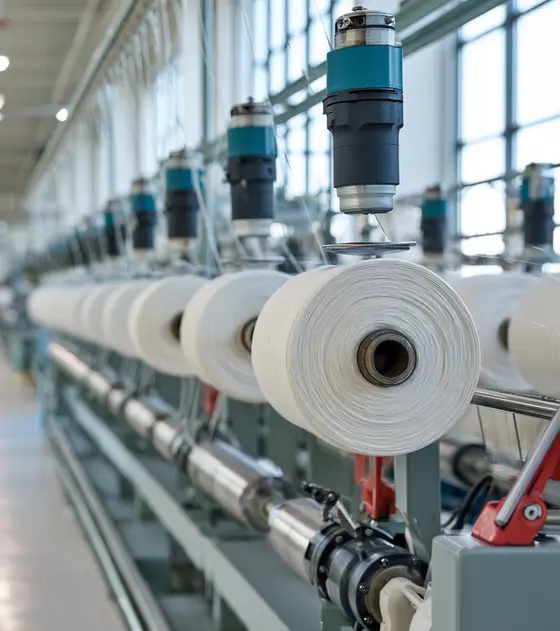
In short:Textile machines are many-axis machines: each winding position, yarn feeder or needle bed has its own small motor, and the hardest axis is usually the traverse, which reverses many times a second. Size it from yarn speed, wind ratio and reversal distance, keep moving mass low, and protect motors and encoders from lint.
Typical requirements
| High-speed filament winding (published example) | Up to 5,200 m/min for HOY on a 12-end winder (Oerlikon Barmag WINGS 1800) |
|---|---|
| Industrial lockstitch speed (published example) | 5,000 stitches/min up to 4 mm stitch length, 400 W direct-drive AC servo (JUKI DDL-9000C) |
| Circular knitting production factor (published example) | 2,300 = 92 feeders × 25 rpm at 38 in (Mayer & Cie OVJA 2.4 EM) |
| Servo traverse example (patent) | 10 in (254 mm) stroke, wind ratio 3.5–6.5, up to 1,000 yd/min |
| Yarn guide drive | Stepper or servo with rapid start-stop and frequent reversals |
| Yarn feeder drive | Small DC or brushless motors, up to about 100 W |
Machinery we specify motion for
- Yarn winding machines
- Yarn guides and traverse units
- Yarn feeders and tension control
- Circular and flat knitting machines
- Industrial sewing machines
- Button-sewing and automatic sewing units
- Yarn and material testing devices
- Creels and take-up units
What textile machines demand from motion
Textile machinery is built around one material, yarn or fabric, that must never be stretched, slackened or snagged. So most of the motion problem is about keeping speed and tension constant while something else changes: a package growing on a spindle, a guide reversing at the end of its stroke, a needle punching through a seam. The loads are small. The speeds, cycle counts and number of axes are not.
Three things set textile machines apart:
- Many identical axes. A winder has one winding position after another, each with its own spindle, traverse and feeder. Cost and reliability per axis decide the design.
- Reversing duty. A yarn guide reverses at both ends of every stroke, many times a second, all day.
- A dirty environment. Lint and fibre fly settle on motors, encoders and contacts, and many machines carry oil mist from lubricated needles or cylinders.
FAULHABER sums up the guide duty well: high positioning accuracy, rapid start-stop and frequent reversals. That is why it supplies stepper motors for yarn guiding. For yarn feeders it stresses a drive that reacts quickly to load changes and meters power finely, so the yarn does not break, in a space where the motor must not set the maintenance interval.
Where motion sits in textile machinery
| Machine | Axis | What it does | Usual drive |
|---|---|---|---|
| Winder | Spindle or drum | Winds the package at constant yarn speed | Servo or brushless motor |
| Winder | Traverse | Lays yarn across the package | Stepper or servo with belt, or linear motor |
| Yarn feeder | Feed roll | Delivers yarn at set tension | Small DC, brushless or stepper motor |
| Circular knitting | Cylinder | Main rotation | AC servo or inverter motor |
| Circular knitting | Take-down | Pulls fabric away at set tension | Servo or stepper with gearhead |
| Flat knitting | Carriage, yarn carriers | Traverses the needle beds | Servo motor and belt |
| Industrial sewing | Main shaft | Drives needle and hook | Direct-drive AC servo |
| Automatic sewing | Clamp X-Y, trimmer | Moves the work under the needle | Steppers or servos |
| Yarn testing | Clamp and traverse | Tensile and evenness tests | Servo or stepper linear axis |
LinMot lists linear and rotary actuators for gentle process control in textile machines, and WITTENSTEIN includes textile processing among the industries using its gearheads and mechatronic drives.
Winding machines: spindle, traverse and tension
Filament winding runs fast. Oerlikon Barmag’s WINGS 1800 winds HOY at up to 5,200 m/min, on 12 ends as standard with a 16-end variant. At that speed every winding position must hold its yarn speed while the package diameter grows, so the spindle speed falls continuously as the package builds.
The traverse is the hard axis. Grooved drums and scroll cams were the traditional answer. A servo traverse patent explains why builders moved away from them: cam traverses are limited in speed, wear, and must be swapped to change the winding pattern. With a servo-driven guide, traverse length and wind ratio become controller settings. The patent’s example uses a 10 in (254 mm) stroke, a wind ratio between 3.5 and 6.5, and yarn at up to 1,000 yd/min, driven through a low-mass cable so the guide can reciprocate quickly.
Worked example: sizing an electronic traverse
Take a precision winder at 1,000 m/min, a 150 mm traverse stroke, a wind ratio of 5 (spindle turns per double stroke) and a package that starts at 100 mm diameter.
- Spindle speed. 1,000 / (π × 0.1) ≈ 3,180 rpm at the start of the package.
- Double strokes per minute. 3,180 / 5 ≈ 640, or about 10.6 per second.
- Traverse speed. 2 × 0.15 m × 10.6 ≈ 3.2 m/s average.
- Crossing angle. Yarn speed is 16.7 m/s, so the angle is about atan(3.2 / 16.7) ≈ 11°.
- Reversal. Stop and reverse from 3.2 m/s within 10 mm at each end: a = v² / (2s) = 3.2² / 0.02 ≈ 510 m/s², about 52 g.
- Force. With 50 g of moving guide, that needs about 26 N. With 200 g, once you add a carriage and a moving coil, it needs about 100 N, four times the motor.
The lesson is that moving mass decides the motor. Keep the guide light, and if you use a linear motor, consider a moving-magnet or ironless design with a light forcer. The traverse runs close to 100% duty, so size the motor on RMS force and plan its cooling. As the package grows and spindle speed falls, the controller keeps the wind ratio or crossing angle correct, depending on the winding method. These numbers are an illustration, not a design.
Yarn feeders and tensioners are the other half of winding. FAULHABER notes that some customers use DC motors with graphite commutation here and lists brushless motors of up to 100 W continuous for textile drives. A voice coil can also make a fast, programmable tensioner.
Knitting machines
Circular knitting machines quote output as a production factor: feeders × rpm × diameter in inches. Mayer & Cie’s OVJA 2.4 EM double-knit jacquard machine reaches 2,300 (92 feeders × 25 rpm at 38 in), with electronic needle selection in the cylinder. For motion that means a cylinder drive with smooth, constant speed, a take-down whose tension follows the fabric, and positive yarn feeders on every feed. Electronic needle selection relies on accurate cylinder angle, so the main drive’s encoder matters as much as its torque.
Flat knitting machines traverse a carriage over the needle beds and reverse at each end, which is a smaller version of the traverse problem above.
Industrial sewing machines
Industrial sewing heads increasingly use direct-drive servos. JUKI’s DDL-9000C couples a compact 400 W AC servo motor straight to the main shaft and sews at up to 5,000 stitches per minute at stitch lengths up to 4 mm, with an automatic thread trimmer and, on some models, an electronically controlled presser foot. For automatic sewing units and button-sewing machines, add stepper or servo X-Y axes to move the clamp, plus small actuators for trimming, wiping and stacking. Size the clamp axes on acceleration between stitches and positional stiffness at the needle.
Lint, oil mist and the mill environment
Specify for the mill, not the test bench. Fibre fly builds up on fan inlets and heat sinks, so a motor that runs cool on the bench can overheat after a week in production. Prefer fan-less or sealed motors and drives in enclosures that can be blown down. Open optical encoders and exposed slip ring tracks collect lint too; magnetic and capacitive feedback, such as the dirt-tolerant KappaSense FLEXe linear encoder, is more forgiving. Route cables away from yarn paths, and confirm that seals and cable jackets resist the needle and cylinder oils in use.
Typical pitfalls
- Sizing a traverse on average speed. Reversal acceleration and moving mass set the force.
- Ignoring resonance. Steppers driving guides at a fixed reversal rate can hit a resonance band; check across the full recipe range.
- Open optical scales in a mill. Lint clogs them. Magnetic or capacitive feedback is more forgiving.
- One drive per axis by habit. Multi-axis drives and a shared bus cut cost and wiring on many-position machines.
- Forgetting the restart. Without absolute feedback every head must home after a stop, which costs production time.
What to send us
Tell us the machine type, how many identical positions it has, and for each axis the motion, stroke or speed, load and duty. For winders add yarn speed, package size, wind ratio range and traverse stroke. Include the bus voltage, fieldbus, safety functions and target cost per axis. Our specialist engineering and supply partners will propose motors, drives and feedback to suit.
Stepper motors for yarn winding and yarn guides
Hybrid stepper motors drive yarn guides, electronic traverses on smaller winders, feeders and positioning axes because they position accurately without an encoder and are cheap enough to fit one per winding head. The duty is hard: rapid start-stop and a reversal at every end of the traverse. Size on torque at the reversal frequency, not holding torque, and check resonance across the speed range. Closed-loop steppers add an encoder so a missed step is caught before it spoils a package. Ask for sealed or IP65 versions where lint collects, and keep cables flexing away from yarn paths.
- Precision winders: electronic yarn guide per head
- Yarn feeders: positive feed rollers
- Knitting machines: yarn carrier and needle-bed positioning
- Testing devices: specimen clamps and traverses
Available through our supply network
All servo and stepper motors →Specify servo and stepper motors for textile machinery →
Linear motors for yarn traverse and textile machines
A linear motor drives the yarn guide directly, with no belt, cam or scroll to wear, and lets the controller change stroke, wind ratio and reversal profile in software. The governing figure is acceleration at the reversals, so moving mass decides the force. Ironless motors have no cogging and no attraction force, which keeps reversals smooth; iron-core and magnet-free track types give more force per euro. Short-stroke voice coils suit yarn tensioners and small oscillating motions. Specify stroke, reversal distance, double strokes per minute and the guide's mass, and plan cooling, because a traverse runs near 100% duty.
- Filament and precision winders: direct-drive yarn traverse
- Yarn tensioners: voice coil force control
- Sewing and quilting automation: fast linear positioning
- Textile testing: programmable linear stroke
Available through our supply network
All linear actuators →Specify linear actuators for textile machinery →
Servo motors for knitting and sewing machines
AC and low-voltage servo motors drive knitting machine cylinders, take-down rollers, sewing machine main shafts and automatic sewing units. Industrial sewing heads now couple a compact servo motor straight to the main shaft, so needle position, speed and thread trimming are all under electronic control. Specify the speed range, peak torque at needle penetration or fabric take-down, the positioning accuracy needed at stop, and the inertia ratio. Absolute encoders let a machine restart at the right needle position after power loss. Low-voltage servos suit battery-backed or many-axis machines with a common DC bus.
- Circular knitting: cylinder main drive
- Knitting: electronic fabric take-down
- Industrial sewing: direct-drive main shaft
- Automatic sewing units: X-Y clamp axes
Available through our supply network
All servo and stepper motors →Specify servo and stepper motors for textile machinery →
Multi-axis drives for textile machines
A winder or knitting machine can carry dozens of identical axes, so drive cost per axis and cabinet space matter. Dual- and four-axis EtherCAT drives share one housing and one network node, which cuts wiring across long machine frames. Stepper drives with EtherCAT run feeders and yarn guides; servo drives run traverses and main shafts. Specify axis count, current per axis, bus voltage, the fieldbus and the safety functions such as STO. Ask how a single failed axis is replaced without stopping the whole machine.
- Multi-head winders: one drive axis per winding position
- Knitting machines: feeder and take-down axes
- Sewing automation: X-Y and clamp axes
- Textile finishing: roller and tension axes
Available through our supply network
All servo drives →Specify servo drives for textile machinery →
Motion controllers for traverse and tension control
The controller links traverse, spindle and feed so that yarn speed and crossing angle stay correct as the package grows. That needs electronic gearing and cams between axes, a fast cycle, and recipes for stroke, wind ratio, ribbon-breaking and tension. CODESYS controllers on EtherCAT handle tens of synchronised axes on a 1 ms cycle. Specify the axis count, the number of identical winding positions, the cycle time, and the HMI the operator will use to load yarn recipes. Plan remote access for diagnostics if machines ship abroad.
- Winders: traverse-to-spindle electronic gearing
- Yarn feeders: closed-loop tension control
- Knitting: pattern and take-down synchronisation
- Operator HMIs: yarn and pattern recipes
Available through our supply network
All controllers and plcs →Specify controllers and plcs for textile machinery →
Encoders for traverse position and spindle speed
Encoders close the loop on linear traverses, measure spindle speed for constant yarn speed, and confirm needle or shaft position at stop. Textile mills are full of lint and fibre fly, so magnetic and capacitive encoders that tolerate dirt are often a better choice than open optical scales. Specify resolution at the reversal, maximum speed, the interface the drive accepts, the mounting tolerance and the IP rating. Absolute encoders avoid homing every head after a stop, which matters on a machine with dozens of positions.
- Linear traverses: position feedback for the yarn guide
- Winding spindles: speed and position
- Sewing heads: needle position
- Knitting: cylinder angle for pattern timing
Available through our supply network
All encoders and feedback →Specify encoders and feedback for textile machinery →
Slip rings for rotating textile machinery
Where a motor, sensor or heater rides on a continuously rotating part of the machine, such as a rotating take-down and batching frame, a rotating creel or a turntable, a slip ring carries its power and signals across the rotation. Specify the circuit count with current and voltage for each, any fieldbus or encoder signals, the bore, speed and IP rating, and note that lint and oil mist can collect on open contacts. Sealed capsule or through-bore units are the usual choice; pancake units suit short axial space.
- Circular knitting: power and sensors to rotating take-down units
- Rotating creels: sensor and motor circuits
- Turntables and rotary testers: power and signals
Available through our supply network
Standards to have in view
- ISO 11111-1 (textile machinery: safety requirements, common requirements)
- ISO 10821 (industrial sewing machines: safety requirements)
- EN 60204-1 (electrical equipment of machines)
- ISO 13849-1 (safety-related parts of control systems)
- IEC 61800-5-2 (drive safety functions such as STO)
- IEC 60529 (IP codes)
Which standards apply depends on the end product and its market. Your engineer will confirm what the component itself needs to meet.
Frequently asked questions
Which motor is best for yarn winding?
It depends on the axis. The spindle needs a servo or brushless motor that can hold yarn speed as the package grows. The traverse needs a drive that reverses quickly with low moving mass: a stepper or servo with a light belt or cable, or a linear motor for the fastest machines. Feeders and tensioners use small DC, brushless or stepper motors.
What is an electronic traverse?
It is a yarn guide driven by its own servo, stepper or linear motor instead of a grooved drum or scroll cam. Because the motion is set in software, stroke length, wind ratio and reversal profile can change with each yarn recipe. A traverse patent from the field notes that mechanical traverses are speed-limited, wear, and must be replaced to change the winding pattern.
How do I size a yarn traverse drive?
Start from yarn speed, package diameter and wind ratio to get double strokes per minute and traverse speed. Then set the reversal distance, which gives the acceleration. Multiply by the moving mass, including guide, carriage and any moving coil, to get peak force, and size the motor on RMS force at almost 100% duty. Check the crossing angle the package needs.
What motors are used in industrial sewing machines?
Modern industrial lockstitch machines use a compact AC servo motor connected directly to the main shaft. JUKI publishes a 400 W direct-drive servo on its DDL-9000C, which sews at up to 5,000 stitches per minute at stitch lengths up to 4 mm. Automatic sewing units add stepper or servo axes for clamp movement, thread trimming and presser foot control.
How do textile mills affect motor and encoder choice?
Lint and fibre fly collect on everything and can block fans, clog open optical scales and build up on slip ring contacts. Choose sealed or fan-less motors, magnetic or capacitive encoders that tolerate dirt, and enclosures that are easy to blow down. Also allow for oil mist from lubricated needles and for the humidity control many mills use.
What should I send for a textile machine enquiry?
Send the machine type, the number of identical positions, and for each axis the motion, stroke or speed, load and duty. For winders add yarn speed, package size, wind ratio range and traverse stroke. Include bus voltage, fieldbus, safety functions, the mill environment and the target cost per axis, which often decides between stepper and servo.
Sources
- FAULHABER: Drive systems for textile machines
- LinMot: Industry solutions (textile machines)
- WITTENSTEIN: Other industries (textile processing)
- Fiber Journal: WINGS 1800 high-speed winding concept (Oerlikon Barmag)
- US6776367B2: Servo-controlled traverse mechanism for winder
- JUKI: DDL-9000C series direct-drive lockstitch machine
- Mayer & Cie: OVJA 2.4 EM circular knitting machine (DirectIndustry)
Figures are summarised from the sources above and from manufacturers' published data on the date shown. Always confirm against the current datasheet for your exact part.