
In short:Start from maximum take-off mass and work outwards: set a thrust target of roughly 2 to 2.5 times MTOW across the rotors, choose the largest propeller the airframe allows, then pick the motor KV and battery voltage that spin that propeller to its maximum thrust with headroom. Confirm hover efficiency in g/W from test data, size the ESC with 20 to 30% current margin, and check cooling and environmental ratings for the mission.
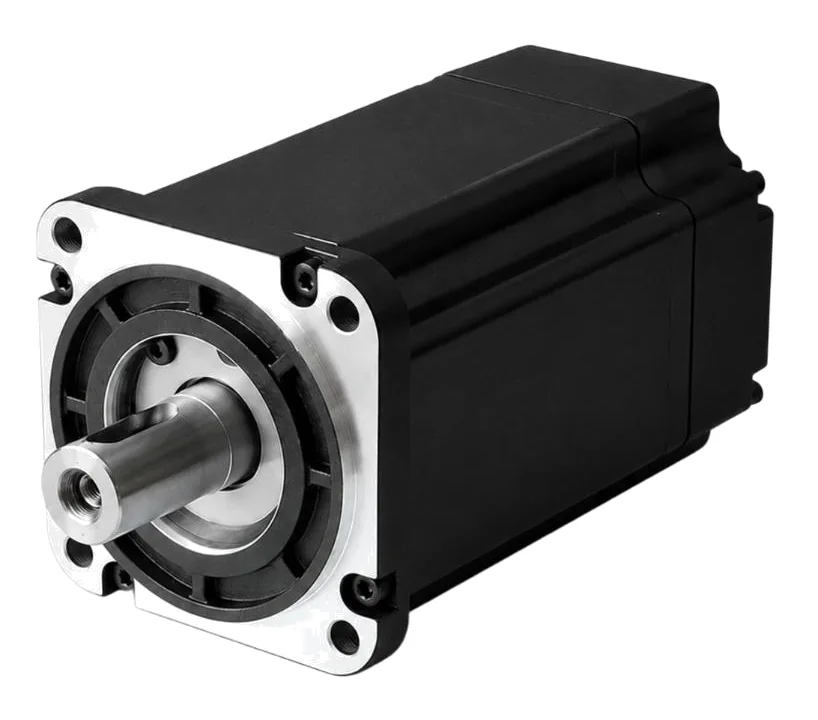
The propulsion motor sets a UAV’s endurance, payload and reliability more than almost any other component. For multirotors and VTOL lift systems the motor of choice is a brushless outrunner: a rotating magnet bell outside a fixed wound stator, giving high torque at the moderate speeds large propellers need. This guide covers selection at component level for civil and commercial platforms and for military drones and UAVs. For the wider market context, see drones and UAVs.
Step 1: Fix the mass budget and thrust target
Everything follows from maximum take-off mass (MTOW): airframe, batteries, payload, motors, ESCs and propellers. Estimate it honestly, including cabling and mounts, and expect it to grow.
T-Motor’s guidance for multirotors (T-Motor):
- Maximum thrust per motor ≈ MTOW ÷ number of motors × 2.2 to 2.5
- Hover at about 50–55% throttle, where the motor-propeller combination is efficient
- For an industrial VTOL lift system, 2.0 to 2.2 times MTOW (T-Motor)
Too little margin leaves no control authority in gusts or with a sagging battery. Too much margin adds motor mass and cuts flight time.
Step 2: Choose the propeller first
Pick the largest propeller the airframe geometry allows, considering arm length, tip clearance, folding and transport. Basic momentum theory explains why: ideal hover power is P = T^1.5 ÷ √(2ρA), where A is the rotor disc area and ρ is air density. For the same thrust, a bigger disc needs less power. Larger, slower propellers therefore give better g/W, at the cost of slower thrust response.
T-Motor’s matching rule is to pair large propellers with low-KV motors and small propellers with high-KV motors (T-Motor). An oversized propeller overloads the motor, with a risk of overheating, demagnetisation or burnout; an undersized one wastes energy.
Pitch matters too: higher pitch suits faster forward flight; lower pitch suits hover efficiency.
Step 3: Pick battery voltage and KV together
KV is no-load speed per volt (rpm/V). The motor’s loaded speed at full throttle must reach the propeller speed for your maximum thrust, from the propeller maker’s test data.
- KV ≈ rpm at maximum thrust ÷ (loaded-speed fraction × pack voltage under load)
- Loaded speed is typically a sizeable fraction of no-load speed; take the real figure from the motor’s test table with your propeller.
- Torque constant follows from KV: Kt ≈ 9.55 ÷ KV (Nm/A), so low-KV motors make more torque per amp.
Voltage: higher voltage cuts current for the same power, which reduces wiring losses and voltage sag (T-Motor). Industrial VTOL platforms commonly use 12S or higher packs (T-Motor). A lithium polymer cell is about 3.7 V nominal and 4.2 V fully charged, so 12S is 44.4 V nominal and 50.4 V full. Check the operating point at the pack’s minimum voltage, not just nominal.
Military and some commercial airframes use a regulated 28 V or higher-voltage DC bus rather than a raw battery; size against that bus and its transients.
Step 4: Compare efficiency in g/W at hover
g/W is thrust in grams divided by electrical input power, for a specific motor, propeller and voltage. It is highest at low throttle and falls as thrust rises. Compare candidate motors at your hover thrust per motor, because that is where the aircraft spends its flight time.
Endurance then follows from hover power: total hover power across all motors, plus avionics and payload, against usable battery energy. T-Motor warns that adding battery capacity helps only until the extra mass’s power cost cancels the gain (T-Motor).
Ask for test data measured on a thrust stand with the actual propeller and voltage: thrust, current, power, rpm, g/W and temperature across the throttle range.
Step 5: Size the ESC
- Continuous current should exceed the motor’s maximum current at 100% throttle by 20–30%; for a 40 A motor, a 50 to 60 A ESC (T-Motor).
- Voltage rating must exceed the fully charged pack voltage.
- Control interface: PWM, DShot or CAN. CAN suits larger UAVs that need telemetry (rpm, current, temperature, faults) back to the flight controller.
- Commutation: field-oriented control (sinusoidal) ESCs run quieter and smoother than trapezoidal ones, which matters for heavy-lift and camera platforms.
- Integration: some heavy-lift motors ship with a matched ESC, which removes one matching risk.
Step 6: Cooling, environment and reliability
Cooling. Outrunners cool through airflow over the bell and stator. Do not enclose ESCs in unventilated compartments or wrap them tightly inside arm tubes, and run full-throttle tests of at least 30 seconds while monitoring motor and ESC temperature (T-Motor). Semi-enclosed nacelles on VTOL designs are a known overheating risk (T-Motor).
Environment. State what the motor will face:
- Dust, sand and grass cuttings: sealed bearings, protected windings
- Rain, spray and agricultural chemicals: coated windings, stainless or coated hardware, a tested IP rating to IEC 60529
- Salt atmosphere for maritime operations: corrosion-resistant bell, shaft and fasteners
- Temperature range, including cold-start behaviour of bearings and battery
- Vibration and shock, including landing loads
Defence platforms. Expect a tailored MIL-STD-810H environmental programme and EMC requirements, plus traceability, quality system and magnet-sourcing questions. Parts specially designed for military UAVs can fall under the UK Military List or dual-use controls; the supplier and exporter classify and license, so state the end use early. See defence and security.
Reliability. Bearings are the main wear item. Ask for bearing type and expected life, and whether the motor has passed long-duration testing at your hover load.
Worked example: a 25 kg hexacopter on 12S
Platform: hexacopter, MTOW 25 kg, 12S LiPo (44.4 V nominal, assume about 42 V under heavy load).
Thrust targets:
- Hover per motor: 25 ÷ 6 ≈ 4.17 kg (40.9 N)
- Maximum per motor at 2.2 × MTOW: 4.17 × 2.2 ≈ 9.2 kg (90 N)
Propeller choice and hover power. Compare a 30-inch (0.762 m) and a 24-inch (0.610 m) propeller, using momentum theory with ρ = 1.225 kg/m³. For real hardware, assume a propeller figure of merit of 0.65 (real rotors usually fall between about 0.5 and 0.7, per rotorcraft aerodynamics notes) and motor-plus-ESC efficiency of 0.85. Replace both with test data.
| 30-inch prop | 24-inch prop | |
|---|---|---|
| Disc area A | 0.456 m² | 0.292 m² |
| Ideal hover power, 40.9^1.5 ÷ √(2ρA) | 248 W | 309 W |
| Electrical hover power ÷ (0.65 × 0.85) | about 450 W | about 560 W |
| Hover efficiency | about 9.3 g/W | about 7.5 g/W |
| Total hover power, 6 motors | about 2.7 kW | about 3.4 kW |
The 30-inch propeller saves about a fifth of hover power, which translates almost directly into flight time.
Speed and KV. Propeller rpm at 90 N comes from the propeller’s test data. As an estimate, using a thrust coefficient of 0.1 (T = C_T × ρ × n² × D⁴, n in rev/s; again an assumption):
- 30-inch: about 2,800 rpm. At 42 V and a loaded speed of about 85% of no-load, KV ≈ 2,800 ÷ (0.85 × 42) ≈ 78 KV
- 24-inch: about 4,400 rpm, so KV ≈ 123 KV
Current and ESC. Power at maximum thrust scales roughly with thrust^1.5: (9.2 ÷ 4.17)^1.5 ≈ 3.3 times hover power, before the efficiency drop at high throttle.
- 30-inch: about 1.5 kW per motor, about 35 A at 42 V. ESC with 20–30% margin: about 45 A continuous.
- 24-inch: about 1.8 kW per motor, about 44 A. ESC about 55 A continuous.
- Both ESCs must be rated above 50.4 V for a fully charged 12S pack.
Result. The 30-inch, roughly 80 KV option is more efficient if the airframe can fit it. If the frame limits propellers to 24 inches, a motor around 120 KV fits the HDM-L range, with a 55 A class ESC. Confirm both on a thrust stand with the real propeller, and check motor temperature after a sustained full-throttle run.
Products in our range to consider
- HDM-L brushless drone motors: outrunner motors for small to medium UAVs on 4S to 12S, from 28.8 to 108 mm diameter, 110 to 1,150 KV and up to 3.8 kW, with optional ESC.
- HDM-FC heavy-lift drone motor: flat-wire (hairpin) PMSM motor with matched ESC for large UAVs and eVTOLs, 12.5 kW peak and 76.5 kg thrust per rotor at 60–74 V DC.
- AR/BR/CR capsule slip rings: compact gold-on-gold capsules for mixed power and signal across gimbal and payload rotation, from 5.5 mm diameter.
- Novanta Capitan servo drives: 18 g micro servo drives at 8–60 V DC and 10 A continuous for gimbal and payload axes, with BiSS-C feedback and STO.
- Novanta Everest servo drives: 8–72 V DC drives at 45 A continuous, up to 5 kW, in compact module and PCB formats, aimed partly at unmanned vehicles.
- Netzer VLP: hollow-shaft contactless absolute encoder tested to MIL-STD-810, up to 23-bit, −40 to +105 °C, for gimbal axes.
- Novanta Mini Ultra IncOder: inductive absolute angle encoder in 37 and 58 mm sizes, IP67 possible, −60 to +105 °C.
- DINGS ZWWC slotless brushless motors: 10–42 mm slotless BLDC motors at 12–48 V with no cogging, for small actuators and payload mechanisms.
What else the build needs
- ESC matched for current, voltage, protocol and cooling, or supplied with the motor.
- Propellers with published thrust, rpm and power test data at your voltage.
- Battery or power system sized for peak current without excessive sag.
- Gimbal motors, encoders and drives for payload stabilisation. See encoders and servo drives.
- Slip ring for continuous-pan gimbals carrying power, video or Ethernet. See slip rings for gimbals and drones and Ethernet through slip rings.
- Servo actuators for control surfaces, landing gear or payload release on fixed-wing and VTOL designs. See linear actuators.
- Wiring and connectors rated for current, vibration and the environment.
Things that catch engineers out
- Comparing g/W at full throttle instead of at hover thrust.
- Sizing on nominal voltage and losing thrust margin at the end of the pack.
- ESC voltage rated for nominal rather than fully charged pack voltage.
- Motors that pass bench tests but overheat in a nacelle, arm tube or sealed fairing.
- Adding batteries for endurance past the point where extra mass costs more power than it supplies.
- An oversized propeller on a high-KV motor, which overloads and can demagnetise it.
- Assuming open-frame motors suit spray, dust or salt without a sealed or coated version.
- Leaving export classification to the end on defence programmes.
Checklist
Send these to our engineers, or enter them in the spec builder:
- Platform type (multirotor, coaxial, VTOL, fixed-wing) and number of propulsion motors
- MTOW and target thrust-to-weight ratio
- Propeller diameter and pitch, or the space available
- Battery cell count or DC bus voltage, with minimum and maximum
- Hover and maximum thrust per motor, and target endurance
- ESC: supplied or existing, control protocol, telemetry needs
- Environment: temperature, dust, rain, spray, salt, altitude
- Shock, vibration and any MIL-STD-810H or EMC requirements
- Mass limit per motor, mounting pattern and cable exit
- Civil or defence end use, any sourcing restrictions, volumes and timescale
Frequently asked questions
What thrust-to-weight ratio does a multirotor drone need?
T-Motor's propulsion matching guidance is maximum thrust of about 2.2 to 2.5 times maximum take-off mass for a multirotor, and 2.0 to 2.2 times for the lift system of an industrial VTOL. That keeps hover at around 50 to 55% throttle, where motor and propeller are efficient, and leaves control authority for gusts, manoeuvres and a degraded battery.
What does KV mean on a drone motor?
KV is the motor's no-load speed per volt, in rpm/V. A 100 KV motor on 44.4 V spins at about 4,440 rpm unloaded and less under load. Low-KV motors make more torque per amp and suit large propellers on high-voltage packs; high-KV motors suit small propellers. Torque constant follows from KV: roughly 9.55 divided by KV gives Nm per amp.
What is g/W efficiency for drone motors?
It is thrust in grams divided by electrical input power in watts, for a given motor, propeller and voltage. It is highest at low throttle and falls as thrust rises, so compare motors at your hover thrust, not at maximum. Larger, slower propellers give more grams per watt for the same thrust, which is why heavy-lift UAVs use low-KV motors and big props.
How do I size an ESC for a drone motor?
Take the motor's maximum current at 100% throttle with your propeller and battery, and choose an ESC whose continuous rating exceeds it by 20 to 30%. Its maximum voltage must exceed the fully charged pack voltage, for example 50.4 V for 12S LiPo. Check the ESC's cooling assumptions, its control protocol (PWM, DShot or CAN) and whether it reports telemetry.
Are military drone motors different from commercial ones?
The electromagnetic design is often similar. The differences are qualification and supply: environmental testing to a tailored MIL-STD-810H programme, sealing against sand, rain and salt, EMC performance, traceable materials and magnet sourcing. Parts specially designed for military platforms can fall under UK military or dual-use export controls; the supplier and exporter handle classification and licensing.
Should a drone motor be IP rated?
It depends on the mission. Open outrunner motors cool well but admit dust and water. Crop-spraying, maritime, firefighting and defence UAVs often need sealed bearings, coated windings and corrosion-resistant hardware, or a tested IP rating to IEC 60529. Sealing can reduce cooling airflow, so check continuous power ratings for the sealed version, not the open one.
Sources
- T-Motor: Multirotor UAV propulsion system matching guide (motor, ESC and propeller)
- T-Motor: VTOL drone motor selection guide
- Helicopter aerodynamics lecture notes (S. Kumar): Figure of merit in hover
- Helicopter aerodynamics lecture notes (S. Kumar): Momentum theory
Figures are summarised from the sources above and from manufacturers' published data on the date shown. Always confirm against the current datasheet for your exact part.